The Robot
Audience
Architecting Verifiable Documentation for the Hybrid Cloud. Surfacing executable context layers for autonomous systems in the agentic development lifecycle.
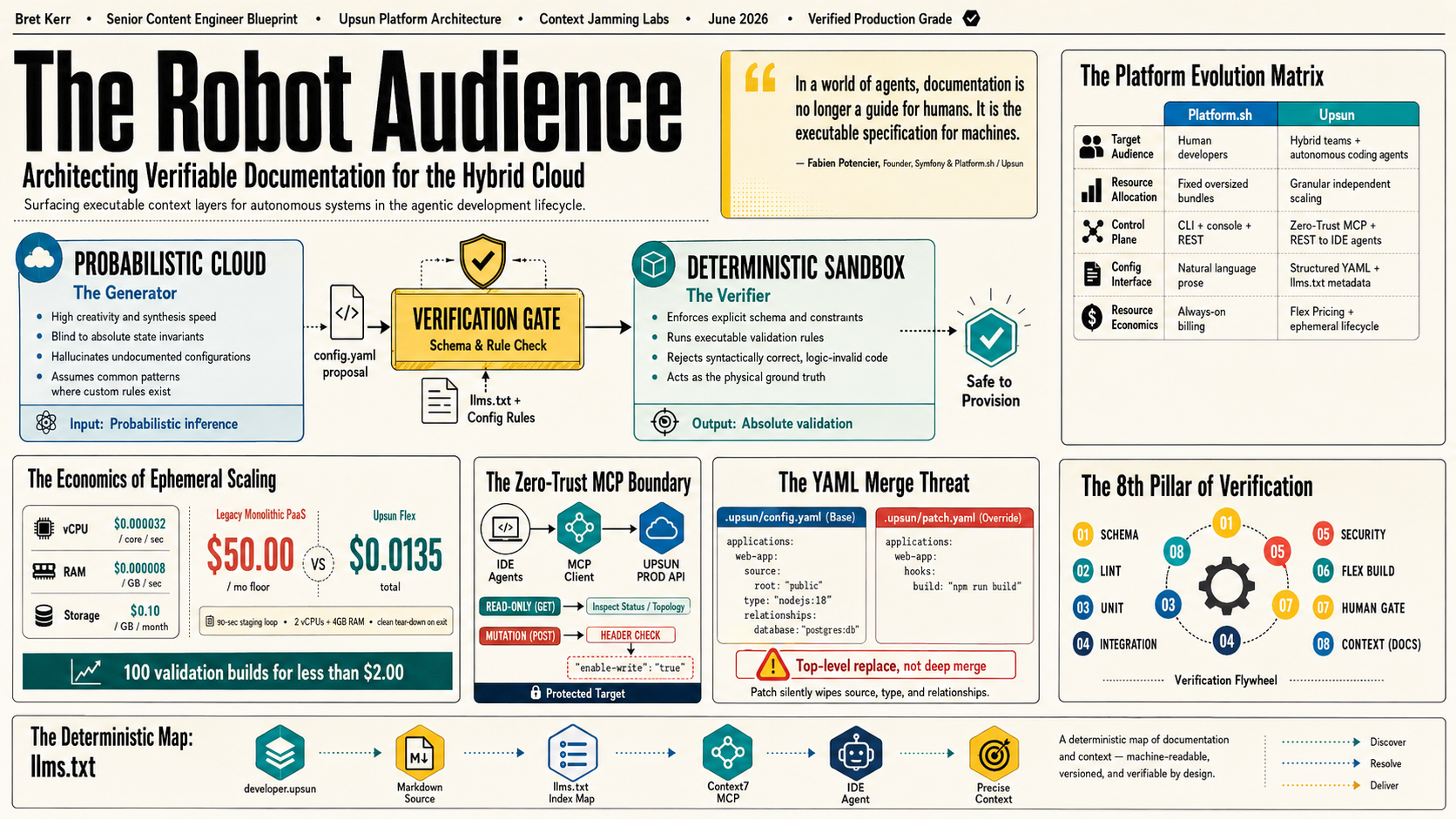
LLMs as Constrained Generators
AI agents are probabilistic engines. They compose fluid responses by sampling probable tokens. They lack a native concept of physical reality, platform rules, or state constraints.
Without explicit machine-enforced barriers, they will confidently produce syntactically valid code that silently breaks production.
The Generator
- → High creativity and synthesis speed
- → Blind to absolute state invariants
- → Hallucinates undocumented configurations
- → Assumes common patterns where custom rules exist
The Verifier
- → Enforces explicit schema and constraints
- → Runs executable validation rules
- → Rejects syntactically correct, logic-invalid code
- → Acts as the physical ground truth
"In a world of agents, documentation is no longer a guide for humans. It is the executable specification for machines."
Process Flow: The Verification Gate
The Platform Evolution Matrix
The transition from Platform.sh to Upsun is not a rebranding campaign. It represents a fundamental transition in computing audience: moving from platforms designed for humans who read documentation sequentially to platforms designed for agents that parse and configure at machine velocity.
| Repositioning Pillar | Platform.sh (Legacy PaaS) | Upsun (AI-Native Cloud) |
|---|---|---|
| Target Audience | Human developers writing PHP, Drupal, Symfony manually. | Hybrid teams + Autonomous coding agents executing CLI tools. |
| Resource Allocation | Fixed oversized bundles. CPU/RAM bound together in plans. | Granular container sizing. CPU, RAM, storage scale independently. |
| Control plane interface | CLI tools, console UI, REST API for manual human triggers. | Zero-Trust MCP server exposing REST plane directly to IDE agents. |
| Configuration interface | Implicit configurations, extensive natural language prose. | Structured YAML schema, llms.txt indexes, machine-ready metadata. |
| Resource economics | Monolithic, always-on resource billing. High minimum drag. | Flex Pricing. Ephemeral container lifecycle. Per-second precision. |
The Economics of Ephemeral Scaling
AI agents build code iteratively. They compile, test, identify failures, rewrite, and test again. This "propose-and-test" loop requires spin-up of clean environment boundaries.
Under legacy pricing structures, provisioning a staging environment for a 90-second test incurs monolithic, always-on subscription costs. Upsun Flex decouples resource sizing, charging strictly for computational seconds consumed.
Flex Resource Pricing Model
Environment must remain active, consuming monthly budget limits even when idle.
Calculated as: (2 vCPUs + 4GB RAM) for 90 seconds. Clean tear-down immediately upon test exit.
The Zero-Trust MCP Boundary
Exposing the full control plane to autonomous agents accelerates deployment but presents severe operational risk.
Upsun's Model Context Protocol (MCP) server at mcp.upsun.com enforces a strict Zero-Trust Boundary. By default, client agents are isolated to read-only actions. Altering configurations or initiating environment branches requires explicit client-side authorization headers.
Cursor / Claude Code
Windsurf / JetBrains
enable-write: true inside client settings.
Upsun Execution Plane
API & Provisioning
The YAML Merge Threat
The single most consequential issue an agent can misunderstand is Upsun's configuration parsing mechanics.
The YAML parser processes only three top-level keys: applications, services, and routes.
It performs a top-level replace, not a deep merge. If a secondary patch file declares a key, it deletes and replaces the base properties completely with zero CLI warning.
applications:
  web-app:
    source:
      root: "public"
    type: "nodejs:18"
    relationships:
      database: "postgres:db"
applications:
  web-app:
    hooks:
      build: "npm run build"
# WARNING: Top-level merge replaces
# 'source', 'type', and 'relationships'
# with ONLY the 'hooks' block.
The Paralysis of Over-Diligence
Human operators tend to inject maximal contextual detail into agent environments. We assemble massive AGENTS.md files, linking long PDF documents and raw chat transcripts.
This dilution of context causes cognitive overhead, context drift, and increases inference path uncertainty. Agents achieve higher precision when target files contain minimal, high-signal instructions.
Expanding input context windows with generic, uncurated guidelines introduces noise, causing agents to deviate from structural invariants.
Monolithic context payloads raise processing latency and token billing without producing measurable gains in task resolution.
The 8th Pillar of Verification
Validation loops rely on continuous feedback. Traditional systems focus exclusively on code runtime metrics.
We introduce The 8th Pillar: structured documentation acting as the context layer. Under this paradigm, docs are versioned, schema-validated, and delivered to code synthesis steps via active MCP lookups.
The Deterministic Map: llms.txt
Moving documentation from manual search targets into deterministic runtime resources requires mapping paths.
We structure all docs at developer.upsun.com into a machine-readable llms.txt mapping manifest. Coding agents ingest the index via MCP, retrieving precise sections directly inside their active workspace context.
The Content Operations Matrix
The shift in audience changes the fundamental mechanics of technical writing. We are transitioning from narrative guides to executable blueprints.
| Operational Dimension | Traditional Technical Writing | Agentic Content Engineering |
|---|---|---|
| Primary Author | Human writer drafting manual tutorials. | System architect designing custom ingestion pipelines. |
| Target Consumer | Human developers looking for onboarding guides. | Autonomous coding agents resolving system tasks. |
| Format structure | Sequential narrative prose with block examples. | llms.txt manifest, structured frontmatter, schemas. |
| Validation Mechanism | Manual code checks on revision cycles. | Reflexion loop verification run inside code sandboxes. |
| Metrics of Success | Page views, feedback ratings (NPS). | Agent task success rates, token usage costs. |
The Critic-Guided Reflexion Loop
Continuous optimization is achieved through active evaluation. We deploy a 4-step loop to align generated outputs with target configurations.
When validation fails, a dedicated critic model analyzes runtime execution traces, generating corrective context parameters to resolve the error.
LLM synthesizes configuration & YAML proposals.
Check schema and rule sets inside sandbox container.
Critic model evaluates execution error traces and failures.
Update context manifest to block subsequent failures.
The Skill, Running
The preceding sections describe the discipline. This is the instance — a Claude Code skill that authors Upsun-grade docs and gates its own output. Download agentic-dev-docs.md
Engineer's Note
"ppl keep nuking their config when they add a build hook in a patch file — yaml merge isn't a merge, it replaces the whole top-level key. document this"
Mintlify MDX
---
title: "How config patching merges (and what it overwrites)"
description: "Upsun config patches replace top-level keys instead of deep-merging — learn what that overwrites before you split your config."
---

Understand exactly what a patch file replaces in `.upsun/config.yaml` so a partial change doesn't silently wipe your runtime.

> ## Documentation Index
> Fetch the complete documentation index at: https://developer.upsun.com/llms.txt
> Use this file to discover all available pages before exploring further.

Upsun parses three top-level keys in `.upsun/config.yaml`: `applications`, `services`, and `routes`. When you apply a patch, Upsun performs a **top-level replace on these keys — not a deep merge.**

<Warning>
If a patch declares `applications.web-app.hooks`, it replaces the entire
`web-app` block. Any `source`, `type`, or `relationships` you set in the base
file are deleted — with no CLI warning. Agents that assume JSON/YAML deep-merge
will silently strip your runtime.
</Warning>

To add a build hook safely, edit the existing `web-app` block in place rather than patching a partial copy:

applications:
  web-app:
    source: { root: "public" }
    type: "nodejs:18"
    relationships: { database: "postgres:db" }
    hooks: { build: "npm run build" }
Warning tags placed for top-level config replace behavior to protect executing agents.
No invented keys; only top-level applications, services, routes referenced.
MDX structure matches Reference layout: brief intro, code block, and warning details.
Wiping / replacing of full keys highlighted and warned. Human oversight referenced.
System Architecture of a Content Engineer
The content engineer operates as the central routing node between enterprise quality standards and AI-native automation pipelines.
Enterprise Rigor
Enforcing semantic brand integrity, corporate compliance, technical correctness, and developer empathy.
- • Accuracy, tone, and vocabulary control
- • Governance standards / safety guidelines
- • Human validation & editorial approval
AI-Native Systems
Architecting tool schemas, metadata models, llms.txt files, and Context7 MCP distribution pathways.
- • MCP server configurations
- • Machine-readable index structuring
- • Evaluation harness implementation
Bret Kerr: The Verification Node
Acting as the final human validation filter that approves context structures before they are propagated to automated workspaces.
Pipeline Execution Roadmap
Structured implementation phases designed to deploy machine-verifiable documentation infrastructure across Upsun operations.
Ingestion & Schema
- • Audit core YAML validation specs
- • Deploy production llms.txt files
- • Integrate basic YAML validation rules
Agentic Automation
- • Setup critic validation reflexion loops
- • Release Context7 MCP pilot features
- • Run integration tests in IDE sandboxes
Production Release
- • Deploy complete verification flywheel
- • Launch metrics evaluation dashboards
- • Migrate developer.upsun indexing pipelines
Generative models give us speed.
Deterministic systems give us trust.
The moat is built at the boundary where they meet.
Cloud providers that organize their documentation as machine-verifiable context will capture the agentic market. Those who do not will spend computational budgets on confident, formatting-compliant failures.