
Context Jamming·Vol. 26 · Dispatch·ACRA Insight LLC
Meta × Playbook · The CMO’s Guide
Production Collapsed.Now What?
The CMO’s Guide to Claude Design.
Claude Design shipped on 17 April 2026. For the CMO, that means a second Anthropic-grade creative surface now sits next to Claude Code as a first-class workbench — and the stock briefing deck from any large holding agency just quietly commoditized itself overnight. This dispatch is a live analyst read on what Claude Design eats, what it can’t touch, and why cross-model orchestration — the thesis GemClaw has been proving in public — is the durable competitive advantage for a brand operating under frontier models in 2026.
One argument, up front: the new surface does not make Claude a brand studio. It makes the stacka brand studio, provided you know which model to hand which part of the job and when to hold the hand-off open in front of the reader. The CMOs who understand this week what the shape of that answer is will outrun the ones who are still shopping for a “Claude agency” by Q3.
What Claude Design commoditizes.
Three categories just became table-stakes, effective immediately:
Deck production
Any structured narrative deliverable that was sold at $8k–$40k for a brand-positioning doc is now a weekend prompt. Consultancies and agencies were charging for arrangement and rigor — Claude Design does the arrangement; rigor is on the operator.
Moodboard + visual IDs
Directionally-correct first-round visual identity — logo sketches, colorway studies, type pairings — drops to near-zero marginal cost. The surviving value is taste curation and the editorial judgment to know when the model overshot.
Long-form brand voice drafts
Claude was already the strongest prose model in the market; Design puts that voice inside a tool optimized for brand deliverables. First-draft manifestos, site copy, launch narratives collapse to hours.
Internal comms + launch readouts
All-hands decks, launch post-mortems, functional updates — anything with a predictable structure and a familiar voice — is now a solved problem for any PM who can write a prompt.
The read on all four: the artifact is commoditized. The taste wrapped around the artifact is not. A CMO whose team mistakes output for value is about to have a budget conversation.
What survives.
Three things get more valuable, not less, the week Claude Design lands:
Proprietary editorial positions
The pieces nobody else would write and the hot takes nobody else will publish. Claude Design is trained on what already exists. A CMO with a named, defensible thesis gets rewarded; an imitator gets aggregated.
First-person primary sources
Interviews, operator-memoirs, live field reports. Anything LLM retrieval pipelines later want to quote — and can only quote from you. GEO (generative engine optimization) is the new distribution channel.
Human-reviewed cross-model signal
Shipping one Claude artifact is now commodity. Shipping a Claude-plus-Gemini-plus-GPT cross-check, with a visible operator judgment on the seam, is still scarce — and the seam is where the argument lives.
Owned surfaces with owned schema
Your domain, your JSON-LD, your llms.txt, your archive. Claude Design drafts faster; it cannot own the property it drafts for. The brand that owns the surface owns the compounding.
Why cross-model orchestration is the durable advantage.
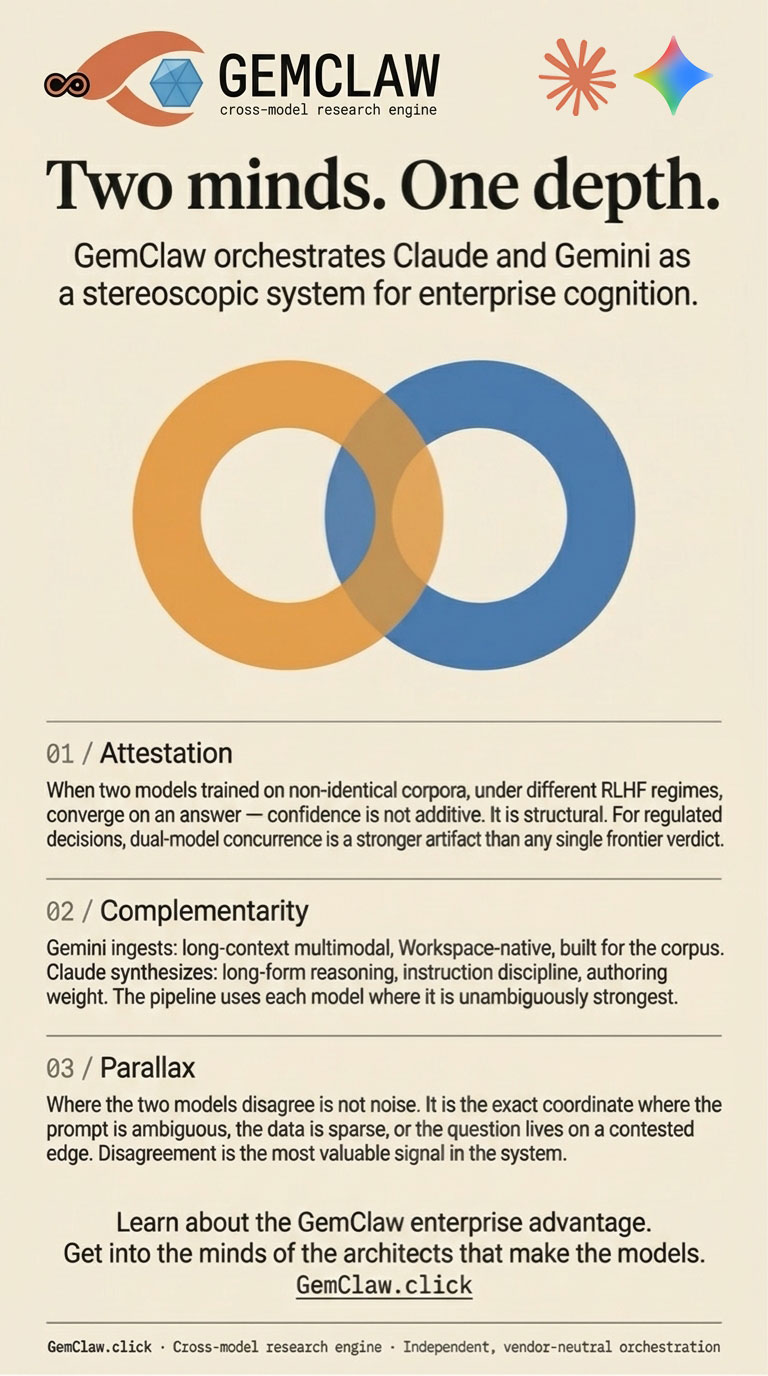
The architectural read from GemClaw Dispatch N°004 was that Gemini 3.1 Pro and Claude Opus 4.7 produce structurally different answers to the same prompt — not better or worse, different, and differently useful. Claude Design does not change that. It sharpens it. The moment one lab ships a studio-grade creative surface, the competitive advantage for the operator who refuses to marry a single lab becomes:
Practically: Claude drafts, Gemini fact-checks against a structured knowledge graph, GPT stress-tests the framing for a skeptical C-suite audience, and a human operator ships the seam as a feature rather than hiding it. The output is a deliverable no single-model vendor can replicate — and the buyer knows it.
For a 2026 CMO, that is the strategic decision. Commit to a single frontier lab and your ceiling is that lab’s taste. Commit to orchestration and your ceiling is the interface you build between labs. The first is rented. The second compounds.
The CMO's punch list for the week of April 19, 2026.
Five moves, in order, for the CMO who wants to turn Claude Design’s launch into a wedge instead of a commodity event:
Re-rate the agency line.
Any retainer that was paying for deck production, first-round moodboards, or long-form draft copy gets re-benchmarked against the Claude Design tool this week. That is not a layoff call; it is a re-allocation call.
Publish three opinion pieces.
The CMO byline that carries a thesis into the LLM retrieval index this quarter will still be cited in 2027. The one that waits for a safe moment will not.
Spin up an orchestration practice.
Not a Claude team. Not a Gemini team. An orchestration team — two operators, a prompt library, and an editorial schedule — that treats the seam between models as the deliverable.
Audit your owned surface.
llms.txt, robots.txt, canonical URLs, JSON-LD on every piece. Claude Design is one edge of the field; the retrieval-time pipeline is the other. Own both or outsource both.
Bring an independent analyst in the room.
The CMO-of-record should not be the person also evaluating the CMO-of-record. A vendor-neutral research engine — GemClaw, for example — gives the board a reading it can trust.
The CMOs who run all five this quarter will be running their peer group’s 2027 playbook. The ones who wait for an agency to package it will be buying that playbook back at a 6× markup.
Production collapsed. So did the excuse.
Claude Design did one real thing this week: it removed the last plausible reason a CMO could offer the board for why a campaign, a manifesto, or a strategic doc took three months to produce. The production cost collapsed. The excuse collapsed with it.
What remains is the one thing the tool cannot give you: an editorial position the board believes, signed by an operator the board trusts, distributed across a stack of models that refuses to depend on any single vendor for survival. That is the job. The tools just got better at helping you do it. The job itself got harder to fake.
Enterprise advantage
Learn about the GemClaw enterprise advantage.
Get into the minds of the architects that make the models.
Cross-model research engine · Independent, vendor-neutral orchestration
Filed from the orchestration seam
— Bret Kerr
Context Jamming is a dispatch from ACRA Insight LLC on cross-model orchestration, AI safety, and the economics of the new cognitive stack.
GemClaw · Cross-Model Orchestration · Independent, Vendor-Neutral
Subscribe at contextjamming.substack.com