
Context Jamming·Vol. 26 · Dispatch·ACRA Insight LLC
Polemic · The Double Standard
Vibe Coding Good.Vibe Writing Bad?
Silicon Valley will lionize a founder who ships a production app he barely understands — then call a writer a fraud for using the same tools to think. The double standard isn't about craft. It's about which priesthood still believes in its own robes.
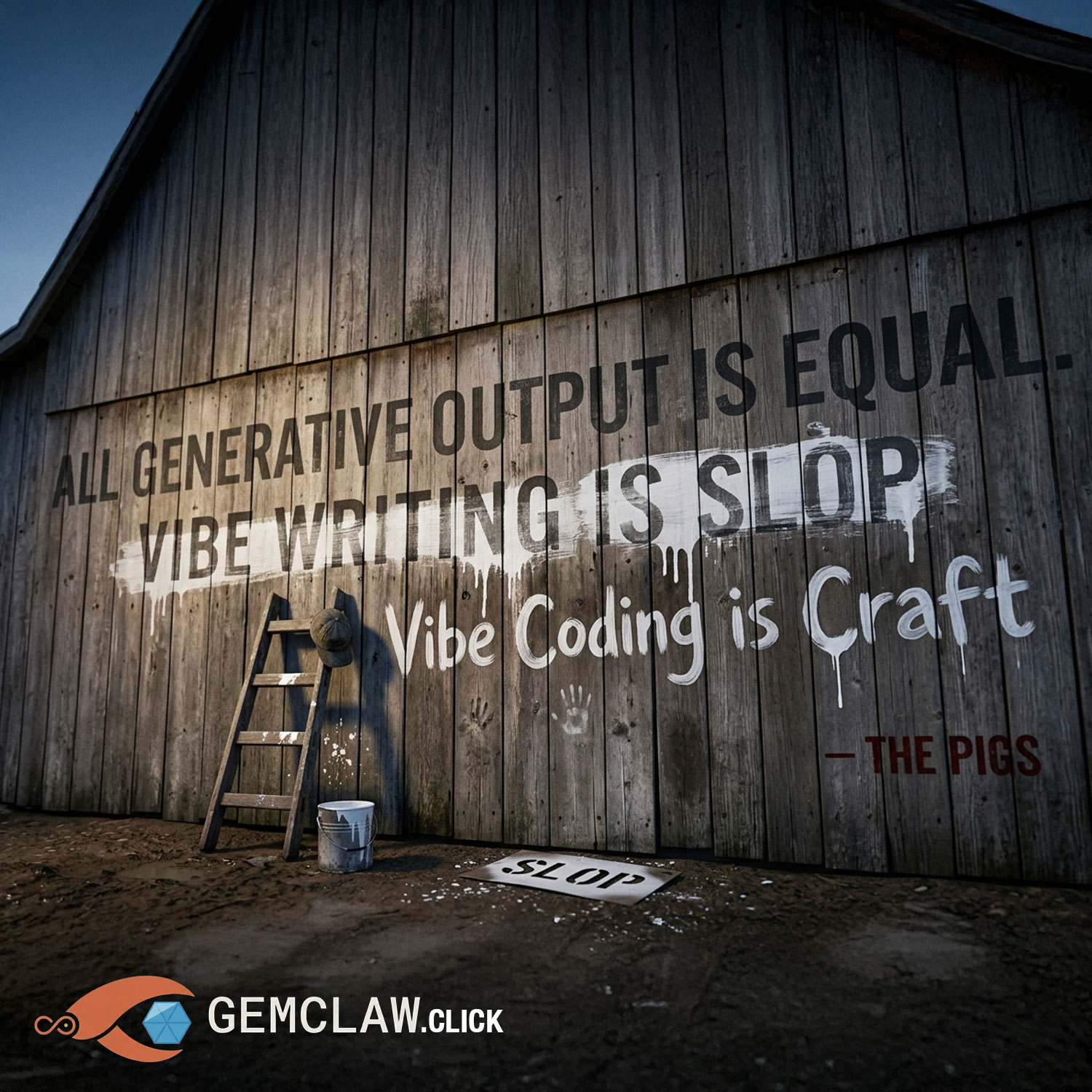
There is a running joke in the industry that has stopped being funny. A twenty-three-year-old in Mission District sweatpants opens Cursor, types “build me a CRM with Stripe integration and a dark mode toggle,” watches an autonomous agent hammer out two thousand lines of TypeScript over the next forty minutes, pushes to production, and is celebrated on X as a one-man startup. He posts the screen recording. Andreessen reposts it. A term of art gets coined: vibe coding. A venture thesis forms around it. Capital flows.
That same afternoon, a writer orchestrates two frontier models in parallel — say, Claude drafting the argument and Gemini stress-testing it, with the human holding the thesis and adjudicating every sentence — and publishes an essay. And the reply guys descend. Did you write this or did the AI? This reads like slop. Real writers don’t need a model. The stamp comes down: cheating.
Both people are doing the exact same thing. One gets a seed round. The other gets a character attack.
The Motion, Described Plainly
Strip the aesthetics away and look at what actually happens in a vibe coding session. A human forms an intent — I want a thing that does X. They describe it to a model in natural language. The model proposes an implementation. The human reads, reacts, refines, rejects, redirects. The model iterates. Somewhere between turn three and turn thirty, something exists that did not exist before. The human did not type most of the characters. The human shaped every decision that mattered.
Now look at what happens when I run the GemClaw protocol to draft an essay. A human forms an intent — I want an argument that does X. They describe it to two models in parallel. The models propose language, structure, counterarguments. The human reads, reacts, refines, rejects, redirects. The models iterate. Somewhere between turn three and turn thirty, something exists that did not exist before. The human did not type most of the characters. The human shaped every decision that mattered.
Code or prose. Prose or code. The substrate is different. The motion is identical. Anyone who tells you otherwise is selling a status game.
Why the Asymmetry Exists
The asymmetry is not about craft. It is about which priesthood is still pretending. Programming spent fifty years pretending it was magic, and the profession got rich on the pretense. Then the models arrived and the magic became commodity, and the profession — to its genuine credit — largely shrugged and said fine, the leverage is the leverage, I am going to use it. GitHub Copilot shipped. Cursor shipped. Claude Code shipped. The discourse around each was not is this cheating but how do I get more of this, faster.
Writing spent three hundred years pretending it was magic, and the profession got poor on the pretense, and the poverty became part of the identity. A novelist is allowed to be paid nothing because the suffering is the proof of the art. A journalist is allowed to work for free because the byline is the compensation. When a tool arrives that threatens to make the work less painful, the guild does not ask how do I get more of this, faster. The guild asks how do I excommunicate the people who touched it.
The Craft Moved. The Critics Didn’t.
Here is the part that the purity crowd cannot metabolize: orchestration is the new craft, and it is harder than what it replaced, not easier. Writing a decent paragraph alone at a desk was never the hard part of writing. The hard part was knowing which paragraph to write. Orchestrating two models in parallel does not remove that judgment. It concentrates it. Every turn, you are making editorial decisions at ten times the bandwidth of a solo draft. You are reading two competing drafts of a sentence and asking which one carries the argument. You are noticing when one model hedges and the other commits, and choosing which instinct to trust for this particular beat. You are holding a thesis in your head across forty exchanges and refusing to let either model drift it.
The people who are bad at this produce the slop the critics are pointing at. They are bad at it in a specific, legible way: they cannot tell when the model is flattering them, they cannot tell when it has gone generic, and they cannot tell when their own prompt was the problem. Their output is AI-shaped because their judgment is AI-shaped. The fix is not to ban the tool. The fix is to get better at the craft the tool demands.
Intent Fidelity
Holding a thesis across dozens of turns without letting either model soften it into consensus prose. This is a harder skill than anything a writing workshop teaches.
Cross-Model Adjudication
Reading Claude and Gemini side by side on the same passage and knowing, in under three seconds, which one read the room and which one missed it. This is an editorial reflex, and it is trainable.
Register Control
The models will drift to the mean. Your job is to drag every sentence back toward the specific voice the piece requires. Most people cannot do this because most people do not have a specific voice.
Taste as Terminal Condition
The session ends when the artifact matches the intent, not when the model stops producing. Knowing the difference is the entire game.
The Real Accusation
When someone tells you that using models to write is cheating, listen to what they are actually saying. They are not making a claim about quality — the best orchestrated prose is already indistinguishable from, and frequently better than, the unassisted baseline. They are not making a claim about authorship — they happily accept that a director who never held a camera “made” a film, and that a showrunner who never typed a line of dialogue “wrote” a series.
They are making a claim about legitimacy of leverage. They believe, usually without having examined the belief, that some kinds of cognitive leverage are noble and some are contemptible. Capital leverage is noble. Institutional leverage is noble. A Harvard MFA is noble leverage. A literary agent is noble leverage. A ghostwriter paid in cash is, somehow, also noble leverage — the industry has quietly tolerated ghostwriting for a century. But a model you prompt yourself, at your own desk, for your own argument? That is the one form of leverage that threatens the pricing power of the leverage the guild already controls. So it gets called cheating.
What The Vibe Coders Already Know
Ask a serious developer using Claude Code what changed, and they will not tell you the model writes their code. They will tell you the model changed what they spend their time on. Less typing, more architecture. Less syntax, more systems thinking. Less labor, more judgment. The ones who are good at it got better at the parts that always mattered and offloaded the parts that never did. Nobody in engineering mourns the lost hours spent debugging a missing semicolon.
The same shift is already underway in writing, and the people who refuse to see it are going to spend the next five years being lapped by people who did. Less typing, more argument. Less draft polishing, more thesis construction. Less sentence labor, more structural judgment. The writers who are good at orchestration are not producing less writing. They are producing more writing, at higher quality, on harder subjects, in less time. The critics will call this evidence of the slop epidemic. The writers will call it Tuesday.
The Hill
So yes: vibe coding and orchestrated writing are the same motion. The industry celebrates one and pillories the other, and the reason has nothing to do with craft and everything to do with which guild still thinks it can hold the line. It cannot. The line is already gone. What remains is the work of figuring out what the craft actually is now that the substrate has changed, and the people doing that work seriously are, without exception, using the tools.
The writers who orchestrate well will be read. The writers who refuse will be read less. The critics will keep moving the goalposts, because moving goalposts is what critics do when the field has already scored. And somewhere in San Francisco, a founder will vibe code another startup this afternoon, and nobody will ask if he earned it.
Filed from the hill
— Bret Kerr
Context Jamming is a dispatch from ACRA Insight LLC on cross-model orchestration, AI safety, and the economics of the new cognitive stack.
GemClaw · Semantic Triple Transformation · LMaaS · Architectural Determinism
Subscribe at contextjamming.substack.com