Skip to guide
FORMLABS ANALYSISCONTEXTJAMMINGINDEPENDENT · VERIFIED 2026-07-22
Maxim Lobovsky, co-founder and CEO of FormlabsFounderFiles · N°047 · The origin storyMaxim LobovskyHow Lobovsky's MIT Media Lab lineage turned industrial fabrication into a capability smaller teams could hold—and why explanation became part of the product.Read founder file

INDEPENDENT CANDIDATE PROTOTYPE · VERIFIED 2026-07-22

Find the Formlabs printer that fits your workflow—and model when it pays for itself.

This guide is a decision instrument. It collapses the distance between printing physics, configured workflow, and economics so a technical buyer can hold the system in their hands before purchase.

Independent candidate prototype by Bret Kerr. Not an official Formlabs page. Product details should be confirmed with Formlabs before purchase.

FIG. 01 · SYSTEM MAP
Formlabs printer selection systemResin and powder printing paths connect materials, post-processing, and return-on-investment modeling.01 · RESIN / LFDFULL-LAYER CUREFORM 4 SERIES02 · POWDER / SLS3D NESTINGFUSE SERIES03 · MATERIALPART BEHAVIORRESIN OR POWDER04 · FINISHPOST-PROCESSLABOR + YIELD05 · MODELPAYBACKYOUR INPUTS
Technology determines material and post-processing; workflow economics determine fit.
SHAREABLE SNAPSHOT · VERIFIED 2026-07-22

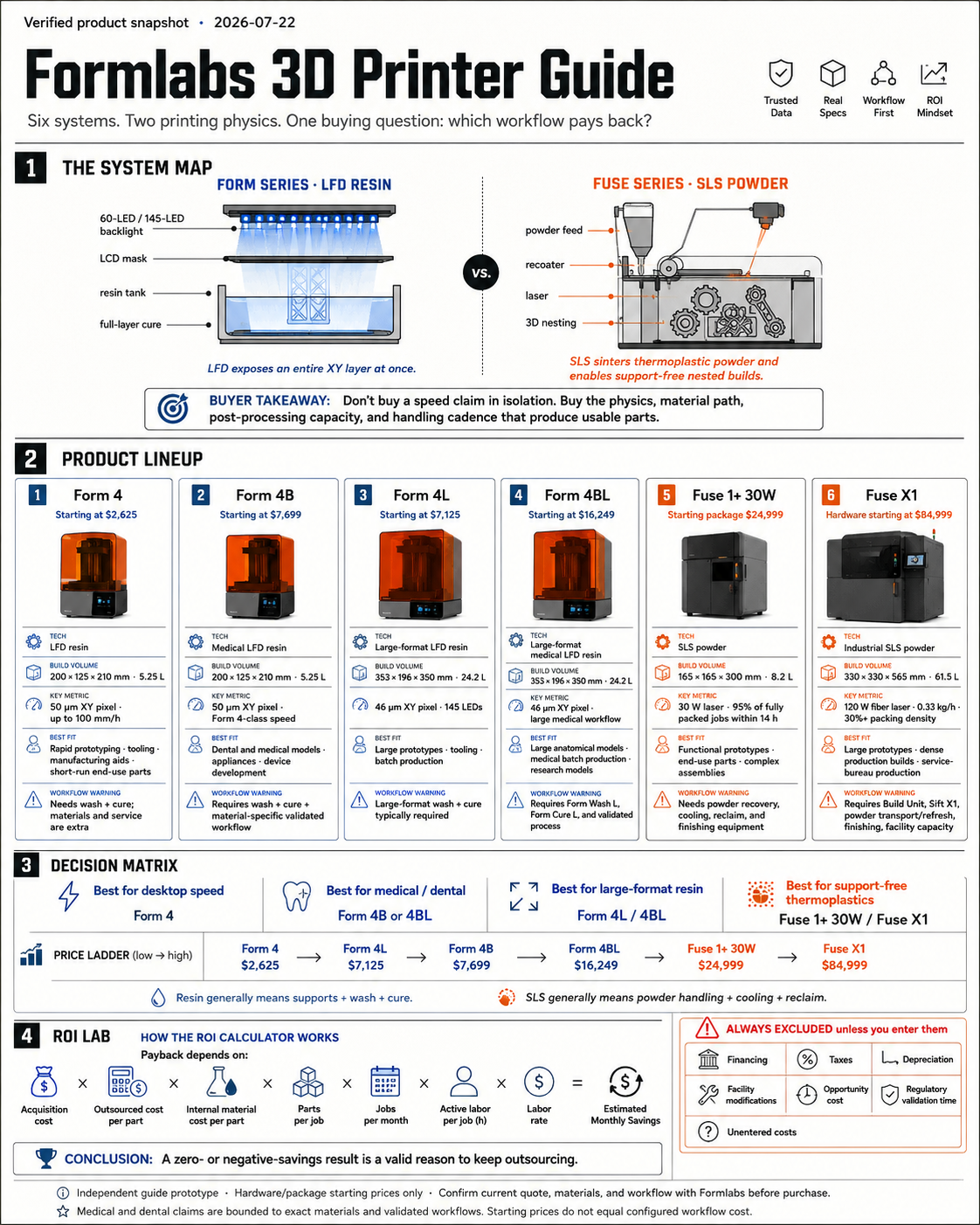
The complete buying decision, on one page.

Save the field guide, send it to a technical buyer, or use it to frame the live selector and ROI model below.

Formlabs 3D Printer Guide infographic comparing Form 4, Form 4B, Form 4L, Form 4BL, Fuse 1+ 30W, and Fuse X1 across printing physics, price, workflow, and ROI considerations
1122 × 1402 PNG · 2026-07-22 product snapshotIndependent guide prototype · Confirm current quotes and workflows with Formlabs
01 · CONTEXTUAL SELECTOR

Start with the workflow constraint.

Search or choose a value in each field. Pricing tiers are calculated from the verified starting prices in the product dataset.

6 exact matches

PRIMARY RECOMMENDATION

Form 4

The 60-LED LFD engine exposes a full layer at once, so cure time is independent of how much of the build platform is filled.

Tradeoff

Resin parts generally need supports, washing, curing, and material-specific handling.

Workflow

A configured workflow normally includes washing and curing equipment; confirm the package and material requirements before purchase.

BUYER CONSEQUENCEA fit is only exact when budget, process, and application constraints all intersect. A nearby system can reveal which constraint must move, but it should not be mistaken for a recommendation that clears every requirement.

02 · PRODUCT EXPLORER

Six current systems. Different physics, workflows, and economics.

Speed and resolution are kept in their native technical context; incompatible resin and powder metrics are not flattened into a false ranking.

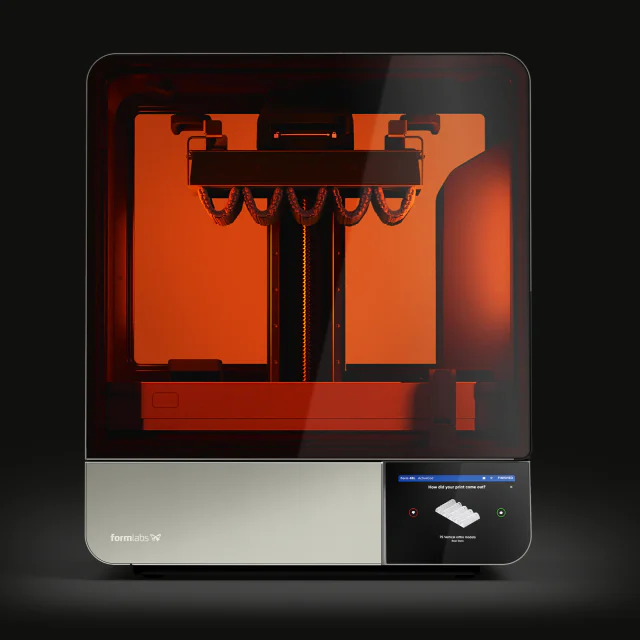
FORM SERIES · LFD

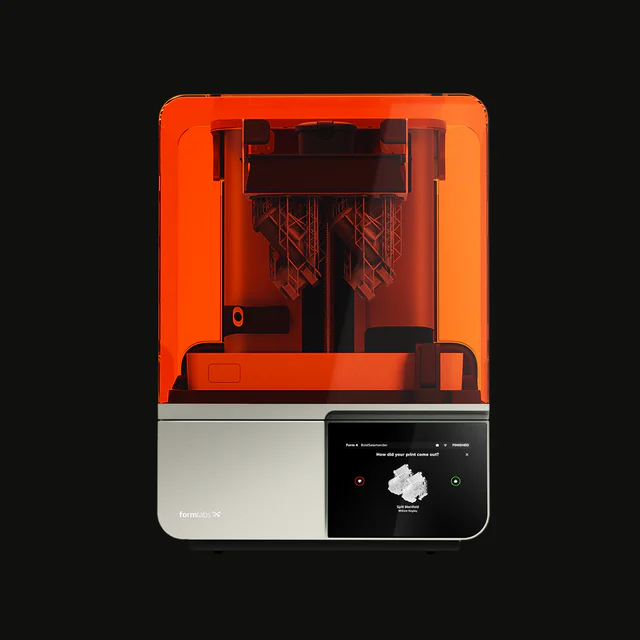
Form 4

Starting at $2,625

Basic printer package. Form Wash, Form Cure, materials, service, and handling capacity are additional workflow decisions.
Form 4 resin 3D printerForm 4 · official product view
VERIFIED 2026-07-22Sources · 9
FORM 4 · PROCESS VIEW
FIG. · LFD LAYER CYCLE60 LEDs · 50 µm pixel01 · 60-LED BACKLIGHT02 · LCD MASK03 · RESIN TANK04 · FULL-LAYER CURE
60 LEDs · 50 µm pixel · Diagram is explanatory, not to scale.
ACTIVE PHYSICS NOTEFull-layer exposure

The LCD mask exposes the entire XY layer at once. Filling more of the platform changes material use and downstream handling, not the per-layer exposure path.

Inspect supporting ledger claim
Open all physics notes
  1. Full-layer exposure

    The LCD mask exposes the entire XY layer at once. Filling more of the platform changes material use and downstream handling, not the per-layer exposure path.

    Source trail
  2. Pixel and energy delivery

    Form 4 pairs a 60-LED backlight with 50 µm XY pixels; stated speed still depends on the selected material and layer settings.

    Source trail
  3. Workflow consequence

    Printed resin parts normally continue through washing, curing, support removal, and material-specific handling before they are usable.

    Source trail
Build volume
200 × 125 × 210 mm · 5.25 L
Resolution / layer
50 µm XY pixel size
Throughput language
Up to 100 mm/h; Formlabs says most prints finish in under two hours
BEST FIT

Rapid prototyping · Manufacturing aids · Tooling · Short-run end-use parts

WHY IT FITS

The 60-LED LFD engine exposes a full layer at once, so cure time is independent of how much of the build platform is filled.

PRINCIPAL TRADEOFF

Resin parts generally need supports, washing, curing, and material-specific handling.

REQUIRED WORKFLOW

A configured workflow normally includes washing and curing equipment; confirm the package and material requirements before purchase.

Inspect materials, workflow, video, and ROI

Material categories

  • General purpose
  • Tough
  • Rigid
  • Elastomeric
  • Casting
  • Open Material Mode

Workflow

  1. PreForm
  2. Resin tank + cartridge
  3. Form Wash
  4. Form Cure
  5. Support removal

Industries

  • Engineering
  • Manufacturing
  • Automotive
  • Consumer products
  • Education
OFFICIAL VIDEO · FORMLABSFrom Design to 3D Print With Form 4/B: Workflow Overview

Official Form 4 and Form 4B workflow overview.

EDITABLE MODEL · NOT A QUOTE

Form 4 ROI scenario

Hardware begins at the verified starting price. Every other input is blank until you enter it or choose a labeled illustrative preset.

LABELED PRESETS
Model waiting for inputs

Complete the highlighted assumptions to calculate a model.

Calculated from your assumptions. Expected good parts = gross parts × (1 − scrap rate). A zero- or negative-savings result is a valid reason to keep outsourcing.

Official product page
FORM SERIES · LFD

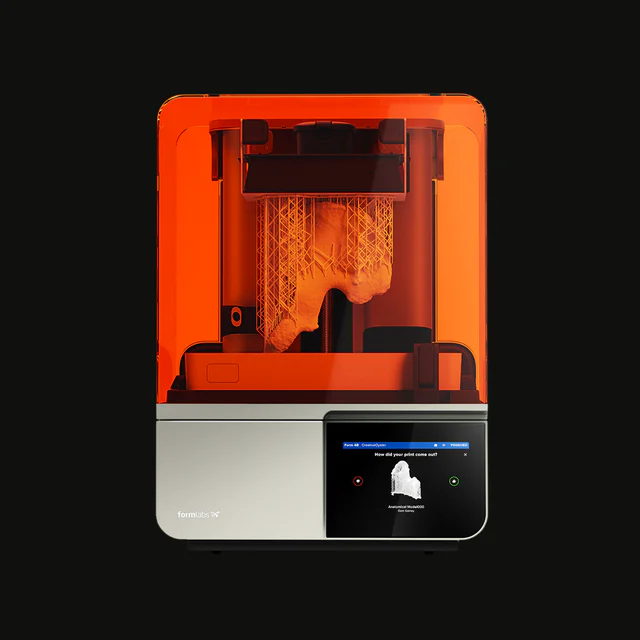
Form 4B

Starting at $7,699

Basic printer package. A usable medical or dental workflow adds washing, curing, materials, and any validated finishing or sterilization steps.
Form 4B medical resin 3D printerForm 4B · official product view
VERIFIED 2026-07-22Sources · 8
FORM 4B · PROCESS VIEW
FIG. · LFD LAYER CYCLE60 LEDs · 50 µm · IFU boundaryIFU CHECK01 · 60-LED BACKLIGHT02 · MEDICAL MATERIAL03 · WASH + CURE04 · VALIDATE PER IFU
60 LEDs · 50 µm · IFU boundary · Diagram is explanatory, not to scale.
ACTIVE PHYSICS NOTEFull-layer exposure

The shared 60-LED LFD architecture exposes a complete layer through the LCD mask rather than tracing each feature serially.

Inspect supporting ledger claim
Open all physics notes
  1. Full-layer exposure

    The shared 60-LED LFD architecture exposes a complete layer through the LCD mask rather than tracing each feature serially.

    Source trail
  2. Material-specific access

    The printer provides access to Formlabs medical and dental material workflows; suitability remains tied to the exact material and intended use.

    Source trail
  3. Validation boundary

    Washing, curing, finishing, and any sterilization step must follow the applicable material instructions for use. Printer ownership is not blanket approval.

    Source trail
Build volume
200 × 125 × 210 mm · 5.25 L
Resolution / layer
50 µm XY pixel size
Throughput language
Same 60-LED LFD architecture as Form 4; job time depends on material and geometry
BEST FIT

Anatomical models · Dental models and appliances · Medical device development · Controlled healthcare workflows

WHY IT FITS

Form 4-class speed with access to Formlabs medical and dental material workflows.

PRINCIPAL TRADEOFF

Suitability is material- and application-specific; printer ownership does not itself establish regulatory compliance or clinical approval.

REQUIRED WORKFLOW

Washing, curing, and any material-specific validated finishing or sterilization equipment are workflow requirements.

Inspect materials, workflow, video, and ROI

Material categories

  • Medical
  • Dental
  • Biocompatible
  • General purpose
  • Open Material Mode

Workflow

  1. PreForm
  2. Validated material settings
  3. Form Wash
  4. Form Cure
  5. Material-specific finishing or sterilization steps

Industries

  • Medical
  • Dental
  • Healthcare engineering
  • Research
OFFICIAL VIDEO · FORMLABSFrom Design to 3D Print With Form 4/B: Workflow Overview

Official shared Form 4B workflow overview.

EDITABLE MODEL · NOT A QUOTE

Form 4B ROI scenario

Hardware begins at the verified starting price. Every other input is blank until you enter it or choose a labeled illustrative preset.

LABELED PRESETS
Model waiting for inputs

Complete the highlighted assumptions to calculate a model.

Calculated from your assumptions. Expected good parts = gross parts × (1 − scrap rate). A zero- or negative-savings result is a valid reason to keep outsourcing.

Official product page
FORM SERIES · LFD

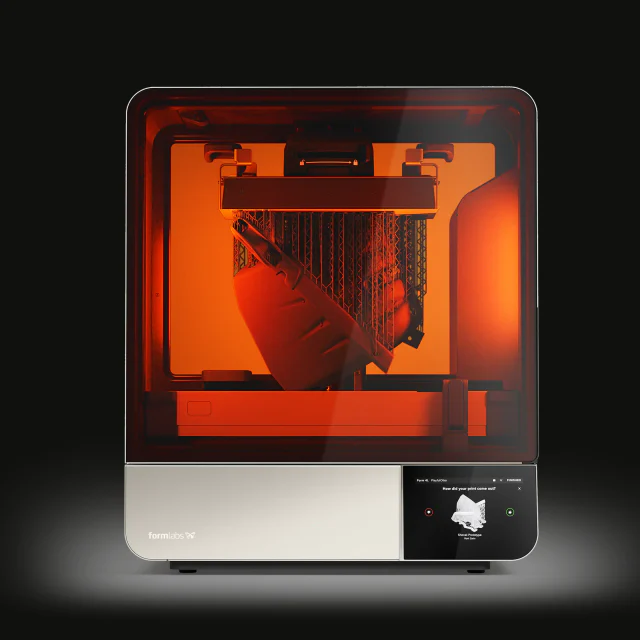
Form 4L

Starting at $7,125

Basic large-format printer package. Form Wash L, Form Cure L, resin inventory, service, workspace, and handling capacity are additional.
Form 4L large-format resin 3D printerForm 4L · official product view
VERIFIED 2026-07-22Sources · 9
FORM 4L · PROCESS VIEW
FIG. · LFD LAYER CYCLE145 LEDs · 46 µm · 24.2 L01 · 145-LED ARRAY02 · EXPANDED CURE PLANE03 · 24.2 L ENVELOPE04 · MONOLITHIC / BATCH
145 LEDs · 46 µm · 24.2 L · Diagram is explanatory, not to scale.
ACTIVE PHYSICS NOTEScaled full-layer cure

A 145-LED backlight expands LFD exposure across the large build plane while retaining 46 µm XY pixel positioning.

Inspect supporting ledger claim
Open all physics notes
  1. Scaled full-layer cure

    A 145-LED backlight expands LFD exposure across the large build plane while retaining 46 µm XY pixel positioning.

    Source trail
  2. Envelope economics

    The 24.2 L envelope can hold a monolithic part or a batch; the buyer must model resin consumption and downstream batch capacity separately.

    Source trail
  3. Large-part handling

    Large-format output carries larger wash, cure, support-removal, material, floor-space, and handling requirements.

    Source trail
Build volume
353 × 196 × 350 mm · 24.2 L
Resolution / layer
46 µm XY pixel size
Throughput language
Formlabs positions the system for large prints in under six hours; actual time varies by job
BEST FIT

Large prototypes · Large tooling · Batch production · Manufacturing aids

WHY IT FITS

A 145-LED backlight scales full-layer LFD exposure across a 24.2 L build envelope.

PRINCIPAL TRADEOFF

Large-format resin jobs increase material, handling, wash, cure, and workspace requirements.

REQUIRED WORKFLOW

Large-format washing and curing equipment is normally required for a complete workflow.

Inspect materials, workflow, video, and ROI

Material categories

  • Tough
  • Rigid
  • Flame retardant
  • Silicone
  • Elastic
  • Ceramic
  • Open Material Mode

Workflow

  1. PreForm
  2. Large resin tank
  3. Form Wash L
  4. Form Cure L
  5. Support removal

Industries

  • Engineering
  • Manufacturing
  • Automotive
  • Aerospace
  • Consumer products
  • Education
OFFICIAL VIDEO · FORMLABSForm 4L Workflow: Large-Format 3D Printing Made Easy

Official Form 4L workflow demonstration.

EDITABLE MODEL · NOT A QUOTE

Form 4L ROI scenario

Hardware begins at the verified starting price. Every other input is blank until you enter it or choose a labeled illustrative preset.

LABELED PRESETS
Model waiting for inputs

Complete the highlighted assumptions to calculate a model.

Calculated from your assumptions. Expected good parts = gross parts × (1 − scrap rate). A zero- or negative-savings result is a valid reason to keep outsourcing.

Official product page
FORM SERIES · LFD

Form 4BL

Starting at $16,249

Basic large-format medical printer package. Complete workflows add Form Wash L, Form Cure L, validated materials, and application-specific processing.
Form 4BL large-format medical resin 3D printerForm 4BL · official product view
VERIFIED 2026-07-22Sources · 8
FORM 4BL · PROCESS VIEW
FIG. · LFD LAYER CYCLE46 µm · 24.2 L · IFU boundaryIFU CHECK01 · LARGE LFD ENGINE02 · ANATOMICAL SCALE03 · WASH + CURE L04 · VALIDATION GATE
46 µm · 24.2 L · IFU boundary · Diagram is explanatory, not to scale.
ACTIVE PHYSICS NOTELarge-format LFD

The LFD engine exposes full layers across a 24.2 L build envelope with 46 µm XY pixels.

Inspect supporting ledger claim
Open all physics notes
  1. Large-format LFD

    The LFD engine exposes full layers across a 24.2 L build envelope with 46 µm XY pixels.

    Source trail
  2. Batch or anatomy scale

    The envelope supports large anatomical models or dense batches, but neither geometry nor printer name establishes clinical suitability.

    Source trail
  3. Validation gate

    Biocompatibility, sterilization, and use claims remain specific to the material, process, and instructions for use.

    Source trail
Build volume
353 × 196 × 350 mm · 24.2 L
Resolution / layer
46 µm XY pixel size
Throughput language
Large-format LFD with same-day large-part positioning; verify job time in PreForm
BEST FIT

Large anatomical models · Medical device development · Dental and medical batch production · Research models

WHY IT FITS

Large-format LFD capacity paired with Formlabs medical and dental material workflows.

PRINCIPAL TRADEOFF

Large parts require substantial post-processing capacity, and every biocompatibility or sterilization use is material- and process-specific.

REQUIRED WORKFLOW

Form Wash L, Form Cure L, and any application-specific validated finishing or sterilization process.

Inspect materials, workflow, video, and ROI

Material categories

  • Medical
  • Dental
  • Biocompatible
  • Large-format resin
  • Open Material Mode

Workflow

  1. PreForm
  2. Validated material settings
  3. Form Wash L
  4. Form Cure L
  5. Material-specific validation checkpoints

Industries

  • Medical
  • Dental
  • Healthcare engineering
  • Research
OFFICIAL VIDEO · FORMLABSIntroducing Form 4 and Form 4L

Official large-format LFD technology introduction; Form 4BL-specific claims remain on the product page.

EDITABLE MODEL · NOT A QUOTE

Form 4BL ROI scenario

Hardware begins at the verified starting price. Every other input is blank until you enter it or choose a labeled illustrative preset.

LABELED PRESETS
Model waiting for inputs

Complete the highlighted assumptions to calculate a model.

Calculated from your assumptions. Expected good parts = gross parts × (1 − scrap rate). A zero- or negative-savings result is a valid reason to keep outsourcing.

Official product page
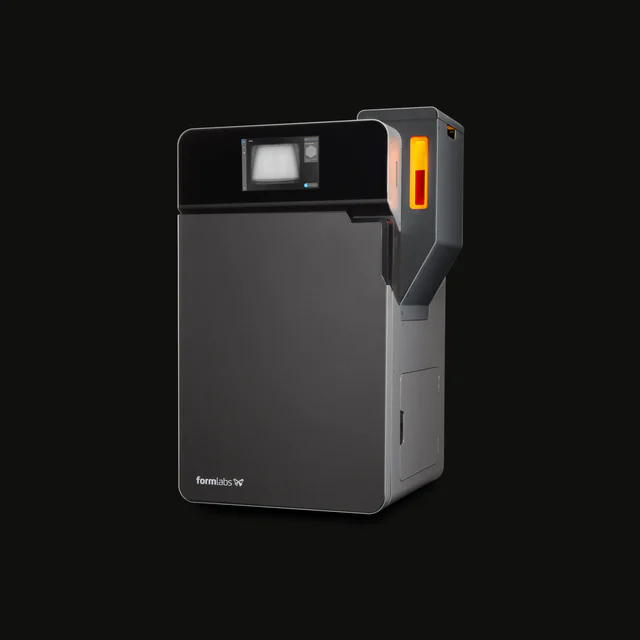
FUSE SERIES · SLS

Fuse 1+ 30W

Starting package $24,999

Starter package, not a complete production cell. Powder recovery, cooling, cleaning, finishing, facility, and safety capacity remain workflow costs.
Fuse 1+ 30W SLS 3D printerFuse 1+ 30W · official product view
VERIFIED 2026-07-22Sources · 9
FUSE 1+ 30W · PROCESS VIEW
FIG. · SLS POWDER CYCLE30 W · 8.2 L · 3D nesting01 · POWDER FEED02 · RECOATER03 · 30 W LASER04 · 3D NESTING
30 W · 8.2 L · 3D nesting · Diagram is explanatory, not to scale.
ACTIVE PHYSICS NOTERecoater dynamics

Each cycle spreads a controlled powder layer before the 30 W laser selectively sinters the current cross-section.

Inspect supporting ledger claim
Open all physics notes
  1. Recoater dynamics

    Each cycle spreads a controlled powder layer before the 30 W laser selectively sinters the current cross-section.

    Source trail
  2. Scan strategy

    Unlike LFD full-layer exposure, SLS scans selected geometry across the powder bed; job time and thermal behavior depend on the packed build.

    Source trail
  3. Packing-density economics

    Unsintered powder supports parts, allowing three-dimensional nesting without sacrificial supports. More good parts per build can distribute labor and machine time.

    Source trail
  4. Cool-down and refresh

    The printed cake must cool before unpacking; usable workflow economics include powder recovery, refresh, cleaning, and finishing.

    Source trail
Build volume
165 × 165 × 300 mm · 8.2 L
Resolution / layer
110 µm typical layer thickness
Throughput language
30 W fiber laser; Formlabs says 95% of fully packed jobs finish within 14 hours
BEST FIT

Functional prototypes · End-use parts · Complex assemblies · Low-volume production

WHY IT FITS

Compact SLS produces support-free thermoplastic parts and enables three-dimensional nesting.

PRINCIPAL TRADEOFF

Powder handling, cooling, reclamation, and finishing add equipment, space, labor, and safety requirements.

REQUIRED WORKFLOW

A useful production workflow normally includes Fuse Sift and finishing equipment such as Fuse Blast.

Inspect materials, workflow, video, and ROI

Material categories

  • Nylon 12
  • Nylon 11
  • Glass-filled nylon
  • Carbon-filled nylon
  • TPU
  • Open Material Mode

Workflow

  1. PreForm 3D packing
  2. Print + cool
  3. Fuse Sift powder recovery
  4. Fuse Blast cleaning
  5. Powder refresh

Industries

  • Engineering
  • Manufacturing
  • Automotive
  • Aerospace
  • Consumer products
  • Medical
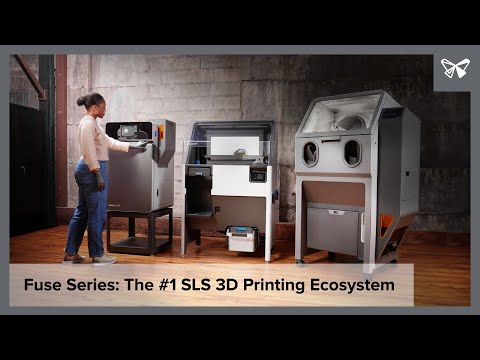
OFFICIAL VIDEO · FORMLABSFuse Series: The #1 SLS 3D Printing Ecosystem

Official Fuse Series ecosystem overview.

EDITABLE MODEL · NOT A QUOTE

Fuse 1+ 30W ROI scenario

Hardware begins at the verified starting price. Every other input is blank until you enter it or choose a labeled illustrative preset.

LABELED PRESETS
Model waiting for inputs

Complete the highlighted assumptions to calculate a model.

Calculated from your assumptions. Expected good parts = gross parts × (1 − scrap rate). A zero- or negative-savings result is a valid reason to keep outsourcing.

Official product page
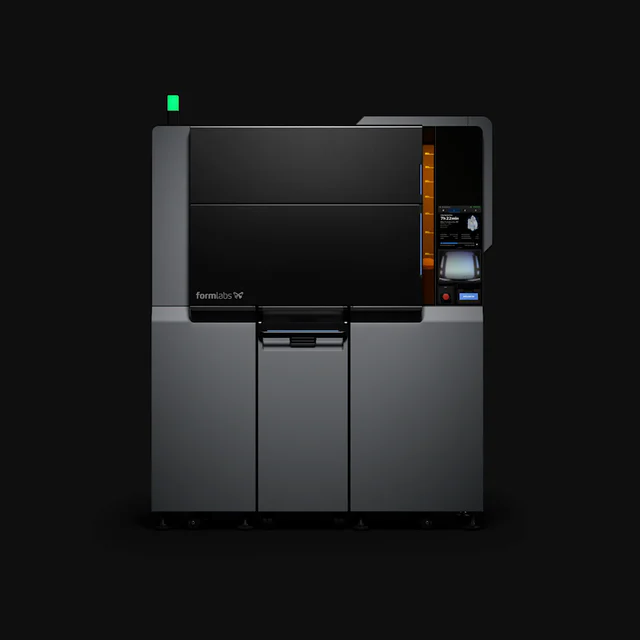
FUSE SERIES · SLS

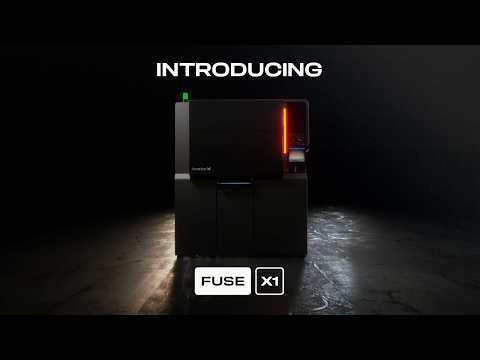
Fuse X1

Hardware starting at $84,999

Hardware-only starting price. Build Unit, Sift X1, powder transport and refresh, Fuse Blast, installation, service, materials, and facility work are additional.
Fuse X1 industrial SLS 3D printerFuse X1 · official product view
VERIFIED 2026-07-22Sources · 10
FUSE X1 · PROCESS VIEW
FIG. · SLS POWDER CYCLE120 W · 61.5 L · 13 zones01 · 120 W LASER02 · 13 THERMAL ZONES03 · PRINT INTELLIGENCE04 · BUILD UNIT CHANGEOVER
120 W · 61.5 L · 13 zones · Diagram is explanatory, not to scale.
ACTIVE PHYSICS NOTELaser and scan path

A 120 W fiber laser scans each selected cross-section; realized throughput still depends on material, geometry, and the packed job.

Inspect supporting ledger claim
Open all physics notes
  1. Laser and scan path

    A 120 W fiber laser scans each selected cross-section; realized throughput still depends on material, geometry, and the packed job.

    Source trail
  2. Adaptive Thermal Control

    Thirteen independently managed thermal zones address the large bed's temperature field; they do not remove cool-down or validation requirements.

    Source trail
  3. Packing-density economics

    Formlabs states 30%+ packing density for supported builds and settings. Part mix, orientation, refresh rate, and yield determine the realized economics.

    Source trail
  4. Cell-level workflow

    Build Unit changeover, Sift X1, powder transport, refresh, cleaning, and finishing make this a production cell rather than an $84,999 standalone decision.

    Source trail
Build volume
330 × 330 × 565 mm · 61.5 L
Resolution / layer
110 µm layer thickness
Throughput language
0.330 kg/h stated material throughput; 30%+ packing density
BEST FIT

Large functional prototypes · High-volume end-use parts · Dense production builds · Service-bureau production

WHY IT FITS

A 61.5 L build, 13-zone Adaptive Thermal Control, and computer-vision Print Intelligence target dense industrial SLS production.

PRINCIPAL TRADEOFF

Highest capital, facility, nitrogen, powder-management, and operational requirements in this comparison; some announced materials are not yet available.

REQUIRED WORKFLOW

The complete workflow includes a modular Build Unit, Sift X1, powder transport and refresh equipment, and Fuse Blast finishing.

Inspect materials, workflow, video, and ROI

Material categories

  • Nylon 12
  • Nylon 11 (availability stated for late 2026)
  • Nylon 12 GF (stated for 2027)
  • TPU 90A (stated for 2027)
  • Open Material Mode

Workflow

  1. PreForm
  2. Modular Build Unit
  3. Sift X1
  4. Vacuum transport + powder refresh
  5. Fuse Blast

Industries

  • Manufacturing
  • Automotive
  • Aerospace
  • Consumer products
  • Service bureau
  • Engineering
OFFICIAL VIDEO · FORMLABSFuse X1: Formlabs' LARGEST SLS 3D Printer Yet!

Official Fuse X1 product overview.

EDITABLE MODEL · NOT A QUOTE

Fuse X1 ROI scenario

Hardware begins at the verified starting price. Every other input is blank until you enter it or choose a labeled illustrative preset.

LABELED PRESETS
Model waiting for inputs

Complete the highlighted assumptions to calculate a model.

Calculated from your assumptions. Expected good parts = gross parts × (1 − scrap rate). A zero- or negative-savings result is a valid reason to keep outsourcing.

Official product page

BUYER CONSEQUENCEDo not buy a speed claim in isolation. Buy the physics, material path, post-processing capacity, and handling cadence that together produce usable parts.

03 · COMPARISON

Compare the constraints that change a buying decision.

Select up to three systems. The tray remains visible while you explore.

SystemForm 4Form 4BForm 4LForm 4BLFuse 1+ 30WFuse X1
Product viewForm 4 resin 3D printerOfficial Formlabs image Form 4B medical resin 3D printerOfficial Formlabs image Form 4L large-format resin 3D printerOfficial Formlabs image Form 4BL large-format medical resin 3D printerOfficial Formlabs image Fuse 1+ 30W SLS 3D printerOfficial Formlabs image Fuse X1 industrial SLS 3D printerOfficial Formlabs image
Starting hardware / package$2,625$7,699$7,125$16,249$24,999$84,999
What that price excludesBasic printer package. Form Wash, Form Cure, materials, service, and handling capacity are additional workflow decisions.Basic printer package. A usable medical or dental workflow adds washing, curing, materials, and any validated finishing or sterilization steps.Basic large-format printer package. Form Wash L, Form Cure L, resin inventory, service, workspace, and handling capacity are additional.Basic large-format medical printer package. Complete workflows add Form Wash L, Form Cure L, validated materials, and application-specific processing.Starter package, not a complete production cell. Powder recovery, cooling, cleaning, finishing, facility, and safety capacity remain workflow costs.Hardware-only starting price. Build Unit, Sift X1, powder transport and refresh, Fuse Blast, installation, service, materials, and facility work are additional.
TechnologyLFD resinMedical LFD resinLFD resinMedical LFD resinSLS powderSLS powder
Build envelope200 × 125 × 210 mm · 5.25 L200 × 125 × 210 mm · 5.25 L353 × 196 × 350 mm · 24.2 L353 × 196 × 350 mm · 24.2 L165 × 165 × 300 mm · 8.2 L330 × 330 × 565 mm · 61.5 L
Technically relevant metric50 µm XY pixel size
Up to 100 mm/h; Formlabs says most prints finish in under two hours
50 µm XY pixel size
Same 60-LED LFD architecture as Form 4; job time depends on material and geometry
46 µm XY pixel size
Formlabs positions the system for large prints in under six hours; actual time varies by job
46 µm XY pixel size
Large-format LFD with same-day large-part positioning; verify job time in PreForm
110 µm typical layer thickness
30 W fiber laser; Formlabs says 95% of fully packed jobs finish within 14 hours
110 µm layer thickness
0.330 kg/h stated material throughput; 30%+ packing density
Workflow equipmentA configured workflow normally includes washing and curing equipment; confirm the package and material requirements before purchase.Washing, curing, and any material-specific validated finishing or sterilization equipment are workflow requirements.Large-format washing and curing equipment is normally required for a complete workflow.Form Wash L, Form Cure L, and any application-specific validated finishing or sterilization process.A useful production workflow normally includes Fuse Sift and finishing equipment such as Fuse Blast.The complete workflow includes a modular Build Unit, Sift X1, powder transport and refresh equipment, and Fuse Blast finishing.
Add

BUYER CONSEQUENCEThe lowest starting figure is not necessarily the lowest usable-system cost. Compare the complete workflow boundary before comparing payback.

04 · ROI LABORATORY

Transparent payback, not a promise.

Choose a printer, enter a configured-system quote and your operating assumptions, then test the same workload against a second acquisition scenario. Presets identify whether values are illustrative or published.

EDITABLE MODEL · NOT A QUOTE

Form 4 ROI scenario

Hardware begins at the verified starting price. Every other input is blank until you enter it or choose a labeled illustrative preset.

LABELED PRESETS
Model waiting for inputs

Complete the highlighted assumptions to calculate a model.

Ranked sensitivity · largest payback impact first

01Volume −25%Incomplete
02Volume +25%Incomplete
03Labor rate −25%Incomplete
04Labor rate +25%Incomplete
05Outsourced cost −25%Incomplete
06Outsourced cost +25%Incomplete

Each row changes one assumption by 25% while holding the rest constant. Ranking updates live; a status change outranks a finite payback movement.

Same assumptions · two acquisition scenarios

Only printer acquisition changes; operating inputs stay locked.

Form 4Complete the model$2,625 acquisition · cost / part pending
Form 4BComplete the model$7,699 acquisition · cost / part pending

Complete the shared assumptions to expose payback and cost-per-good-part deltas.

Calculated from your assumptions. Expected good parts = gross parts × (1 − scrap rate). A zero- or negative-savings result is a valid reason to keep outsourcing.

SOURCE-BACKED DEMONSTRATION · NOT A GENERAL FORECASTFuse X1 mixer-latch example

Formlabs publishes a specific comparison of $0.50 per latch on Fuse X1, $1.56 on a legacy SLS system, and $22 outsourced for a 3,280-part build. Treat those as Formlabs' case inputs—not transferable defaults for your model.

Inspect the Formlabs case comparison

BUYER CONSEQUENCEUse the result as a challengeable scenario. If modest changes in volume, labor, or outsourced cost erase payback, the decision is fragile—and continued outsourcing may be the better operating choice.

05 · EVIDENCE LEDGER

Every mutable fact has a source and status.

Filter the committed static ledger. No product data is scraped in the browser.

53 of 53 claims shown

form-4 · pricestarting price

2625 USD

Form 4 Basic Package official-product · verified 2026-07-22 · verified
Basic package price; taxes, service, materials, and post-processing may be additional.
form-4 · buildbuild volume

200 × 125 × 210 mm

Form 4 Basic Package official-product · verified 2026-07-22 · verified
form-4 · performancemaximum print speed

100 mm/h

Form 4 Basic Package official-product · verified 2026-07-22 · verified
Maximum depends on material and layer settings.
form-4 · materialsmaterials

23 Formlabs materials plus eligible third-party materials through Open Material Mode

Form 4 Basic Package official-product · verified 2026-07-22 · verified
form-4 · applicationapplications

Prototyping, manufacturing aids, tooling, and end-use applications

Form 4 professional resin 3D printer official-product · verified 2026-07-22 · verified
form-4b · pricestarting price

7699 USD

Form 4B Basic Package official-product · verified 2026-07-22 · verified
Basic package price; configured medical or dental workflows cost more.
form-4b · technologytechnology

Masked stereolithography using the Low Force Display print engine

Form 4B medical 3D printer official-product · verified 2026-07-22 · verified
form-4b · buildbuild volume

200 × 125 × 210 mm

Form 4 Basic Package official-product · verified 2026-07-22 · verified
form-4b · performancexy pixel size

50 µm

Form 4 Basic Package official-product · verified 2026-07-22 · verified
form-4b · materialsmedical workflow

Medical and dental material access with material-specific instructions for use

Form 4B medical 3D printer official-product · verified 2026-07-22 · verified
Biocompatibility and sterilization claims apply only to specific materials and validated workflows.
form-4b · workflowworkflow

Prepare, print, wash, cure, finish and follow the material-specific instructions for use

Form 4B medical 3D printer official-product · verified 2026-07-22 · verified
form-4b · applicationapplications

Medical and dental models, appliances, and device-development workflows

Form 4B medical 3D printer official-product · verified 2026-07-22 · verified
form-4l · pricestarting price

7125 USD

Form 4L Basic Package official-product · verified 2026-07-22 · verified
Basic package price; post-processing and service may be additional.
form-4l · buildbuild volume

353 × 196 × 350 mm

Form 4L Basic Package official-product · verified 2026-07-22 · verified
form-4l · materialsmaterials

19 Formlabs materials plus eligible third-party materials through Open Material Mode

Form 4L Basic Package official-product · verified 2026-07-22 · verified
form-4bl · pricestarting price

16249 USD

Form 4BL Basic Package official-product · verified 2026-07-22 · verified
Basic package price; complete medical workflows cost more.
form-4bl · buildbuild volume

353 × 196 × 350 mm

Form 4BL Basic Package official-product · verified 2026-07-22 · verified
form-4bl · materialsmaterials

32 Formlabs materials, including 12 described by Formlabs as biocompatible, plus Open Material Mode

Form 4BL Basic Package official-product · verified 2026-07-22 · verified
Use claims depend on the exact material and validated process.
fuse-1-plus · pricestarting price

24999 USD

Fuse 1+ 30W Starter Package official-product · verified 2026-07-22 · conflict
Starter package price. The Fuse X1 comparison page lists $24,649 hardware starting price; this guide prefers the current dedicated store package page and records the conflict.
fuse-1-plus · performancepacked job time

95% of fully packed jobs within 14 hours

Fuse 1+ 30W compact SLS 3D printer official-product · verified 2026-07-22 · verified
Formlabs-reported platform statistic; actual jobs vary.
fuse-1-plus · materialsmaterials

Nylon and TPU powders plus eligible 1064 nm third-party powders through Open Material Mode

Fuse 1+ 30W compact SLS 3D printer official-product · verified 2026-07-22 · verified
fuse-x1 · pricestarting price

84999 USD

Fuse X1 large-format industrial SLS 3D printer official-product · verified 2026-07-22 · verified
Hardware starting price; ecosystem equipment, installation, materials, service, and facility costs are additional.
fuse-x1 · materialsmaterials

Nylon 12 at launch; other listed materials carry future availability dates

Fuse X1 large-format industrial SLS 3D printer official-product · verified 2026-07-22 · conditional
Nylon 11 is listed for end of 2026; TPU 90A and Nylon 12 GF are listed for June 2027.

BUYER CONSEQUENCEStart with exceptions. Conditional and conflicting claims identify where a current quote, material release, or instructions-for-use document must replace a web-page assumption.

06 · LEGACY AND FLEET-CONTINUITY CONTEXT

Prior systems are context, not default recommendations.

A fleet decision may value validated materials, known settings, operator familiarity, and spare capacity. That continuity has value, but it must be compared with support status and migration cost.

Form 3+ / Form 3B+

Prior-generation laser LFS desktop systems. Existing fleets may retain value through validated materials, known PreForm settings, operator familiarity, and compatible wash/cure capacity. Confirm current service, consumables, and application support; this guide does not recommend an unverified secondary-market purchase.

Form 3L / Form 3BL

Prior-generation large-format laser LFS systems. The current default is the Form 4L / 4BL generation. Before migrating, inventory resin and tank stock, finishing capacity, QA records, software dependencies, and any material- or application-specific revalidation work.

FLEET CONTINUITY CHECK
  • Confirm current service and consumable support.
  • Inventory validated materials, settings, and QA records that would need migration.
  • Map wash, cure, powder, finishing, software, and operator dependencies.
  • Test whether distributed or localized capacity materially reduces lead-time or outage exposure.

BUYER CONSEQUENCEFleet continuity is a real constraint, not nostalgia. Model the cost to revalidate and retrain alongside the cost of staying on a prior platform.

07 · SOURCE METHODOLOGY

Current first-party product pages lead; uncertainty stays visible.

The guide is maintained as a committed, typed dataset—not a browser scrape. A new verification date is earned by repeating the checks below.

01

Hierarchy

Current official Formlabs product, store, specification, support, material, case-study, press, and video pages take priority. The supplied research report is an index, not the authority.

02

Conflicts

The dedicated Fuse 1+ Starter Package page lists $24,999 while the Fuse X1 comparison currently lists $24,649. This guide uses the dedicated package page and records the discrepancy in the ledger.

03

Conditional claims

Future Fuse X1 material dates remain conditional. Medical and dental statements are bounded to exact material instructions and never treated as blanket printer-level approval.

04

Price scope

Hardware and starter-package figures remain distinct from configured workflows. Post-processing, service, materials, facility work, and application validation are never inferred into a quote.

  1. 01

    Open every source URL and record whether it resolves, redirects, or has been superseded.

  2. 02

    Compare price, price scope, build, technology, material status, and workflow language against the typed claim.

  3. 03

    Retain disagreements as conflicts and future or use-bounded statements as conditional claims.

  4. 04

    Verify each official video relationship and the exact material instructions governing medical or dental language.

  5. 05

    Update claim values, caveats, and the verification date together; then run completeness, selector, URL-state, and ROI tests.

  6. 06

    Review desktop, mobile, keyboard, reduced-motion, error, empty, and print states before publication.

BUYER CONSEQUENCEA visible source date is a starting point, not permission to skip the current quote, current material availability, or exact instructions for use.

Repository ledger notes: docs/formlabs-printer-guide-sources.md

08 · WHY THIS PAGE EXISTS

A proof of work for explaining a technical system honestly.

This independent prototype tests a simple premise: product communication is strongest when the underlying evidence, operating tradeoffs, and economic assumptions remain inspectable.

THE INSTRUMENT

From catalog to decision

The selector, diagrams, comparison, ROI model, and ledger translate separate product facts into a buyer-controlled evaluation without impersonating a Formlabs quote.

Read the Formlabs strategy analysis
THE ORIGIN

Accessibility as product architecture

The companion Founder File traces how Maxim Lobovsky repeatedly made sophisticated fabrication legible and available to smaller teams. This page turns that thesis into interface behavior.

Read the Maxim Lobovsky Founder File

BUYER CONSEQUENCEGood product communication preserves the boundaries of the decision: what is known, what is conditional, what the system still requires, and which assumptions belong to the buyer.

09 · BUYER QUESTIONS

What the selector can—and cannot—decide.

How do masked resin printing and SLS differ?

Form 4 systems cure a full resin layer through an LCD mask, then require washing and curing. Fuse systems scan a laser across a powder bed; surrounding powder supports the parts, enabling support-free geometries and three-dimensional nesting.

Which systems require supports?

Resin prints commonly use generated supports that are removed after washing and curing. SLS parts are supported by surrounding powder and generally do not need sacrificial supports.

Desktop or large format?

Choose large format for monolithic parts or packed batches that exceed the desktop envelope. Account for the larger wash, cure, material, floor-space, and handling requirements—not just the printer price.

What is different about the medical variants?

Form 4B and 4BL provide access to Formlabs medical and dental material workflows. Claims depend on the exact material, intended use, and validated instructions; the printer alone does not establish regulatory or clinical suitability.

What does the ROI estimate include?

The model includes hardware, required equipment, installation, training, initial materials, service, fixed cost, material, labor, scrap, energy and consumables, plus optional revenue or avoided-delay value. It remains an editable scenario, not a quote or promise.

Why can actual pricing differ?

Published figures are starting package or hardware prices. A usable system may also require service, materials, post-processing, accessories, shipping, taxes, facility changes, and training.

When can outsourcing remain the better choice?

Outsourcing can remain rational when demand is intermittent, material needs change often, internal labor or safety capacity is limited, or the modeled monthly savings are zero or negative.

BUYER CONSEQUENCEThe guide can narrow the decision and expose missing assumptions. It cannot replace sample-part testing, a configured quote, application validation, or operational due diligence.