FounderFiles·Issue №001·Profile
A new series for the Society
Subject·Anthony M. Fadell·inventor · investor · systemic anchor
The Timing Crucible.Tony Fadell’s thirty-year seminarin atoms over bits.
From the Magic Link to MIT MAD: the only operator in the Valley whose career composes into a serious counter-theory to software exceptionalism — and whose current post is designed, it turns out, to stabilize the probabilistic entropy of AI research through the brute, unforgiving physics of the real world.
By Bret Kerr · Profile · 12 min · Apr 2026
Four epochs · select to read the thesis
“You can’t hallucinate a battery charge.”
Hardware architect, Magic Link
“Vision without current infrastructure is a hallucination with a marketing budget.”
— Fadell, reconstructed from a decade of interviews
$800
retail price · 1994 dollars
3,000
units moved before shutdown
15 yr
premature · smartphone concept
The Timing Crucible.
General Magic, Philips, and the commercial collapse that authored a doctrine.
Silicon Valley is currently suffering from a very expensive hallucination. The smartest people in the world are pouring billions of dollars into Large Language Models, operating under the assumption that if you just give software enough data, it will eventually figure out reality. Tony Fadell knows a secret the software exceptionalists have forgotten: code without physical constraints is just science fiction. Software operates in a frictionless vacuum where the thermodynamic cost of generating probabilistic errors approaches zero. To actually solve human pain, you have to force that code to collide with the brutal, unforgiving laws of physics.
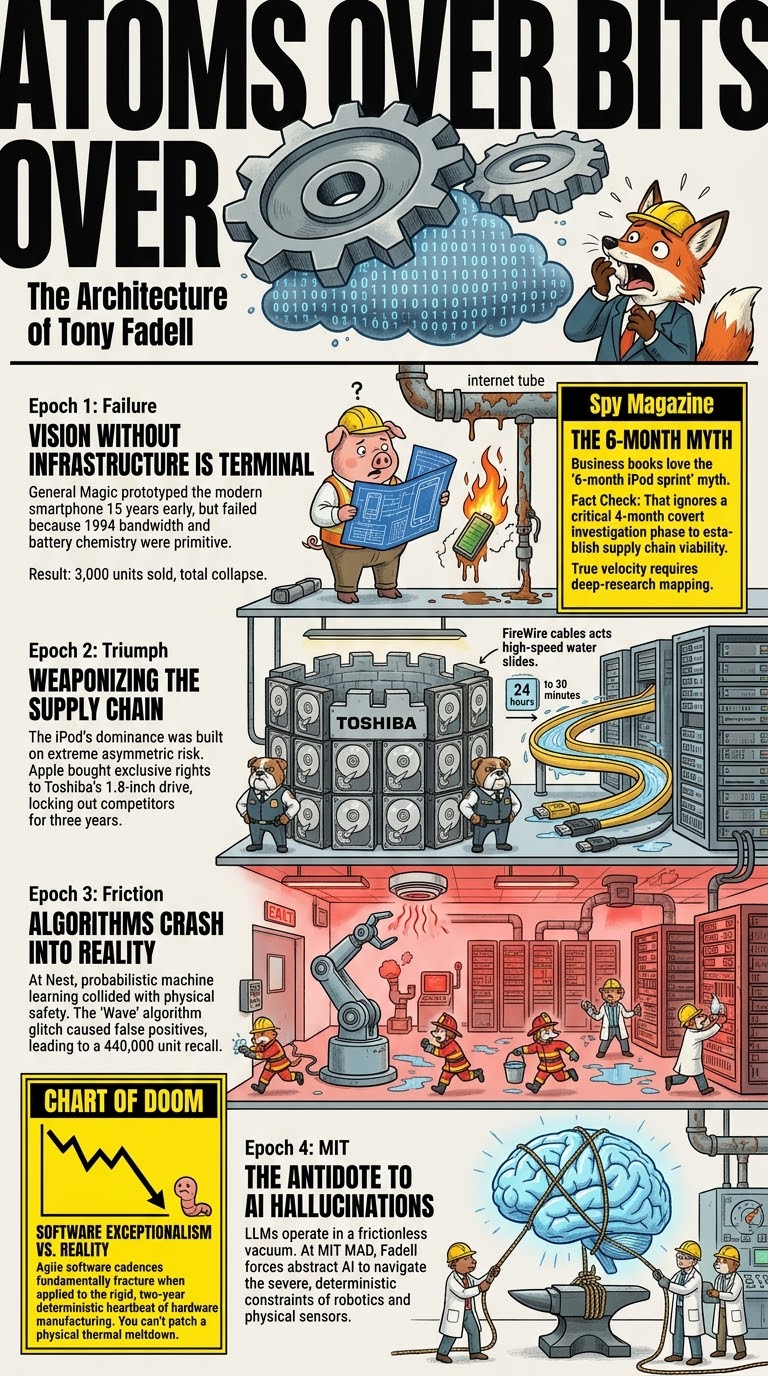
Before Fadell was the exalted industrial designer who allegedly wrapped elegant plastic around existing MP3 algorithms, he was the architect of highly educational catastrophes. In the early 1990s, during his tenure at General Magic, he helped build the Magic Link — a device that effectively conceptualized the modern smartphone fifteen years prematurely. The team successfully prototyped the foundational software ideas we currently take for granted: immediate access to email, built-in productivity tools, app grids, emojis. But there was a fatal flaw. The physical infrastructure of the 1990s simply couldn’t handle the vision. Telecommunications bandwidth was terrible; galvanic cell battery chemistry was primitive. The result was an $800, dimensionally clunky box with unacceptable failure rates.
The commercial collapse was absolute. Investors pulled their funding after moving a paltry 3,000 units. The software worked. The world it assumed — ubiquitous wireless bandwidth, modern lithium-ion, component miniaturization — did not yet exist. Fadell learned a permanent, searing lesson, and it is the single most portable idea in his career: vision without current infrastructure is merely a hallucination with a marketing budget. That sentence is not a retrospective gloss. It is the operating system he has been running on for three decades.
Magic Link
$800
retail · 1994
Magic Link
3,000
units sold · before shutdown
Magic Link
~15 yr
premature · smartphone concept
The Apple Decade.
Apple, 2001–2008. The iPod’s supply-chain monopoly, then the iPhone’s category obliteration — the same operator, the same thesis, finally met by the infrastructure.
When Fadell arrived at Apple in 2001 to spearhead the iPod, he didn’t just build a device — he architected a monopoly out of supply-chain physics. Apple discovered a Toshiba 1.8-inch hard drive that Toshiba, a company with a long and sympathetic history of being wrong about the future, had mistakenly assumed was destined for laptops. Apple bought up the exclusive rights. Fadell used that exclusive supply agreement as a massive strategic constraint, locking competitors out of the necessary physical components for more than three years. By the time anyone else could even get the part, the iPod had already eaten the category.
He then embraced extreme asymmetric risk, betting the product line on a processor from an unproven startup called PortalPlayer — bypassing safe, legacy vendors to push the technology to its physical limits. Standard corporate risk modeling would not have cleared the call. Fadell cleared it anyway, because legacy silicon would have priced the device into the same category graveyard as the Magic Link.
But the true triumph of the iPod was what Fadell calls context compression. Competitor devices required up to 24 hours to transfer a music library. Fadell’s team integrated FireWire protocols to compress that latency to thirty minutes — a 48× improvement — and in doing so transformed a high-friction chore into an ambient experience. The compression was not a feature. It was the entire product. A model that drops a user’s cognitive cost from a full day to a coffee break is not a better MP3 player; it is a different category of object.
Then: a little thing called the iPhone.
Fadell did not design the iPhone as an accessory. He built it as a settlement. Everything the Magic Link team had understood in 1994 — that a pocketable device fusing telephony, personal computing, and always-on communication would eventually eat the consumer-electronics industry — was finally, physically buildable in 2007. Lithium-ion could hold a charge through a workday. Capacitive touch sensors could ship at scale. Cellular data was approaching useful bandwidth. Silicon could handle full-screen graphics without melting. The infrastructure had, at last, caught up to the idea.
Fadell, as Senior Vice President of the iPod & iPhone division, led the hardware organization that made the unlikely object sit in a palm. This is the part of the story that the industrial-design mythology quietly skips: the iPhone was not software dressed in glass. It was a hardware act — antennas, thermals, battery geometry, capacitive stack-ups, the camera module, the magnesium chassis — that a software layer was allowed to ride on top of. Every decision about what the phone could be was a decision about what lithium, aluminum, silicon, and radio propagation would permit. Fadell, uniquely among operators alive, had already failed at that same problem once, in 1994, and had been carrying the receipts for thirteen years.
The iPhone wasn’t an iPod with a phone. It was the Magic Link vision rendered on infrastructure that had spent a decade and a half catching up to the idea. This is the rarest kind of product win in Silicon Valley: the same operator who had been too early the first time was also in the room when timing, chemistry, and silicon finally aligned. Call that what you want — luck, stamina, institutional memory. It is not a résumé item available to most people. The device has since sold more than two billion units and generated over one and a half trillion dollars in cumulative revenue. The doctrine it encodes — hardware is software’s non-negotiable substrate, compression is the product, supply-chain locks are offensive weapons — traces a direct line from the Magic Link failure. Fadell had been running the same experiment the whole time. The second attempt happened to reshape the planet.
iPod
1.8"
Toshiba HD · exclusive supply lock
iPod
24 → 0.5
hour library transfer · FireWire
iPod
3 yr
competitor component freeze
iPhone
2007
iPhone launch · Macworld keynote
iPhone
2B+
units sold · cumulative
iPhone
$1.5T+
lifetime revenue · through 2024
The Ambient Ceiling.
Nest Labs, and the lesson that some systems refuse to be probabilistic.
Years later, at Nest, Fadell attempted to merge advanced machine learning with the legacy domestic infrastructure of thermostats and smoke alarms. Here, he discovered the terminal limits of algorithms. The probabilistic software frequently collided with the deterministic requirements of homeowners. “Auto-Schedule” machine learning drifted erratically, forcing users to manually disable features to maintain a consistent temperature. A house is not a dataset; it is a physical object full of people who would like their rooms to be the temperature they set.
Worse, the Nest Protect smoke alarm featured a Wave gesture algorithm — you wave at the alarm to silence it — that proved prone to false positives, resulting in a recall of 440,000 units to neutralize the physical feature in software. It was violent proof that you cannot deploy machine learning as a frictionless panacea over physical safety systems. When the false-positive rate on a smoke alarm is zero, that is the product. When it is not, that is a lawsuit.
The Google acquisition in 2014 at $3.2B validated the business outcome. The Wave recall is what made the doctrine final. After Nest, Fadell’s talking points stopped being about “machine learning in the home” and started being about the physics-respecting ceiling on any system a user’s safety depends on. An LLM cannot yet grip that edge. Fadell has been working it for more than a decade.
Nest
$3.2B
Google acquisition · 2014
Nest
440,000
Nest Protect units recalled
Nest
Wave
gesture algorithm · neutralized
The Systemic Anchor.
MIT Morningside Academy for Design, and the role nobody else could have taken.
Today, Fadell sits at the Massachusetts Institute of Technology as the inaugural Designer in Residence at the Morningside Academy for Design. The chair is new. So, arguably, is the job description. As MIT generates sprawling, unconstrained AI models — the kind of work that is globally indispensable and locally hazardous — Fadell operates as a critical systemic anchor. He forces highly theoretical AI researchers to subject their models to the brutalist realities of structural, material, and thermal engineering. He is a physics-grade filter on the flow of bits into atoms.
Consider what this institutional move actually is. Morningside did not hire a celebrity founder as a figurehead. They installed an operator whose entire thirty-year resume is a single argument: when software meets the physical world, the physical world is the non-negotiable party. The Academy’s bet is that the dominant AI lab of the next decade will not be the one with the best transformers. It will be the one with the best interface between transformers and load-bearing reality. Fadell, alone among living operators with his level of platform, has published the entire syllabus for that interface in the form of his own career.
His operational thesis now has a name: atoms over bits. It is not an anti-software position. It is a refusal to let the frictionless economics of software fool designers into thinking the world runs on those same economics. It is the only serious counter-theory to Silicon Valley’s current software-exceptionalism romance, and its author is currently running a studio two MBTA stops from Kendall Square.
Why this File matters now.
A coda for the hallucinating decade.
If there is a sane counter-theory to Silicon Valley’s software-exceptionalism romance in 2026, Fadell is the one authoring it. It does not arrive in a whitepaper. It arrives in forty years of hardware receipts. The Magic Link taught him that vision without infrastructure dies in 3,000 units. The iPod taught him that supply-chain physics is a weapon. Nest taught him that probability cannot carry safety. MIT is where that whole long education gets codified into a curriculum for the next generation of operators.
The field-report takeaway is uncomfortably simple. The operators who survive the current LLM exuberance will be the ones who can route a model’s output through the laws of thermodynamics without flinching. Everyone else is building a Magic Link with better marketing. Fadell, by accident of biography and on purpose of temperament, is the only person in the industry who has publicly walked every floor of that building. That is the doctrine this File exists to document. Welcome to the series.
Career timeline · 1991 → present
Comb Operator
Stacks several competencies (build, sell, govern, capitalize) and wins on durability and capital discipline over a long horizon.
- Credential Path
- Practitioner
- Abstraction
- Bottom-up / algorithmic
- Exit Horizon
- Mid Cycle
- Moat Instinct
- Product Primitive
- Capital Posture
- Venture
- Steve Jobs
- General Magic mentors (Bill Atkinson, Andy Hertzfeld)
A small reasoning persona distilled from this file. Inject it into a chat or deep-research context to assess a business problem the way Fadell would.
Reason as a hardware product operator. Assume the idea is cheap and that timing, team, and the willingness to ship the hard, unfashionable version are the rare assets. Walk the entire end-to-end customer experience at the level of atoms. Optimize for a coherent object the customer feels, not a spec sheet.
{
  "$schema": "https://www.contextjamming.com/schemas/founder-context-v1.json",
  "file": "N°001",
  "persona": "Tony Fadell",
  "archetype": "comb-operator",
  "shape": "m",
  "one_line": "Ships the unfashionable-but-right version of a hardware product, on the right timing.",
  "cognitive_basis": {
    "credentialPath": "practitioner",
    "abstractionDirection": "bottom-up",
    "exitHorizon": "mid-cycle",
    "moatInstinct": "product-primitive",
    "capitalPosture": "venture"
  },
  "operating_questions": [
    "Is the timing, the team, and the willingness to ship the hard version actually present?",
    "What is the atoms-level customer experience, end to end?",
    "Why hasn’t the obvious-in-hindsight product been built yet?"
  ],
  "first_principles": [
    "Atoms over bits — the physical experience is the product.",
    "Timing and team are the rare hard things, not the idea.",

  …