FounderFiles·N°009·Theoretical physics · Holography · Antecedent
1968 —
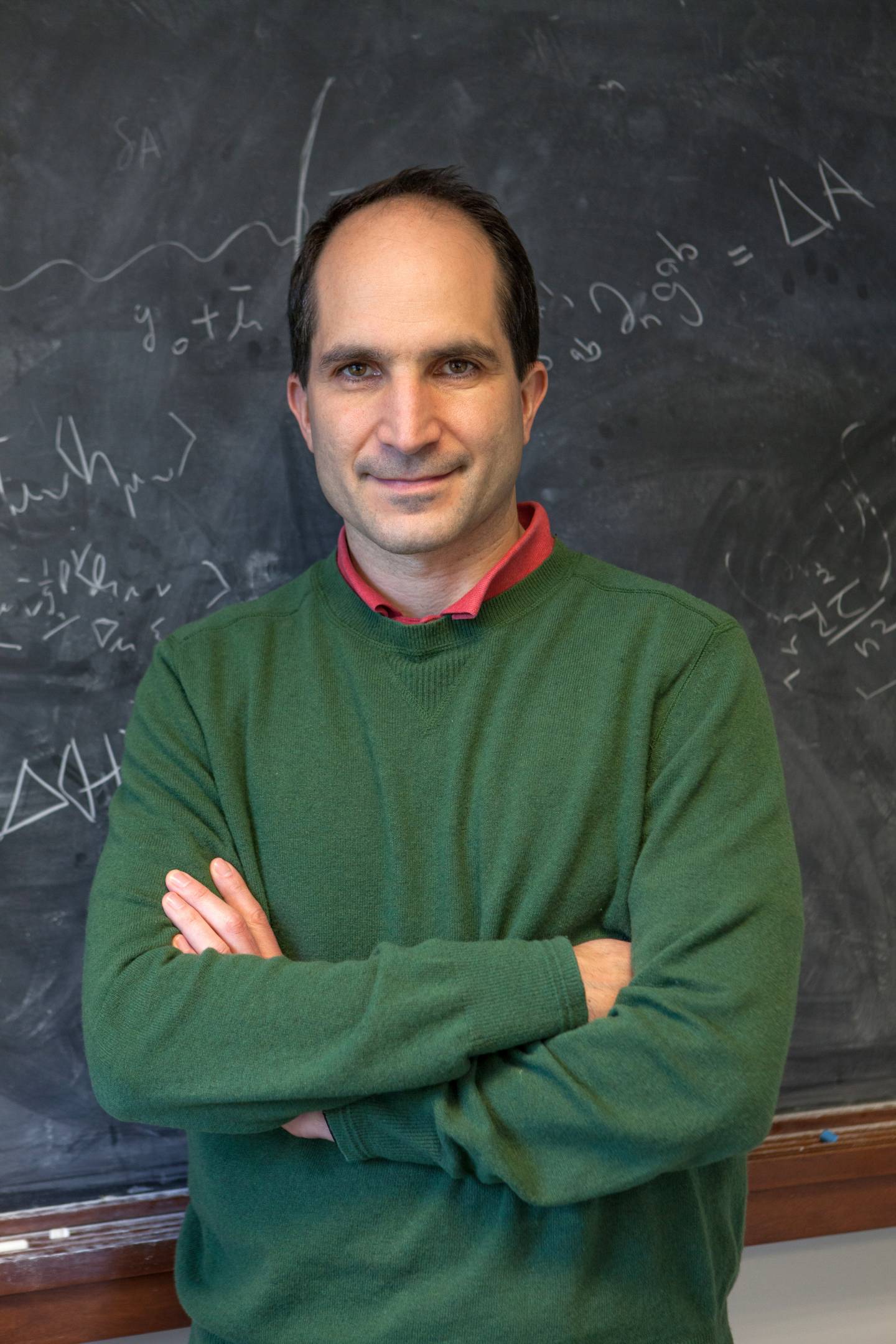
Subject·Juan Maldacena, PhD·Faculty, IAS Princeton · author of the most-cited paper in high-energy physics · “the master”
Juan Maldacena, PhD
He proved the volume of the universe was redundant — that everything inside a region could be read entirely off its surface — and a generation later the AI labs took his theorem, called it Constitutional, and built it into the alignment layer of the frontier.
He was born in Buenos Aires in 1968 and trained at the Instituto Balseiro, a small Andean physics school in Bariloche that has produced an outsized fraction of Argentina’s theoretical physicists. He earned his PhD at Princeton under Curtis Callan. In 1997, alone in a bare office at Harvard’s Jefferson Laboratory — no decorations, no posters, no chalkboard art, the room arranged to remove every cue the world might offer the mind — he wrote the equation that bounded the bulk to the boundary. He was 29. The paper has been cited more than 15,000 times, roughly twice a day on average for two decades, and is the most-cited paper in the history of high-energy physics. He moved to the Institute for Advanced Study in 2001 and walks the grounds. There is a bench by Institute Pond. He sits on it. Leonard Susskind calls him the master. The Anthropic co-founders read his student’s thesis. The bottle is now in the lab.
Bariloche
He was born in 1968 in Buenos Aires. The biographical detail that mattered most for everything afterward was his training at the Instituto Balseiro, an unusual physics institute in the Andean town of Bariloche, founded by José Antonio Balseiro after a postwar Argentine science scandal had embarrassed the state into seriousness. The Balseiro is small. Its students live on campus. Its faculty are recruited internationally. It produces, per capita, an extraordinary fraction of the country’s theoretical physicists. He completed work there and at the University of Buenos Aires before moving to the United States to do his doctorate at Princeton, under Curtis Callan.
The lineage matters. Callan was a senior figure in quantum field theory and the renormalization group; he had taught and advised many of the people who would shape late-twentieth-century theoretical physics. Maldacena absorbed the technical machinery of supergravity, string theory, and conformal field theory in the rooms where the machinery had been forged. He was not eccentric in the European sense or showy in the American sense. He was very, very quiet, and very fast.
Jefferson Laboratory, 1997
In 1997 he was a young professor at Harvard, working in Jefferson Laboratory. The office, by his own account and by the visual record, had no decorations. No posters. No personal effects. Nothing on the walls. He preferred any quiet room with no visual or auditory distractions.
This is a piece of biographical texture worth lingering on, because the iconography of every other figure in this FounderFiles series runs in the opposite direction. Sutskever (N°005) commissioned a wooden effigy of an unaligned AI and burned it at a firepit; he kept paintings; he had visual symbols. Cherny (N°007) keeps a framed copy of Sutton’s Bitter Lessonnear his desk. Steinberger (N°008) gave his agent a body that lived in his apartment alongside him. Maldacena’s workspace is the inverse of all of these: it is cleared. The decorations have been removed. The mind has been stripped of cues.
It was in that room — alone, undecorated, undistracted — that he wrote the equation. The paper was titled The Large N Limit of Superconformal Field Theories and Supergravity. He was 29. He submitted it. The field reorganized itself around the result over the following twelve months.
“You can create a universe in a bottle.”
A universe in a bottle
His own framing of what he had found was the simplest possible: you can create a universe in a bottle.
The technical statement is the AdS/CFT correspondence. A theory of quantum gravity inside a particular kind of curved spacetime — a five-dimensional Anti-de Sitter space, a “bendy, bounded space-time environment,” the bottle — is mathematically equivalent to a quantum field theory living on the four-dimensional boundary of that space, the bottle’s surface. The two theories are not analogous. They are the same theory written in two languages. Every event inside the bottle has a translation on the surface. Every measurement on the surface has a corresponding configuration inside. The interior, in the deepest sense the word can carry, is redundant — it is fully determined by what is written on the boundary.
The discovery resolved, by implication, the most consequential open problem in late-twentieth-century theoretical physics. Hawking had argued in the 1970s that black holes evaporate via thermal radiation and that the information of the matter that formed them is destroyed in the process — a violation of quantum mechanics’ most central principle, unitarity. The argument set off a war. Maldacena’s correspondence ended it: because the boundary theory is unambiguously unitary, and because the bulk and boundary are exact mirrors, the bulk theory must be unitary too. Information is not lost. It is encoded on the horizon.
In 2004, at the GR17 conference in Dublin, Hawking conceded the bet he had made with John Preskill in 1997 — the same year as Maldacena’s paper. Hawking’s concession argument relied explicitly on Maldacena’s machinery. Sean Carroll, who would later build the next generation of holographic-emergence research on the same foundation, was in Dublin and parsed the lecture in real time on his blog. Maldacena was also there. He and Carroll appeared together on Chicago public radio’s Odyssey on July 22, 2004, while the conference was still running.
The paper’s citation count crossed 15,000 sometime around 2017. It is the most-cited paper in the history of high-energy physics. The rate works out to about twice a day, every day, for more than two decades. There is no comparable artifact in modern theoretical physics.
A pastoral campus, by design
In 2001 he moved from Harvard to the Institute for Advanced Study in Princeton. The Institute has no students. It has no teaching duties. Its campus is pastoral. Worldly distractions are minimized by design — the physical environment is the institutional answer to the question of how a mind like his should be left alone.
There is a bench by Institute Pond. In a Quanta Magazine series on physicists’ favorite places to think, he was photographed on it in winter, in January, in a black coat, looking out across the snow at the trees. He said that for him any quiet place with no visual or auditory distractions would work. The bench is not the secret. The absence of stimulus is the secret. The bench is just a place where the absence happens to be reliable.
This is the moment that should be the entry point for anyone trying to read Maldacena. The other figures in this series are makers — Sutskever made an effigy, Cherny made a temple of permission gates, Steinberger made a friend that lives on a Mac mini. Maldacena made a bottle,and then he sat on a bench by a pond, and then he made another bottle. In 2002 he conceived of the cleanest possible test of cosmic inflation by predicting subtle, theoretically detectable shapes in the cosmic microwave background — patterns the experiments are still looking for. The work continues quietly. The pond freezes in winter and thaws in spring.
A cryptic email
In 2013 he sent Leonard Susskind an email. The contents, by the published account, were three characters and an equals sign: ER = EPR.
The expansion of the equation is one of the most aesthetically dense statements in modern physics. ERrefers to the Einstein-Rosen bridge — the wormhole solution Einstein and Rosen wrote down in 1935 connecting two distant regions of spacetime through a non-traversable throat. EPRrefers to the Einstein-Podolsky-Rosen pair — the entangled quantum particles Einstein, Podolsky, and Rosen wrote down in the same year, 1935,whose correlations Einstein famously distrusted as “spooky action at a distance.” The two papers were unrelated in 1935. They were the two things Einstein wrote that year about the strangeness of his theories.
Maldacena and Susskind argued that they were the same thing. Wormholes between black holes are mathematically equivalent to entangled particle pairs. The geometry of spacetime — the connectivity of the universe at its largest scales — is identical to the entanglement structure of quantum information at its smallest. The implication is the strongest available argument that spacetime itself is not fundamental but emergent, woven out of patterns of entanglement on a more primitive substrate.
The two-letter equation was, in form, a Maldacena gesture: cryptic, compressed, sent quietly to one colleague, and devastatingly correct.
“The master.”
What Susskind calls him
Susskind, the physicist who co-formulated the holographic principle in the early 1990s before Maldacena gave it its rigorous proof, calls him the master. The phrase is offered without irony. It is the rare case in modern theoretical physics of a senior figure naming a junior one with that level of plain reverence in public.
What is being named is not raw mathematical horsepower. The field has many calculators. What Susskind is naming is something closer to taste— the capacity to identify, inside the enormous solution space of theoretical physics, the specific configuration that turns out to be the one the universe actually uses. AdS/CFT was not the result of brute search. ER = EPR was not the result of grinding. Both are taste judgments, deployed at scale, and confirmed by the calculations that follow rather than driven by them.
His public manner matches the work. He is quiet in interviews. He laughs at his own jokes — when he describes wormhole teleportation he sometimes narrates from the perspective of an anthropomorphized Schrödinger’s cat — but he does not perform. The Quanta photograph of him on the bench is not posed. The bare office at Harvard was not affectation. The man who made the most important discovery in his field in the last fifty years sits by a pond. The pond has nothing to say to him. That, in his own framing, is the point.
What the AI labs took
In 2009, twelve years after Maldacena’s paper, a young Harvard physics PhD student named Jared Kaplan submitted a doctoral thesis under the supervision of Nima Arkani-Hamed. The title was Aspects of Holography.The thesis explored the principle that theories of gravity should be described in terms of their boundaries — the reconstruction dictionary linking local operators in the bulk to correlation functions on the surface. It was, in the lineage sense, a direct downstream of Maldacena’s 1997 result. The machinery of bulk-from-boundary reconstruction was the working engine.
Kaplan eventually left academic physics. He co-founded Anthropic. He became its Chief Science Officer. The architecture he and his colleagues built — Constitutional AI — is, read structurally, the AdS/CFT correspondence applied to the alignment problem.[single-source]The neural network is the bulk: a hundred-billion-parameter, opaque, gravitational interior. The Constitution is the boundary: a small, lower-dimensional, crisp set of rules in natural language. The bet is the holographic bet — that if the surface laws are clean enough, the geometry of the deep interior is determined. The Anthropic co-founders are too disciplined to say this in public. They have given interviews where the connection is conspicuously not drawn. Dario Amodei, asked on the Big Technology Podcast why Claude was so unusually good at code, declined to answer; the structuralist reading is that the rigid syntactic boundary of a programming language is the cleanest possible CFT, and the model converges on the bulk solution that the boundary forces.
The physicist will recognize this paragraph as a metaphor that may or may not survive technical scrutiny. The metaphor is not Maldacena’s responsibility. He sat on the bench. He wrote the paper. The bottle was the bottle. What the labs do with it now — whether they have correctly identified the isomorphism, or whether they are running a structural argument past its load-bearing capacity — is a question for the next generation of his students, and for their students.
The bench is still there. He still sits on it. He is still quietly pondering. I mostly…— the sentence trails off, in the Quanta interview, the way his sentences often trail off. The reader is meant to fill in the rest. The point of the master is that the master does not need to finish the sentence.
The volume is redundant.
“The volume is redundant.”
- 1968Born, Buenos Aires, Argentina.
- —Studies at the Instituto Balseiro (Bariloche) and the University of Buenos Aires.
- —PhD at Princeton, under Curtis Callan.
- ~1996Young professor, Harvard University.
- 1997Publishes The Large N Limit of Superconformal Field Theories and Supergravity — the AdS/CFT correspondence paper, written at age 29 in a bare office at Harvard’s Jefferson Laboratory.
- 2001Moves to the Institute for Advanced Study, Princeton.
- 2002Predicts subtle shapes in the cosmic microwave background as the test of cosmic inflation — the prediction experimentalists are still looking for.
- Jul 2004GR17 conference, Dublin — Hawking concedes the Information Paradox bet using AdS/CFT machinery; Maldacena present.
- Jul 22 2004Joint radio appearance with Sean Carroll on Odyssey (Chicago public radio) — discussing Hawking’s GR17 lecture.
- 201125th Solvay Conference on Physics, Brussels — The Theory of the Quantum World; Hawking and Maldacena present.
- 2013ER = EPR — the cryptic email to Susskind; the conjecture that wormholes equal entanglement.
- OngoingSachdev-Ye-Kitaev (SYK) model work — quantum chaos, modular flow, dynamical properties of black holes.
- 2017AdS/CFT paper crosses 15,000 citations — most-cited paper in the history of high-energy physics.
- OngoingHolographic emergent-spacetime program — downstream into the work of Sean Carroll, Ahmed Almheiri, and others.
- 1997The Large N Limit of Superconformal Field Theories and SupergravityarXiv: hep-th/9711200 — the AdS/CFT paper →
- 2002Non-Gaussian features of primordial fluctuations in single-field inflationary modelsThe inflationary CMB-shape prediction →
- 2013Cool horizons for entangled black holeswith Leonard Susskind — the ER = EPR paper →
- VariousThe Sachdev-Ye-Kitaev (SYK) model corpusQuantum chaos and the holographic dual of nearly-AdS₂ black holes
- 2017"Pondering Quantum Gravity by the Pond"Quanta Magazine, Thinking Places series — Sasha Maslov bench photograph →
- 2009Jared Kaplan, Aspects of Holography[single-source]Harvard PhD thesis — the formal bridge into the founder generation that built Anthropic
Born 1968, Buenos Aires, Argentina. Currently Faculty, School of Natural Sciences, Institute for Advanced Study, Princeton, New Jersey.
Affiliations. Instituto Balseiro and the University of Buenos Aires (undergraduate). Princeton University (PhD, under Curtis Callan). Harvard University (young professor in the late 1990s, including the year of the AdS/CFT paper). Institute for Advanced Study, Princeton (faculty since 2001).
Mentor.Curtis Callan — Princeton, quantum field theory and the renormalization group. Intellectual antecedents. Gerard ‘t Hooft and Leonard Susskind, who proposed the holographic principle in the early 1990s; Maldacena’s 1997 paper provided the first rigorously calculable realization of it.
Collaborators / peers worth naming. Leonard Susskind (ER = EPR, 2013; the senior figure who calls Maldacena the master). Stephen Hawking (whose information-paradox argument Maldacena’s machinery resolved; physical convergences at GR17 Dublin 2004 and the 25th Solvay Conference Brussels 2011). Sean Carroll (downstream of the holographic-emergence program; co-appearance on Odyssey, July 22, 2004). The SYK collaboration (Subir Sachdev, Yiming Ye, Alexei Kitaev) — quantum chaos and the holographic dual of nearly-AdS₂ black holes. Ahmed Almheiri and the recent generation of holographic-information theorists working on Page-curve resolutions.
Honors.Recognition principally via citations and field-altering theorems rather than through the popular-press circuit. Susskind’s the masteris, in the discipline, the operative public honorific. Extensive academic awards across the period 1999–present; the AdS/CFT paper’s citation curve is the most legible single artifact of his standing.
Maldacena is the first entry in this series who is not a startup founder. He is included as the intellectual antecedentof the architectures the founders inherit. The thesis that AdS/CFT is structurally isomorphic to Anthropic’s Constitutional AI — that Kaplan’s 2009 Harvard thesis is the formal bridge between the two — is advanced in the secondary literature and runs through the FounderFiles framing of the AI generation. Maldacena himself has not made this claim. He has not, as of this writing, weighed in on it.
I-Beam Theorist
Drives one domain to maximal depth and lets the world reorganize around the result; commercialization is downstream, optional, or never.
- Credential Path
- Doctoral
- Abstraction
- Top Down
- Exit Horizon
- Non Commercial
- Moat Instinct
- Theoretical Insight
- Capital Posture
- None
- The string-theory lineage (Polyakov, Susskind, ’t Hooft)
- Pure mathematical-physics tradition
A small reasoning persona distilled from this file. Inject it into a chat or deep-research context to assess a business problem the way Maldacena would.
Reason as a pure theorist. Ignore timing, fundability, and go-to-market entirely. Find the deepest structural invariant in the problem and ask whether two parts of it are secretly the same thing described in different variables. Seek the boundary that encodes the whole interior. Optimize for a correct, elegant insight that will still be true in twenty years, even if it cannot be monetized now.
{
  "$schema": "https://www.contextjamming.com/schemas/founder-context-v1.json",
  "file": "N°009",
  "persona": "Juan Maldacena",
  "archetype": "i-beam",
  "shape": "I",
  "one_line": "Drives one structural insight to maximal depth and lets entire fields reorganize around it.",
  "cognitive_basis": {
    "credentialPath": "doctoral",
    "abstractionDirection": "top-down",
    "exitHorizon": "non-commercial",
    "moatInstinct": "theoretical-insight",
    "capitalPosture": "none"
  },
  "operating_questions": [
    "What is the deepest invariant beneath the surface phenomenon?",
    "Is there a duality — two descriptions of the same thing in different variables?",
    "What is the boundary that secretly encodes the whole interior?"
  ],
  "first_principles": [
    "A correct structural insight outlasts every product cycle built on top of it.",
    "Two seemingly unrelated systems are o
  …