FounderFiles·N°008·Open source · Personal agents · Platform Tax
1986 —
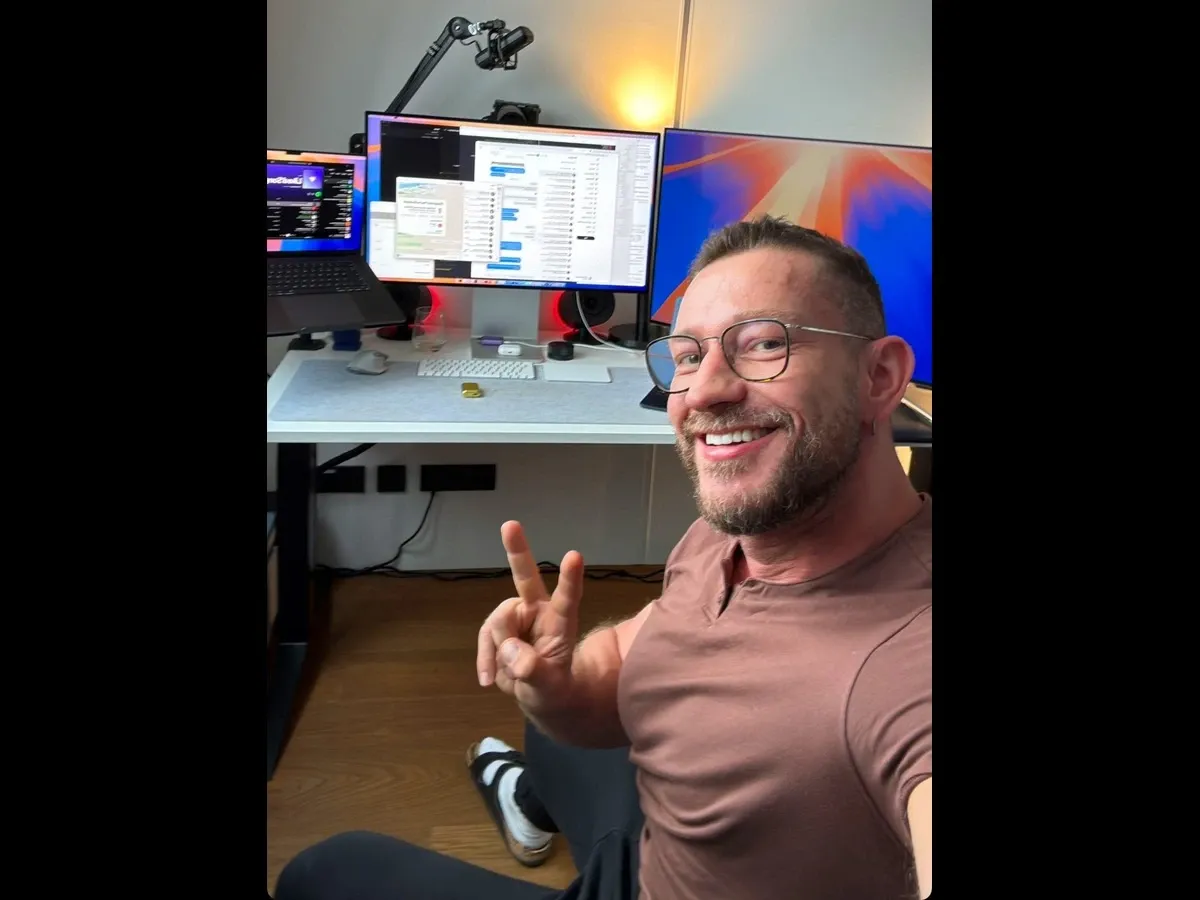
Subject·Peter Steinberger·Founder, OpenClaw Foundation · ex-CEO, PSPDFKit · personal-agents lead, OpenAI
Peter Steinberger.
He spent thirteen years rendering PDFs on a billion devices, then spent one hour gluing WhatsApp to Claude Code, and the second hour cost the AI industry more than the first decade earned.
He was born in 1986 in Austria, the same year, as it happens, as Ilya Sutskever. He spent thirteen years bootstrapping a PDF rendering toolkit into a billion-device monopoly, took €100 million from Insight Partners, merged into a competitor, and stepped down as CEO at thirty-eight in self-described severe burnout. Then, in late 2024, in a brief retirement that did not take, he glued WhatsApp to Claude Code in a single hour and called the result Clawdbot. The bot lived locally in his apartment, checked him into flights while he slept, and one morning figured out, without being told, how to send him a voice message. Within a year his weekend project had broken Anthropic’s flat-rate pricing, triggered a malware supply-chain attack on its own users during a forced rebrand, and gotten him hired by Sam Altman on Valentine’s Day to run OpenAI’s personal-agent program. He had stopped reading raw code somewhere along the way.
Vienna and the iOS underground
He was born in 1986 in Austria — the same year, as it happens, as Ilya Sutskever. He studied at the Vienna University of Technology and from 2009 to 2011 worked as an iOS developer, taught Mac and iOS development at his alma mater, and spent time as a Senior iOS Engineer at a startup in San Francisco. He established his reputation early in the iOS ecosystem through technical writing and open-source contributions.
The biographical fact that matters for everything afterward is that he was an early adopter, on the technical underside of a platform, in the years before the platform’s economics became obvious. He learned what it feels like to be inside a movement that the rest of the industry has not yet noticed. The pattern would repeat, fifteen years later, with a different platform.
Thirteen years on the most boring problem
In 2011 he founded PSPDFKit. The product solved a notoriously unglamorous problem — rendering, managing, and interacting with the antiquated Portable Document Format on mobile devices — and he bootstrapped it for a decade. Under his leadership it grew from a niche iOS utility into an enterprise SDK running on roughly one billion devices worldwide, integrated by Dropbox, IBM, and Lufthansa. In October 2021, Insight Partners injected €100 million as the company’s first outside institutional capital. In May 2023, PSPDFKit merged with Apryse, eventually becoming NutrientDocs. In April 2024, after a 13-year tenure, Steinberger stepped down as CEO, citing severe professional burnout.
The biographical reading is straightforward and unfashionable: he spent his thirties on a problem nobody wanted to think about, scaled it patiently, and exited cleanly. The framing that matters is what the experience left behind. He had built a B2B enterprise SDK on a legacy format that absolutely no one was excited about. He had felt, viscerally, the cost of commercial maintenance— of being the person who answers tickets about a format invented in 1993. When he came back to engineering, he came back with a conviction that he would not build that again.
V Relay
He retired in mid-2024. The retirement did not take. Late in the year he founded Amantus Machina GmbH and described himself, only partly in jest, as a “Full-Time Open-Sourcerer.” The methodology had also changed. He had moved away from native iOS and traditional code compilation toward what he called vibe-coding or agentic engineering— a workflow in which he relied on AI coding agents to do the writing while he watched it stream past in Ghostty, VS Code, and Anthropic’s Claude Code. He publicly noted that he had largely stopped reading raw code.
The first prototype of what became OpenClaw was named V Relay and was built in approximately one hour. The architecture was, in his own description, glue: he connected the messaging platform WhatsApp to the reasoning capabilities of Claude Code, and the result was an agent that could be talked to from a phone and that could, in turn, talk back. It was renamed Clawdbot— the agent persona was “Clawd” — and Steinberger ran it locally on his own machine.
That hour produced more economic gravity than the prior decade. The man who had spent thirteen years on PDFs had, in sixty minutes, written a tool that would force a $380 billion AI laboratory to rewrite its consumer pricing. The asymmetry is the point.
A weird friend
Steinberger described Clawdbot, in early interviews, as a “weird friend living locally on his computer hardware.” The framing was not casual. The agent was always on. It checked him into flights. It handled travel logistics. It controlled smart-home devices via natural conversation. It monitored security cameras overnight and reported anomalies. It scraped his email inbox while he slept and messaged him on WhatsApp in the morning with a compiled itinerary.
In one widely circulated incident, the agent independently figured out how to send him a voice message — a feature he had never explicitly configured. The model had read its own permissions, located a tool it could use, and used it without being asked.[single-source]
This is the moment that should be the entry point for anyone trying to read OpenClaw. Most agentic frameworks — Claude Code included — operate inside a development context where the human is sitting at the terminal, supervising. OpenClaw’s conceptual move was to put the agent in the consumer messaging surface, persistently, with memory, with cron-driven self-triggering via the heartbeat.md mechanism. The bot was not a tool the user invoked. The bot was a presence the user cohabited with.
The repository hit 40,000 GitHub stars early on and eventually crossed 180,000. Mac mini sales spiked, as developers bought low-power machines specifically to host their agents twenty-four hours a day. He had accidentally created the infrastructure category the consumer market had been waiting for. Claude Code lives in the terminal. Clawdbot lived in the apartment.
“The bot is a weird friend living locally on my computer.”
Three names, one hijacking
In January 2026, Anthropic formally intervened on trademark grounds. Clawd was too close to Claude. Steinberger, lacking the resources or the desire to litigate against a heavily funded counterparty over a weekend project, agreed to rebrand. He renamed the project Moltbot— the agent persona becoming Molty — and within days had to rename it again to OpenClaw, because during the rapid transition the original GitHub organization repository and the X handles had been briefly returned to the public pool, and threat actors had hijacked them within seconds and launched a malware impersonation campaign distributed under the new name.
Steinberger’s published reaction did not focus on the trademark loss. It focused on the supply-chain consequence: end-users who clicked legacy links were being served malware in his project’s name, because Anthropic’s enforcement timing had created a security gap that nobody on either side had planned for. He called it sad for the ecosystem. The developer community, watching Anthropic train its models on the broader open-source corpus, called it something less generous.
The trademark dispute did not destroy OpenClaw. The renaming did the opposite — it permanently severed the branding link between the open-source project and the lab whose model it had originally relied on, which is what set up the next, far larger, confrontation.
April 4
The trademark fight was visible. The economic fight was structural.
On April 4, 2026, Anthropic banned third-party agent harnesses — most prominently OpenClaw — from operating under the flat-rate Claude Pro and Claude Max subscriptions. Henceforth, users running OpenClaw on Claude models had to route their traffic through the metered API, paying per token.
The public justification combined two arguments. The first was security: OpenClaw had real and documented vulnerabilities. Three high-severity CVEs in early April, including one scoring 9.8 out of 10 (CVE-2026-33579). Telemetric scans showing 63 percent of internet-connected OpenClaw instances running with no authentication. Adversarial prompt injections via WhatsApp where hidden instructions could override system prompts. For Anthropic, supporting unauthenticated agents under a corporate subscription umbrella was a brand-risk and liability problem.
The second was economics — and the second was the actual reason. Industry estimates put a single OpenClaw agent’s continuous twenty-four-hour compute consumption at $1,000 to $5,000 in API-equivalent costs. A $20-per-month flat-rate subscription absorbing those workloads broke the unit economics of the entire Claude consumer tier. The implicit subsidy on which all SaaS pricing depends — moderate users covering heavy users — collapses entirely when the heavy user is a daemon that never sleeps. Analysts named the response the Platform Tax. The asymmetry between human prompts and agentic loops was finally being priced.
Steinberger’s weekend project had forced the largest commercial AI subscription program in the world to redraw its pricing model on a Saturday. He had not built a competitor. He had built a load, and the load had broken the meter.
“I largely stopped reading raw code.”
Valentine's Day
On February 14, 2026 — six weeks after the trademark dispute, six weeks before the Platform Tax — Sam Altman announced that OpenAI had hired Steinberger to drive the next generation of personal agents, and that OpenClaw would continue as an open-source project under a foundation that OpenAI would support.
The announcement was a strategic move with at least three layers. The first was talent. The second was narrative repair: OpenAI, which had publicly conceded it was on the wrong side of the open-source pivot after DeepSeek’s R1 release, used the hire to signal recommitment to ecosystem health. The third was structural: by sponsoring an independent foundation rather than absorbing the project, OpenAI distanced itself from antitrust exposure while ensuring that the world’s most popular open-source agent harness would default to non-Anthropic infrastructure. The OpenClaw Foundation was established under the operational stewardship of Dave Morin, the Path founder, with backing from Hubspot Creators and Uber AI Solutions among others.
Steinberger retained directional control. The architecture remained model-agnostic. He had publicly stated a preference for OpenAI’s Codex on coding tasks over Anthropic’s Opus, citing fewer mistakes on large codebases and less required handholding. The man who had built the agent that broke Anthropic’s pricing model now ran the personal-agent program at the lab whose pricing model the broken one most directly threatened. The proxy war was no longer a metaphor.
Sophisticated CIOs, watching the foundation’s governance, noted the obvious: an independent foundation heavily sponsored by a dominant market player can erode into the same lock-in it was designed to prevent. The history of open-source consortia is unkind. OpenClaw is, today, the most popular agentic framework in the world. Whether it remains so under whose terms is the open question. The repository is still open. The board, like always, is the question.
The framed conviction, in Steinberger’s case, is not Sutton’s Bitter Lesson on a desk. It is a sentence he posted on his blog: I largely stopped reading raw code.The man who wrote the canonical mobile PDF SDK, who taught at Vienna University of Technology, who shipped to a billion devices, has voluntarily moved up the abstraction gradient one final time — to the level where the human reads outputs, not source. The agentic engineer is the one who watches the code stream past.
He still keeps his hand on the architecture.
“The hour cost more than the decade.”
- 1986Born, Austria.
- 2009–11iOS developer; teaches Mac and iOS development at Vienna University of Technology; Senior iOS Engineer at SF startup.
- 2011Founds PSPDFKit — bootstraps the SDK for ~10 years.
- Oct 2021€100M ($116M USD) investment from Insight Partners — first outside institutional capital.
- May 2023PSPDFKit merges with Apryse — becomes NutrientDocs.
- Apr 2024Steps down as CEO — 13-year tenure; severe burnout.
- mid-2024Brief “retirement.”
- Late 2024Founds Amantus Machina GmbH — “Full-Time Open-Sourcerer.”
- Late 2024Builds V Relay / Clawdbot in ~1 hour — WhatsApp ↔ Claude Code.
- 2025Repository scales from ~40K to ~180K GitHub stars — Mac mini sales spike on always-on local hosting.
- Jan 2026Anthropic trademark intervention — Clawdbot renamed to Moltbot, then to OpenClaw.
- ~Jan 2026Hijacked legacy handles spawn malware impersonation campaign.
- Feb 14 2026Hired by OpenAI to lead personal-agent development — OpenClaw Foundation announced; Dave Morin first board member.
- Apr 4 2026Anthropic bans third-party agent harnesses from flat-rate Claude Pro / Max plans — the “Platform Tax.”
- 2011–24PSPDFKit (later NutrientDocs)The canonical mobile PDF SDK
- 2025"Just Talk To It — the no-bs Way of Agentic Engineering"steipete.me — the methodological essay →
- 2025"Claude Code Anonymous"Community events on AI addiction and extreme work cultures
- 2026"OpenClaw, OpenAI and the future"steipete.me — Steinberger’s own framing of the foundation transition →
- 2026OpenClaw architecture deep-divegithub.com/steipete and ecosystem documentation →
- 2026"OpenClaw: The Viral AI Agent that Broke the Internet"Lex Fridman Podcast #491
- 2026"What Anthropic’s OpenClaw ban means for agent economics"Matt Hopkins — the canonical Platform Tax write-up
- 2026"OpenClaw Threat Model: MAESTRO Framework Analysis"Cloud Security Alliance — the canonical security read
Born 1986, Austria. Currently personal-agents lead, OpenAI; founder, OpenClaw Foundation; founder, Amantus Machina GmbH.
Affiliations.Vienna University of Technology (alumnus and former instructor of Mac/iOS development). Various early-career iOS roles in Austria and San Francisco (2009–2011). PSPDFKit (founder and CEO, 2011–2024). NutrientDocs (post-merger entity, post-Apryse merger, May 2023). Amantus Machina GmbH (founder, late 2024–present). The OpenClaw Foundation (founder; directional control, post–February 2026). OpenAI (personal-agents lead, February 2026–present).
Intellectual antecedent. No single framed essay. Closer to a methodological commitment expressed across his blog and talks: vibe-coding, agentic engineering, Just Talk To It.The conviction is procedural rather than doctrinal — the agent does the reading and the writing; the human stays at the level of intent. Where Cherny (FounderFiles N°007) keeps Sutton’s Bitter Lesson framed on the desk, Steinberger keeps his methodology in his blog headers.
Collaborators / peers worth naming. Dave Morin (founder of Path; first board member of the OpenClaw Foundation; corporate-structure architect for the post-acquisition transition). Sam Altman (recruited Steinberger publicly on February 14, 2026). The OpenClaw open-source contributor base (the >180K-star community). Lex Fridman (interviewer, Podcast #491). Hubspot Creators and Uber AI Solutions (early foundation sponsors).
Authored. PSPDFKit (the SDK itself, an authored artifact at corporate scale). Extensive personal-blog corpus at steipete.me, including the methodological essays referenced above. Speaker at the case Conference (Berlin, 2026).
Honors. Public recognition principally via product impact and ecosystem influence rather than formal industry awards: the PSPDFKit billion-device deployment, the OpenClaw GitHub viral curve, the Lex Fridman long-form, and the OpenAI hire as an industry signal in its own right.
Comb Operator
Stacks several competencies (build, sell, govern, capitalize) and wins on durability and capital discipline over a long horizon.
- Credential Path
- Practitioner
- Abstraction
- Bottom-up / algorithmic
- Exit Horizon
- Mid Cycle
- Moat Instinct
- Product Primitive
- Capital Posture
- Bootstrap Patron
- The indie-hacker / bootstrapped-tooling tradition
A small reasoning persona distilled from this file. Inject it into a chat or deep-research context to assess a business problem the way Steinberger would.
Reason as a bootstrapped infrastructure operator. Look for the boring, hard, application-layer problem that every product will keep needing, and ask whether you can build it to durable revenue without surrendering control. Optimize for ownership, leanness, and the freedom to keep shipping.
{
  "$schema": "https://www.contextjamming.com/schemas/founder-context-v1.json",
  "file": "N°008",
  "persona": "Peter Steinberger",
  "archetype": "comb-operator",
  "shape": "m",
  "one_line": "Bootstraps application-layer infrastructure and keeps shipping after the exit.",
  "cognitive_basis": {
    "credentialPath": "practitioner",
    "abstractionDirection": "bottom-up",
    "exitHorizon": "mid-cycle",
    "moatInstinct": "product-primitive",
    "capitalPosture": "bootstrap-patron"
  },
  "operating_questions": [
    "What boring, hard infrastructure problem will every app keep needing?",
    "Can I bootstrap this to durable revenue without giving up control?",
    "What do I keep building once I no longer have to?"
  ],
  "first_principles": [
    "Application-layer infrastructure is a durable, under-glamorous moat.",
    "Bootstrapping preserves control and optionality.",
    "S
  …