
Issue №001 · Filed April 2026 · ~10 min read
The Rose That Grew
Through the Checkout Counter
How a Black Panther’s son became a $15.98 pair of pajama shorts — and what that price tag tells us about the machine that ate him.
The shorts cost $15.98.
They are hanging on a plastic rack in a Walmart somewhere in America, which is to say everywhere in America, because a Walmart is less a store than a condition. They are polyester, or some cousin of polyester, the kind of fabric that announces its own disposability before you’ve taken it off the hanger. Across the front, in a distressed collegiate font, the kind of font designed to suggest authenticity by appearing to have been through something, runs the word TUPAC. And curling around the block letters, rendered in a delicate cursive more suited to a Hobby Lobby throw pillow than to the body of a dead revolutionary, are the words The Rose that grew from concrete.
That line is the title of a poem. Tupac Amaru Shakur wrote it when he was young, before the fame, before the prison sentence, before the Death Row contract, before the Las Vegas drive-by. He wrote it about survival — specifically, about the unnatural act of blooming in a place engineered to kill you. When his mother, Afeni, a Black Panther who represented herself in federal court while pregnant with him, read the poem later, she reportedly wept. It was a private thing, a personal thing, a thing about her son and her life and what the two of them had been through.
Now it is a floral motif. It coordinates with a matching top. It is priced to move.
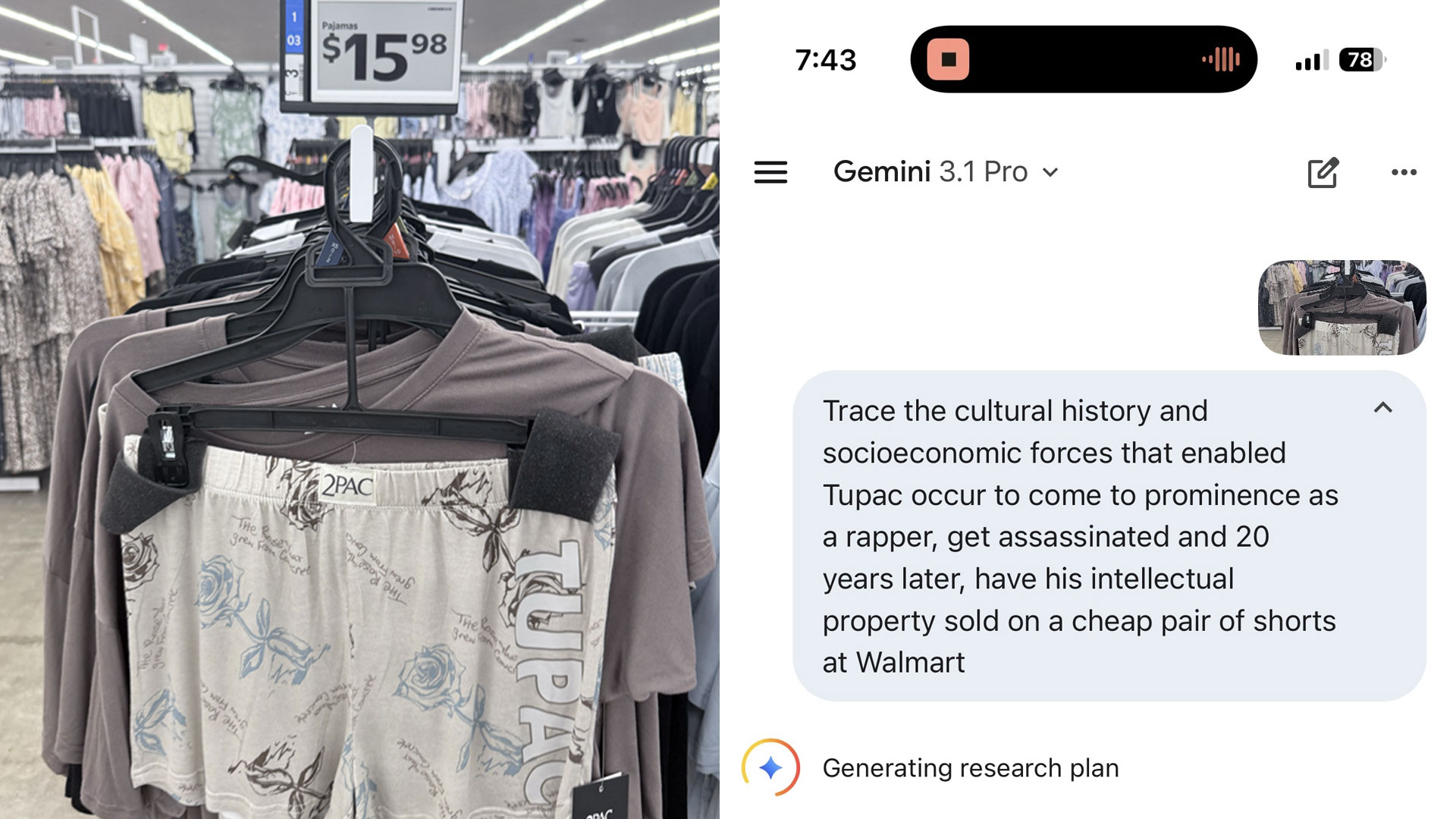
There is a photograph of these shorts, taken recently on an iPhone by a man I’ll call the Observer, because what he observed and what he did with it is the actual story here. The Observer looked at the shorts and did what almost nobody does at a Walmart, which is to pause. He took the photograph. He typed a single paragraph into his phone. He fed the paragraph and the photograph into an AI research tool, and he asked it to trace the full arc — from the burning Bronx of 1980 to this plastic hanger in a fluorescent-lit aisle — of how, exactly, we got here.
What follows is the arc.
The Crucible
To understand the shorts, you have to understand the crucible, and to understand the crucible you have to understand that Ronald Reagan’s War on Drugs was not, despite its packaging, a war on drugs. It was a war on a specific population, fought with specific weapons — militarized police, mandatory minimums, asset forfeiture, and a federal withdrawal from the social safety net so total that the withdrawal itself became a kind of ordnance. Cocaine seizures quadrupled during the Reagan years. Prison populations exploded. The life course of a young Black man in an American city was structurally rewritten.
Into this Tupac was born, in 1971, in East Harlem, to Afeni Shakur, who was not just a Black Panther but theBlack Panther — a lead defendant in the Panther 21 trial, a woman who represented herself against the state and won. His godfather was Geronimo Pratt, another Panther, imprisoned for twenty-seven years on charges later vacated. His political lineage, in other words, was impeccable. It was also useless against crack cocaine, which claimed his mother in the mid-1980s and sent the family on a nomadic retreat — Harlem, Baltimore, Marin City, Oakland — each move a step further from the revolutionary dream that had produced him.
Here is the thing about the young Tupac that tends to get lost: he was, before he was anything else, a reader. He read Shakespeare and Machiavelli. He attended the Baltimore School for the Arts, where he studied acting and ballet. The line on him, the gangsta line, came later, and it came from somewhere specific. It came from a room full of executives.
The Room
By the late 1980s, the hip-hop industry had discovered something that would reshape American popular culture for the next forty years: Black rage, properly packaged, sold extraordinarily well to white suburban teenagers. N.W.A.’s Straight Outta Compton was a document of genuine political anger, a kind of field report from the frontline of the War on Drugs. Its follow-up, Efil4zaggin, was something else — a cartoon of that anger, stripped of the political content, amplified into pure nihilistic spectacle. It went to number one on the Billboard chart. It did so without radio play. It did so without music videos.
The executives, reasonably enough, took notes.
What followed was one of the more remarkable acts of cultural alchemy in the American century. The raw material — actual suffering, actual protest, actual political critique — was fed into the machine, and what came out the other end was a product line. The genre that had produced Public Enemy’s “Fight the Power” was retrofitted into a delivery vehicle for $100 sneakers and Sprite soda. The same demographic that the state was incarcerating at unprecedented rates was simultaneously being mined, by the consumer economy, as its most profitable trendsetter. A young Black man in 1992 was, depending on which federal office you asked, either a looming threat to public safety or the country’s most valuable brand ambassador. Often he was both. Often he was the same person.
Tupac walked into this room in 1991, and the room, for a while, didn’t quite know what to do with him. He was too political for the gangsta rappers and too gangsta for the political rappers. He cried in interviews. He read poetry. He also shot at cops — in Atlanta, in 1993, in an incident where the charges were dropped because the officers turned out to be drunk and armed with stolen weapons. The whole thing had the quality of a stress test, as if the culture was running him through diagnostics to see what he’d break under.
He broke, as it turned out, under Suge Knight.
The Contract
In the fall of 1995, Tupac was in a prison cell at the Clinton Correctional Facility, serving time on a sexual abuse conviction he maintained, until his death, he had not committed. He was desperate. He was broke. He was also, by any honest reckoning, one of the most commercially valuable artists in American music. Suge Knight, the physically enormous and temperamentally unstable founder of Death Row Records, understood both of these facts with perfect clarity. He posted $1.4 million in bail. In exchange, Tupac signed a contract that, read with any degree of skepticism, was not really a contract at all. It was a mortgage on a human being.
All Eyez on Me, released in February 1996, sold more than ten million copies. The money from those ten million copies flowed, per the contract, through Death Row’s accounting, which was opaque in the specific way that all predatory accounting is opaque — studded with advances, deductions, unrecouped expenses, and phantom line items that rendered the artist’s actual share a rounding error. Tupac lived in a mansion. Tupac drove Bentleys. Tupac owned neither. His mother, after his death, was clear-eyed about the arithmetic: the house was the label’s, the cars were the label’s, the wealth was a stage set.
Tupac himself understood exactly what was happening. In a 1994 interview with Ed Gordon on BET, he said, with the bleak precision of a man doing math in his head: I’m getting pimped, that’s true… If you really look at the situation it is not I who’s getting pimped. When you look at the white kids with Raiders hats on, it’s the white folks getting pimped, because I’m making their future.
The Balance Sheet
On September 7, 1996, a white Cadillac pulled alongside a black BMW at a stoplight on East Flamingo Road in Las Vegas, and someone in the Cadillac fired fourteen rounds. Four of them hit Tupac. He died six days later. The case has never been formally solved, though a great many people have always known, or claimed to know, who did it. The murder joined the murder of Christopher Wallace, six months later, in a shared cultural category that had not previously existed: the hip-hop martyrology. The two men, whose feud had been largely manufactured and almost entirely profitable, became, in death, a pair of matched saints. Their catalogs appreciated. Their mystiques compounded. Their narratives, helpfully, could no longer contradict the marketing.
At the time of his death, Tupac had generated $60 million in album sales that calendar year. He had, in his personal accounts, approximately $105,000. He had two cars. He had a five-figure life insurance policy. He had no real estate. He had no investment portfolio. He had, against Death Row’s books, a debt of $4.9 million.
He died intestate. He was twenty-five.
The Mother
Afeni Shakur, who had already survived the FBI, the Panther 21 trial, the crack epidemic, and the murder of her son, now turned her attention to what was left of him, which was his intellectual property. What she did with it, over the next two decades, constitutes one of the more remarkable acts of estate architecture in American entertainment history.
She founded Amaru Entertainment in 1997. She went to war with Death Row Records for the master recordings — a five-year legal campaign that eventually pried the catalog loose from Entertainment One, which had acquired the bankrupt Death Row assets. She released eleven posthumous albums, three of which went Diamond. She oversaw a Broadway musical, an Oscar-nominated documentary, published volumes of his poetry. The estate threw off something like a million dollars a year, reliably, for decades.
She also did something subtler, which was to launder her son’s legacy into respectability. His papers went to an academic archive. His poetry entered university syllabi. The raw, dangerous, anti-establishment artifacts of his life — the lyric books, the legal filings, the business correspondence — were reclassified, by the slow operation of institutional recognition, as American literature. The threat became the heritage. The rebel became the pioneer. This was, on its own terms, an extraordinary achievement. It was also the precondition for everything that followed.
The Machine
Afeni died of a heart attack on May 2, 2016. The trusteeship passed to Tom Whalley, the former music executive who had originally signed Tupac to Interscope — a transition that was either the natural stewardship of a complex brand by a seasoned professional or, depending on which Shakur family member you asked, the capture of the legacy by the industry that had originally consumed him. In 2022, Tupac’s sister Sekyiwa sued Whalley, alleging he had embezzled $5.5 million through excessive compensation, and had withheld personal artifacts from the family for what he called “investment purposes.” The litigation is ongoing.
What is not in dispute is what the estate did with the IP itself. It signed with Jampol Artist Management, the firm that handles the estates of Janis Joplin and Michael Jackson. It partnered with Bravado, Universal Music Group’s global merchandising arm, which operates in forty countries. It opened a pop-up restaurant in the Lower East Side. It did a deal with Alibaba’s Tmall Global to sell Tupac merchandise directly into the Chinese market, alongside Taylor Swift and the Rolling Stones. Tupac, the brand, was now managed with the same logistics, the same segmentation strategies, and the same global distribution architecture as Marilyn Monroe and Elvis Presley — celebrities whose likeness rights are held by Authentic Brands Group, the private equity vehicle that treats dead people as yield-generating assets.
At the premium tier, there are limited-edition leather pieces sold at Barneys. At the mass tier, there are the shorts. The shorts are manufactured by a licensing firm called Mad Engine, or possibly Bioworld, the distinction being immaterial — they are the same kind of operation, producing the same kind of product, under the same kind of licensing deal, for the same kind of retailer. They also make merchandise for Mickey Mouse, for Sesame Street, for the Coca-Cola logo. In the supply chain, Tupac is a SKU. He is functionally indistinguishable from Elmo.
The Ghost
In April 2024, the Canadian rapper Drake released a track called “Taylor Made Freestyle,” aimed at his rival Kendrick Lamar. The track featured two other voices. One was Snoop Dogg. The other was Tupac. Both had been synthesized, without authorization, by artificial intelligence.
The AI Tupac delivered bars. The AI Tupac taunted Kendrick Lamar — a living artist whom the actual Tupac, by every account of those who knew him, would have adored. The actual Tupac had been dead for twenty-seven years. The actual Tupac had not consented to the performance. The actual Tupac could not, by definition, ever consent to anything again. This last point is, increasingly, an industry feature rather than a bug.
The estate’s attorneys sent a cease-and-desist within a day, and Drake pulled the track, but the precedent had been established: a dead rapper’s voice, like a dead rapper’s image on a pair of shorts, is now a raw material. You can feed it into a machine. The machine will produce new content. The new content will move units. The dead rapper, having relinquished the ability to object, will move them very efficiently indeed.
The Aisle
So here, again, are the shorts. $15.98. Polyester. Matching top available.
The Observer who photographed them did not, I should say, photograph them in a spirit of outrage. He photographed them in the spirit of someone who had seen something he needed to think about carefully — the way one might photograph a strange bird, or a piece of evidence. The photograph, once uploaded and paired with a paragraph of prompt, produced sixteen pages of research. The research produced a thesis. The thesis is this:
The machine that built Tupac Shakur, the machine that fed on him while he was alive, the machine that metabolized him after he was dead, the machine that now licenses his likeness to a multinational retailer and synthesizes his voice with a neural network — it is the same machine. It has not changed. It has only refined its instruments. What it did to him in 1995 with a $1.4 million bail bond, it now does with a cease-and-desist letter and a licensing agreement and a diffusion model. The vocabulary has updated. The operation has not.
The Rose That Grew From Concrete was a poem about surviving a system designed to crush you. The shorts that bear its title are a product of that system, printed by it, priced by it, distributed by it, and sold back to you at a margin. The rose, on the shorts, is purely decorative. The concrete, from which it was supposed to have grown, has been airbrushed out. It was not good for sales.
You can buy the shorts for $15.98. They come in sizes small through XXL.
The Transformation Art
Same source. Two renderings.
The same 16 pages of research, rendered once by Gemini under Claude’s art direction, and once by Claude in raw HTML. The question of which machine saw the story better is left to the reader.
![Gemini-made magazine-style infographic — 'A Commodity Autopsy in Three Acts / The Rose That Grew Through The [Concrete] Checkout Counter' — Vol.01 No.7, Stupid LLM Tricks™, with the Busytown illustration on the left and the full chain-of-custody and supply-chain diagrams arranged across three acts.](https://pub-bcdb3a688294470c8056f904d7e6236b.r2.dev/photos/Tupac-gemini-infographic.JPG)
Claude HTML infographic — coming.
Drop the HTML file or image at /public/claude-infographic.html or /public/claude-infographic.png.
— ACRA Insight · Context Jamming