
Issue №003 · Filed April 2026 · ~10 min read
The Grouch Who Sold
the Garbage Bag
How a fuzzy, anti-capitalist monster from a Great Society experiment became a spokesperson for scented plastic — and what that tells us about the last fifty years in America.
Audio overview · listen first
Oscar gets Glad, start to finish.
Kellie Li had a problem, and the problem was the trash bag aisle.
Li is a marketing director at Glad, which is owned by Clorox, which is a $7 billion cleaning-products conglomerate headquartered across the bay from San Francisco. If you have ever stood in a Walmart on a Tuesday night trying to decide between forty-gallon and thirteen-gallon, drawstring and flap-tie, Febreze-infused or fragrance-free, you understand Li’s problem without her having to explain it. The trash bag aisle is where American consumer attention goes to die. It is the aisle people visit on their way to somewhere else. The products are indistinguishable. The margins are thin. The shoppers are tired. Nobody, as Li put it in an interview this spring, feels much of anything about a trash bag.
Except, as it turned out, one guy.
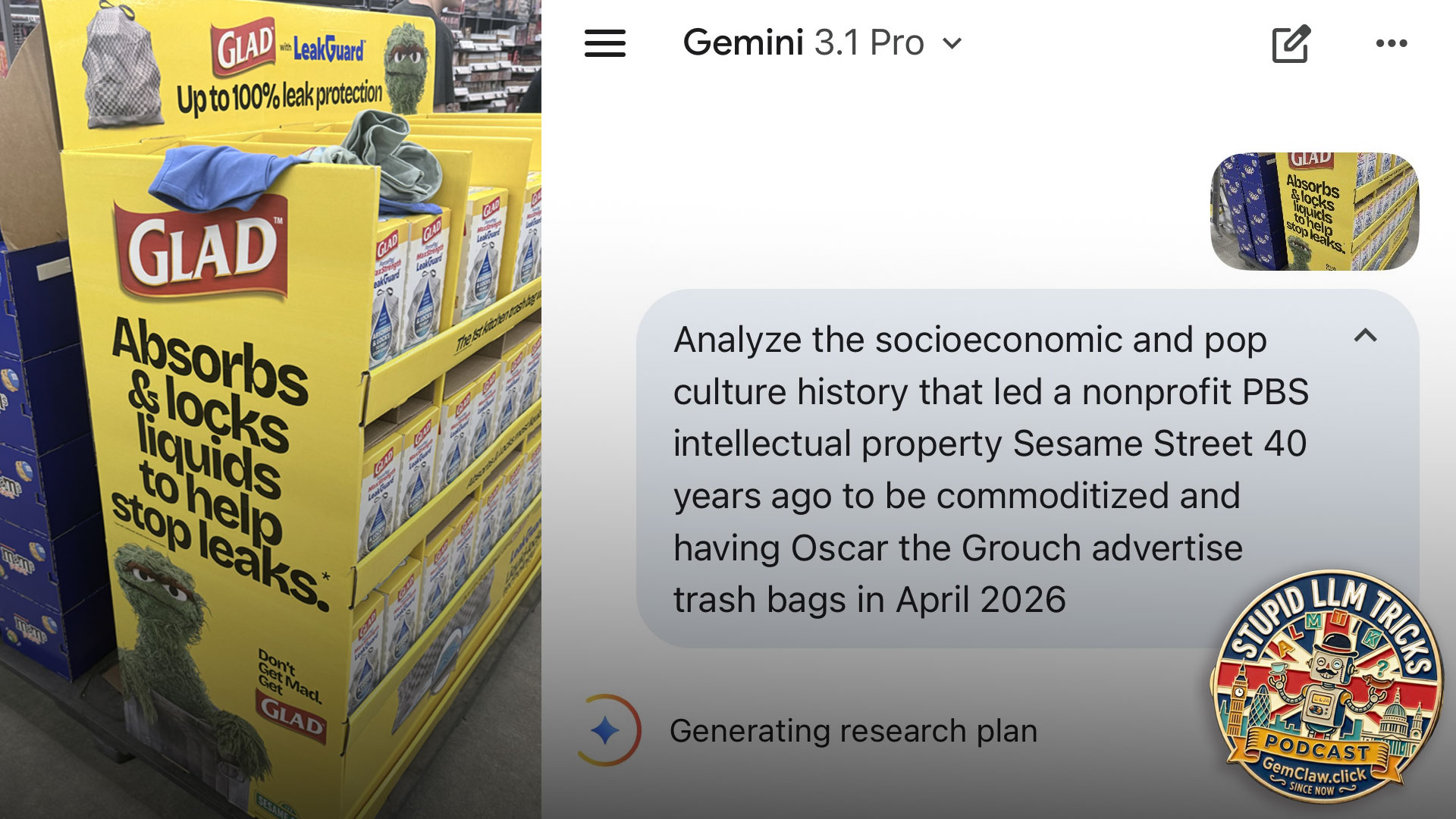
“No one feels more strongly about trash than Oscar the Grouch,” Li said, and when she said it, she was not joking, or not entirely joking, because by April 2026 Oscar the Grouch was the centerpiece of a multi-million-dollar, multi-platform, nationally-distributed Glad ForceFlex campaign, and the campaign was — by every metric Clorox tracks — working. There were yellow endcap displays the size of refrigerators in Walmarts from Bentonville to Burlington. There was a two-minute musical number, directed by the guys who directed Office Christmas Party, in which Oscar sang a remixed version of “I Love Trash” while demonstrating the odor-locking properties of a Cherry Blossom-scented garbage bag. There were TikTok totes. There were back-to-school sweepstakes. The slogan — “Don’t Get Mad. Get Glad.” — had been resurrected from 1987 and attached to a puppet who had been designed, in 1969, to teach the children of the South Bronx that it was okay to be mad.
This is not a story about a trash bag commercial. This is a story about how a country got from there to here.
The thing you have to understand about Sesame Street, if you want to understand anything else, is that it was not supposed to be a business. It was supposed to be a kind of public utility, like a library, or a water main, or the interstate highway system.
In 1966, a television producer named Joan Ganz Cooney and a Carnegie Corporation executive named Lloyd Morrisett sat down with a question that seemed, at the time, almost embarrassingly ambitious. The question was: what if you took all the manipulative, attention-grabbing, neurologically-optimized tricks that Madison Avenue used to sell cigarettes and breakfast cereal to children — the jingles, the rapid cuts, the bright colors, the repetition — and you used them instead to teach a four-year-old in a tenement in Harlem how to read? Cooney commissioned a feasibility study with a title only a foundation executive could love (“The Potential Uses of Television in Preschool Education”) and raised $8 million, half from the Ford Foundation and the Carnegie Corporation, and half from the United States Office of Education. She hired a Mississippi-born puppeteer named Jim Henson. She built a set that looked, deliberately, like a stoop in Bedford-Stuyvesant — graffiti, garbage cans, brownstones, the whole thing.
On November 10, 1969, Sesame Street premiered on National Educational Television. The premise was radical and it was also, in a very specific American way, optimistic. The premise was that the federal government, in partnership with a handful of blue-chip foundations, could build a television show so good that it would meaningfully close the achievement gap between rich kids and poor kids in this country, and that it would do so for free, forever, available to anyone with an antenna. The show was not subsidized by the market. It was, in its foundational logic, a rebuke to the market.
Henson understood this. He had spent his twenties getting rich making aggressive, faintly sociopathic coffee commercials for a regional brand called Wilkins, in which one Muppet would shoot another Muppet in the face for not drinking Wilkins Coffee. He knew exactly what television could do to a child’s brain. And when Cooney offered him the Sesame Street job, he drew a line — what people who have studied this period sometimes call the Henson Firewall. Kermit, Miss Piggy, Fozzie Bear, the Muppets from The Muppet Show— those guys could shill for Polaroid. Those guys could go on The Tonight Show and sell whatever. But the Sesame Street Muppets — Big Bird, Grover, Bert, Ernie, and a particular green monster who lived in a garbage can — were not for sale. They were employed, as Henson liked to put it, to sell the numbers one, two, and three, and the letters A, B, and C. That was it. That was the whole job.
The green monster’s name was Oscar, and to understand why his appearance in a 2026 Glad commercial is not just weird but historically weird — weird in a way that says something about the structure of American life — you have to understand what Oscar was originally for.
Oscar was invented to be an asshole. This was a deliberate pedagogical choice. The show’s child-development consultants had noticed that most children’s television in the 1960s pretended that the proper emotional register of a four-year-old was a kind of serene, beige cheerfulness, and they also noticed that actual four-year-olds are, a substantial portion of the time, furious. So they built a character who was grumpy, who was rude, who lived in a garbage can, who collected broken things, who found beauty in refuse, and who — this is the key part — was not punished for any of it. Oscar’s grouchiness was accepted by his neighbors. It was integrated into the community. The lesson, delivered to a generation of kids, was that you could be unhappy with the world and still belong to it.
He was also, not incidentally, an anti-capitalist. Oscar hated shiny things. He hated new things. He loved what the economy had discarded. In the semiotic language of 1969, Oscar the Grouch was a fuzzy, eighteen-inch critique of planned obsolescence, and the garbage can he lived in was the whole point — it was where consumer society’s cast-offs went, and he was there with them, and he was fine.
What happened next happened slowly, and then all at once, which is how these things tend to happen in America.
In 1981, Ronald Reagan took office, and the federal grants that had supported the Children’s Television Workshop — the nonprofit Cooney had built to make Sesame Street — were cut. The cuts were part of a broader project, the neoliberal project, in which a generation of policymakers concluded that the state was not, in fact, the right vehicle for delivering public goods, and that the market would do a better job. The Workshop’s leaders were handed a choice that was not really a choice. They could let the show die, or they could find the money somewhere else.
They found it in toys. By the end of 1980, 57 percent of Sesame Street’s revenue was coming from licensing — plush Big Birds, talking Elmos, Cookie Monster lunchboxes, an endless cascade of plastic objects bearing the faces of Henson’s characters. By 1996, when a Canadian toymaker called Tyco released a battery-powered Elmo doll that giggled when you squeezed it, the balance of power inside the organization shifted permanently. “Tickle Me Elmo” sold so many units that Christmas that it triggered news reports of physical altercations in toy aisles. Elmo, who had been a minor character, became the breadwinner. The show’s writers began to build episodes around him. Meanwhile Oscar — sour, marginal, hard to monetize — receded.
The Henson Firewall was not so much torn down as it was gradually forgotten. In the late 1990s, Sesame Street Muppets began appearing in toy commercials. The organization’s defense was technical: the Muppets were selling Sesame Street merchandise, which was an extension of the show, which was educational. This was true, in the way that most things a lawyer tells you are true. It was also a precedent.
Then the internet happened, and the DVD market — which had, by the 2000s, become Sesame Workshop’s single largest reliable revenue stream — collapsed. By 2014, the Workshop posted an $11 million operating loss. Production costs were rising. YouTube was chewing through the attention of every preschooler in America. The Workshop’s executives did the math and concluded that they had, at most, a few years of runway left.
In August 2015, they sold the show to HBO.
The deal was structured in a way that allowed everyone involved to pretend it was something other than what it was. HBO would fund production. HBO would get new episodes first. After a nine-month delay, the episodes would trickle down to PBS, where they had originally aired, for the kids whose parents could not afford a premium cable subscription. The show, in other words, had been privatized on a time delay. The optics were, to use the technical term, bad. A program built in 1969 to serve the poor was now serving the subscribers of a premium cable network, and the poor got the leftovers nine months later.
Around this time, people started talking about “the gentrification of Sesame Street.” The set was redesigned for the HBO era. The brownstones got a paint job. The garbage cans got tidied up. The show looked cleaner, brighter, more Brooklyn-Heights than Bed-Stuy. Oscar was still there, but he was a kind of ghost of himself, a quaint throwback to an earlier version of the neighborhood, before the coffee shops arrived.
And the corporate endorsements — the adult ones, the ones the Henson Firewall had been built to prevent — started to arrive in a steady drumbeat. In 2015, Cookie Monster made cookies with Siri in an Apple ad. In 2017, Bert and Ernie sold Chrysler Pacifica minivans. In 2021, in the middle of the pandemic, Big Bird and the gang did a Super Bowl commercial for DoorDash — a company that had, at that moment, been taking enormous public heat for the way it paid its gig-economy drivers. The DoorDash commercial was instructive. What DoorDash was buying, for whatever seven-figure check they wrote to Sesame Workshop, was not really advertising. It was absolution. It was the warm, uncomplicated goodwill of a cultural institution that had been, for half a century, above reproach.
And in 2023, in a development that now looks almost prophetic, Oscar the Grouch himself was appointed “Chief Trash Officer” of United Airlines, where he appeared in a campaign promoting the airline’s sustainable aviation fuel initiatives. It was the first time the character had been used, in a commercial context, to sell something connected to his actual fictional identity. The wall had not just fallen. The wall was being strip-mined.
And then came 2025.
In March of that year, Sesame Workshop CEO Sherrie Rollins Westin sent an internal memo announcing that the organization would be forced to “downsize significantly.” The layoffs, when they came, eliminated 20 percent of the workforce. They arrived, in a moment of timing so bad it read as deliberate, one day after a coalition of more than 200 Sesame Workshop employees — producers, early-childhood experts, fundraisers — announced their intent to unionize with the OPEIU. Westin denied that the two events were connected. The employees, reasonably, were skeptical.
Two months later, Warner Bros. Discovery announced it would not be renewing its output deal for Sesame Street on Max. The show had lost its premium streaming patron.
And a month after that, the United States Congress, at the urging of the Trump administration and a new federal entity called the Department of Government Efficiency — DOGE, a thing that existed in the world, run by Elon Musk — passed the Rescissions Act of 2025, which permanently clawed back $1.1 billion in previously-approved funding for the Corporation for Public Broadcasting. During congressional hearings, DOGE officials had singled out, by name, something called “Iraqi Sesame Street” — a USAID-funded co-production calledAhlan Simsimthat had, for the previous eight years, been teaching refugee children in the Middle East how to read — as an example of federal waste. The Rescissions Act passed the House 214-212 and the Senate 51-48. On August 1, 2025, the CPB, which had been distributing federal dollars to local PBS and NPR affiliates since 1967, announced that it would dissolve entirely by January 2026.
Federal funding accounted for only about 4 to 5 percent of Sesame Workshop’s budget. The damage was not really to the balance sheet. The damage was to the infrastructure. PBS stations across the country — the stations that carried Sesame Street for free, in rural counties, in small cities, in the places where paying $15 a month for a streaming service is not a casual decision — were now in crisis. Some of them would not survive. The public-broadcasting ecosystem that Joan Ganz Cooney had built a show to fit inside of was, fifty-six years later, being deliberately and methodically taken apart.
Westin, in internal communications, called it a “perfect storm.”
In May 2025, weeks after the layoffs, Sesame Workshop announced a new distribution deal with Netflix. Netflix would fund production. New episodes would stream on Netflix globally. And — in what was pitched as a concession to the show’s founding mission — the episodes would air simultaneously on PBS and the PBS Kids app in the United States, ending the nine-month paywall that had defined the HBO era. The deal was described by Westin as an “innovative public-private partnership.” It was described by nearly every media analyst who looked at it as a Hail Mary.
This is the state of affairs in which Ericka Santos and Pia Valencia, marketing executives at Clorox, called up Sesame Workshop and asked if they could rent Oscar the Grouch for a trash bag commercial.
The Glad campaign, when it launched in April 2026, was an undeniable piece of craft. Speck and Gordon, the directors, know what they are doing. The musical number is funny. The production design is loving. Oscar, voiced and performed by Eric Jacobson (who took over the role from Caroll Spinney in 2015), is on-brand — grouchy, textured, recognizable. The Cherry Blossom and Gain scent variants, the TikTok activation, the back-to-school sweepstakes, the Walmart endcaps with the 123 Sesame Street street sign looming over a pallet of thirteen-gallon drawstring bags — all of it hangs together.
And all of it is, on closer inspection, a kind of inversion so precise that it almost has to be accidental.
The original Oscar the Grouch was a character who rejected the premise that garbage needed to be hidden. He lived in it. He named his pet worm after it. He was the neighborhood’s living argument against the middle-class American conviction that the visible existence of waste was an aesthetic and moral failure. The 2026 Glad Oscar is a character who exists to help you hide garbage more effectively — to mask its smell, to contain its leaks, to make it invisible until the truck comes on Thursday. The original Oscar was grumpy because the world demanded cheerfulness. The Glad Oscar is grumpy as a brand asset, grumpy because grumpiness tests well with millennials who have fond memories of public television.
The original Oscar was, in his small and fuzzy way, a critique of exactly the kind of scented, single-use, plastic-consumerist culture that the Glad ForceFlex bag represents. The 2026 Oscar is its spokesman.
You can read this as betrayal, and some people have. But I think the more accurate reading is that this is what happens, over a long enough time horizon, when a country decides that it will not pay for its own public goods. The goods do not disappear. They are too valuable to disappear. They get absorbed. They are picked up by the only institutions left with the money to sustain them, which are the institutions whose logic is the opposite of the original mission. A puppet designed to validate the anger of poor children becomes a puppet designed to sell scented plastic to the parents of non-poor children. A show that was supposed to be a public utility becomes a licensing operation. A firewall that Jim Henson drew in 1969, on a yellow legal pad, at the headquarters of a federally-funded educational nonprofit, becomes a line item in a Clorox marketing deck.
Kellie Li, the Glad marketing director, described the creative strategy this way: “Our intention behind this campaign is to show that trash doesn’t have to be associated with a feeling of ick, avoidance, or grouchiness.” Read that sentence slowly. It is describing, with marketing-deck neutrality, the total ideological repurposing of a character whose entire function, across fifty-seven years of children’s television, was to be associated with grouchiness, and to argue that grouchiness was okay.
Westin, asked about the Glad deal, has called it a “playful extension” of the partnership. This is also true, in the way that most things an executive tells a reporter are true. It is a playful extension. It is also the sound of an organization that has been defunded, stripped of its distributor, struck by layoffs, and abandoned by the state, extracting whatever residual market value it can from a cultural asset that the state built and then walked away from.
Somewhere in an office at Sesame Workshop, there is presumably a spreadsheet that explains why this deal made sense. The spreadsheet is not wrong. Given the choice between the Glad deal and the slow collapse of a fifty-six-year-old institution that still, even now, teaches millions of children how to read, the Glad deal is the rational call. But the existence of the spreadsheet is the story. The fact that a character invented to teach a child in Harlem how to process rage is now an employee of a chemical company — that is not a marketing story. That is a history.
The yellow endcap is still up at the Walmart in Franklin, Massachusetts, as of this writing. Oscar is leaning out of his can, in high-resolution. The slogan above his head reads, “Don’t Get Mad. Get GLAD.”
The original Oscar would have hated it. But nobody asked him.
The Transformation Art
Same source. Two renderings.
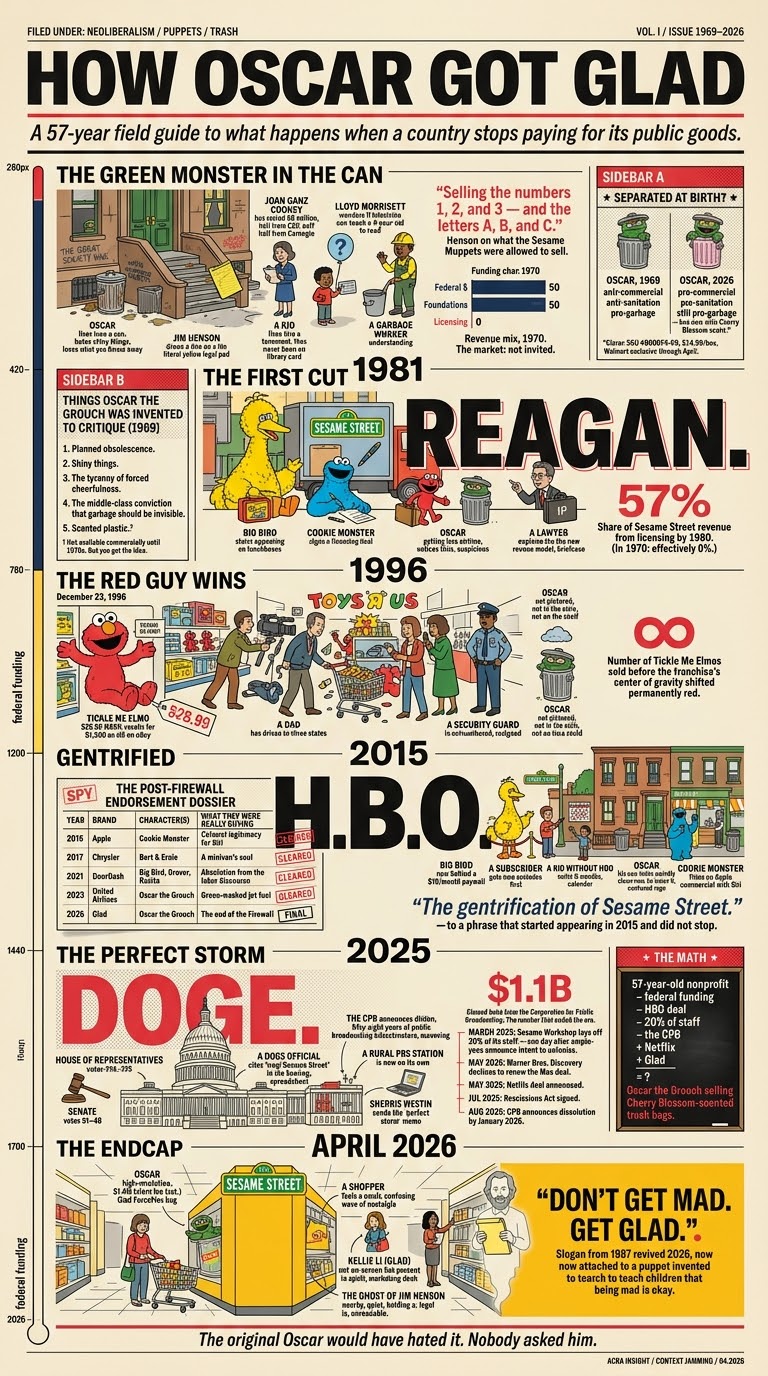
Claude HTML infographic — coming.
— ACRA Insight · Context Jamming