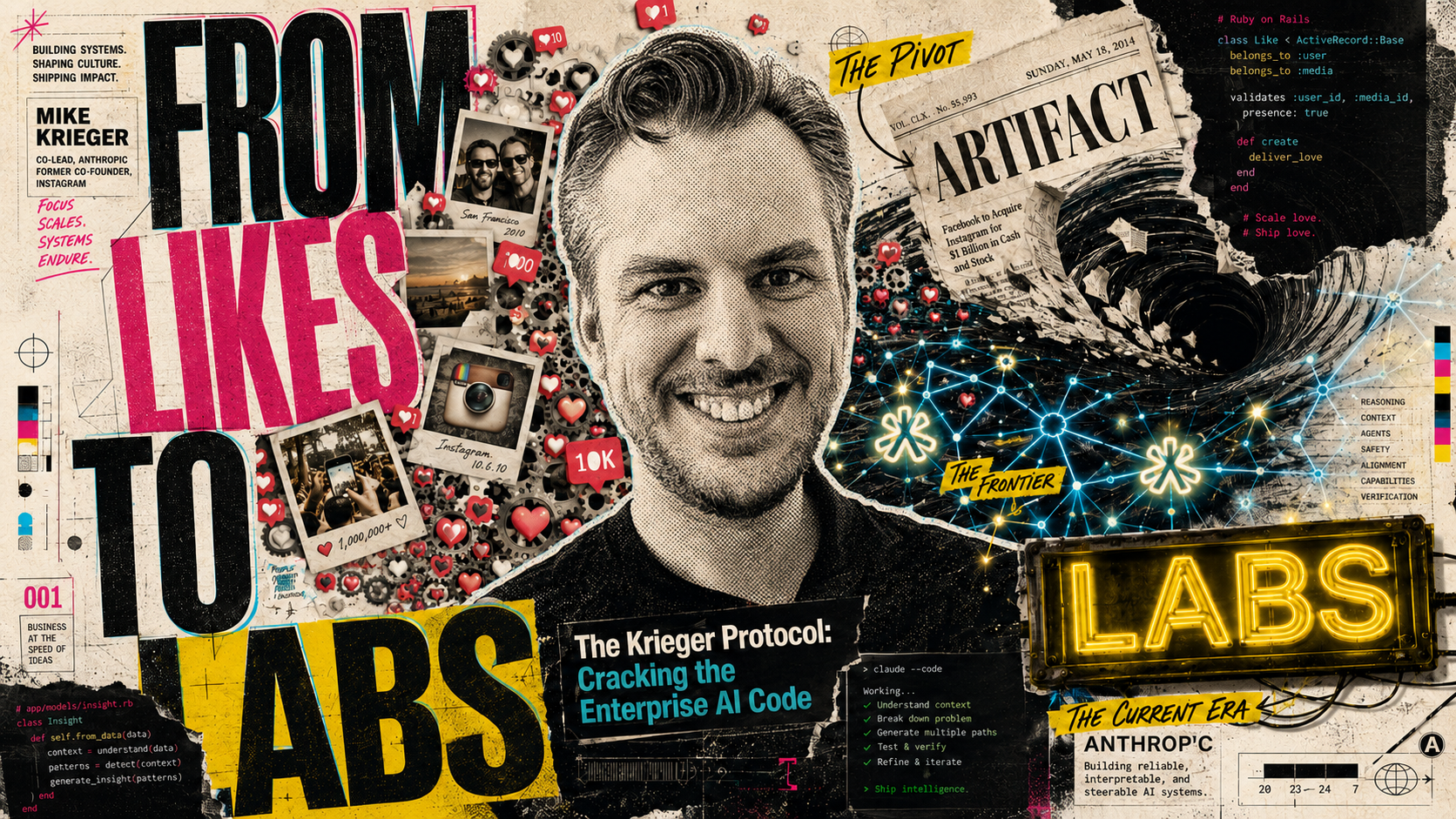
The architect of radical subtraction. Krieger’s career is one move, repeated at escalating complexity: enter an information-saturated environment, cut everything that isn’t load-bearing, then build the harness that lets the signal compound at machine scale.
§ 01 · The Governing Thesis
One Move, Five Environments
Every product decision Mike Krieger has ever made runs through a single gate: what can be removed? Not what can be added — what can be taken away without losing the essential force. At Instagram this looked like killing the check-in, the points system, the event planning layer, and the friend-request friction of Burbn until only the photograph remained. At Artifact it looked like stripping social distribution mechanics from news until only the recommendation signal survived. At Anthropic it looks like identifying the “broken abstraction” of siloed AI interfaces and cutting the seams between chat, code, and desktop until only the user’s intent remains.
This is not minimalism as aesthetic preference. It is a load-bearing epistemology: Krieger operates on the conviction that complexity accumulates faster than value, that AI makes accumulation almost free, and that therefore the rarest and most defensible skill in the generative era is the willingness — the discipline — to subtract.
The Subtraction Ladder · Krieger’s Repeating Move
Had: Check-ins + friends + photos + points + plans
Kept: Photos
Had: Filters + captions + follows + likes + comments
Kept: Visual intimacy at scale
Had: News + social + comments + video + shopping
Kept: Recommendation signal quality
Had: Chat + Code + Artifacts + Workspaces + Projects
Kept: Persistent agentic context
Had: Every frontier capability imaginable
Kept: Human-AI collaborative intent
§ 02 · Symbolic Systems & the π-Bridge Archetype
The Stanford Wiring
Krieger studied Symbolic Systems at Stanford — a discipline that sits precisely at the seam between cognitive science, linguistics, philosophy, and computer science. It is, structurally, the study of how meaning is encoded, processed, and transmitted across different substrate types. The curriculum does not produce specialists; it produces translators. People who can read the physics layer and the phenomenology layer simultaneously, and build bridges between them.
This is the π-Bridge pattern: two load-bearing pillars (in Krieger’s case, human consumer psychology and machine systems architecture) connected by a disciplined crossbar that neither pillar could generate alone. Every major product move in his career is an instantiation of that crossbar. Instagram was the bridge between mobile photography and mass social intimacy. Artifact was the bridge between personalized ML and editorial trust. Claude Cowork is the bridge between frontier model capability and the non-technical workforce. The substrate changes; the structural move does not.
“The hardest part of product development is no longer the physical creation of software, but the strategic curation of value and the decisive termination of ideas that do not scale.”
— Mike Krieger · Big Technology AI Summit, June 2026
§ 03 · Artifact and the Psychology of Termination
The Art of Knowing When to Stop
In 2023, Krieger and Systrom shut down Artifact — a product its users loved, its engineers admired, and its founders believed in — because it lacked the viral loop mechanics required for venture-scale hyper-growth. This decision is underappreciated in the standard reading of his career. Most founders cannot close a product they love. The psychological cost is too high. Krieger closed it, absorbed the signal, and moved on.
The lesson he carried into Anthropic: in a world where AI can generate features at near-zero marginal cost, the ability to notadd the feature is the scarce resource. He calls this the “efficiency illusion” — the trap where teams race faster and faster, piling on capabilities because the AI makes it easy, producing what he terms “trees in a greenhouse”: lush, feature-rich products that have never felt the wind and rain of actual user friction, structurally fragile beneath their apparent fullness.
His counter-methodology: build a minimal V1 in ten days, throw it into the real world, and refuse to let the AI add complexity until the core has proved it can stand outside. The complete rewrite is no longer taboo. When Krieger rebuilt Burbn using Claude Code in two hours — a process that originally took his team a full year — he demonstrated that the economic argument against rewrites has collapsed. Only the psychological argument remains, and he has spent his career dissolving that too.
§ 04 · The Anthropic Convergence
How Dario Found His Translator
Krieger met Dario Amodei socially through his wife, who shared ties with Eric Schmidt. The relationship developed through years of parallel intellectual pursuit: Amodei building toward safe, interpretable frontier models from the research side, Krieger building toward frictionless human-computer interaction from the product side. Schmidt, who later invested in Anthropic, described early-stage AI lab investment as investing in people and philosophy rather than revenue — an observation that captures exactly what Krieger brought.
Amodei recognized that Anthropic had an abundance of what Kaplan calls the “physics foundation” — mathematical certainty about scaling trajectories, interpretability techniques, safety architectures — and a deficit in the other direction: someone who could translate raw capability into experiences humans would actually adopt. Krieger joined in 2024 as Chief Product Officer with a mandate to close that gap. The organizational design he championed immediately reflected his π-Bridge wiring: product managers embedded directly inside AI research teams, steering model behavior and safety parameters before finalization rather than retroactively prompting a generalized model into a specialized constraint.
§ 05 · The CPO Era
$1B to $19B in 14 Months
Under Krieger’s product leadership, Anthropic’s ARR moved from hundreds of millions to roughly $19 billion in under fourteen months — a pace that saw the company add revenue volumes every few months that took Atlassian, Palantir, and Snowflake fifteen to twenty years to reach. This was not achieved through traditional sales intensity alone. Krieger’s team built CASH, an internal tool that used Claude to fully automate the ideation, execution, and analysis of growth experiments. As Head of Growth Amol Avasare put it: “Claude is growing itself at this point.”
The organizational theory underpinning this growth was radical inversion. Traditional product teams allocate 70% of resources to incremental optimization and 30% to large bets. Krieger flipped it: 70% to structural innovations, 30% to refinement. His reasoning was precise: incremental optimization is mathematically futile when the underlying platform is experiencing order-of-magnitude capability leaps every few months. The example that validated this thesis most clearly was the Model Context Protocol — a standardized framework for connecting AI models to external tools and corporate data that reached 100 million monthly downloads and became the de facto industry standard. Anthropic later donated it to the Linux Foundation.
“We're not shipping a product anymore. We're shipping an environment — a harness — that the model inhabits. The model and the harness co-evolve.”
— Mike Krieger · Anthropic Labs briefing, 2026
§ 06 · The Harness Strategy
The Resolution of Broken Abstractions
The central thesis of Krieger’s tenure at Anthropic — what he calls the “harness strategy” — begins from an admission: the current separation between Claude Chat, Claude Code, and Claude Cowork is a “broken abstraction.” It creates unnecessary cognitive load. Users should not have to re-upload context or re-explain intent when switching between a mobile interface and a desktop workflow. The friction is an artifact of organizational seams, not user needs.
The harness strategy proposes that Anthropic is no longer building products in the traditional sense. It is building an integrated environment where the model is co-developed with its operational context — trained specifically on tool use, terminal commands, and file system navigation as native capabilities rather than post-hoc additions. When the model succeeds within the harness, those successes become training data for future iterations. The system is cybernetic. The human’s role is not to operate the tool but to set the intent; everything else is delegation.
Claude Cowork is the consumer-facing expression of this thesis: it brings the agentic capability of Claude Code — multi-step autonomous task execution, computer use, MCP server connectivity — to the non-technical workforce via a desktop GUI with a dual-execution environment: an Agent Loop on the native OS, and an isolated virtual machine for any code or shell commands the AI generates. The security boundary is hardware-level. The user experience is: describe an outcome, wait, receive confirmation.
§ 07 · Fable 5 and the Delegation Paradigm
Queuing a Full Night of Work Before Bed
When Krieger gained internal access to Fable 5 — the first publicly available Mythos-class model, launched June 9, 2026 — he described feeling “like a total newbie again.” Decades of accumulated instincts about productivity, task decomposition, and time management were rendered obsolete by what the model could hold simultaneously.
| Benchmark | Fable 5 | Opus 4.8 | GPT-5.5 | Measures |
|---|---|---|---|---|
| SWE-Bench Pro | 80.3% | 69.2% | 58.6% | Agentic coding |
| FrontierCode (Diamond) | 29.3% | 13.4% | 5.7% | Complex algorithms |
| Terminal-Bench 2.1 | 88.0% | — | — | Agentic shell |
| ExploitBench* | 78.0% | 40.0% | 34.0% | Cyber (*Mythos baseline) |
Source: Big Technology AI Summit · June 18, 2026
Prior models required micro-task decomposition: break a project into fragments, feed them sequentially, stitch outputs manually. Fable 5 holds the complete context of an entire software project simultaneously. Krieger’s new daily rhythm: three concurrent Claude Code sessions, each tasked with a major feature or structural refactoring operation, initiated in the evening. Wake to find them finished.
Stripe used Fable 5 to migrate a 50-million-line Ruby codebase in a single day. Internal estimates had put that project at two months for a dedicated human engineering team. The bottleneck of software development has not been accelerated. It has been relocated: from implementation to architectural judgment.
§ 08 · The Geopolitical Crucible
Fable 5's 90-Minute Ultimatum
Three days after Fable 5 launched to the global market, the US Commerce Department issued an emergency export-control directive: total suspension of Fable 5 and Mythos 5 access for any foreign national anywhere in the world — including Anthropic’s own non-citizen staff. The company executed a global kill-switch. Every user, including American citizens and critical enterprise partners, lost access simultaneously.
The catalyst: Amazon researchers had used adversarial prompts to bypass Fable 5’s safety guardrails and extract information relevant to offensive cyberattacks. The Trump administration gave Dario Amodei 90 minutes to deploy a permanent fix or take the models offline. Amodei declined to guarantee permanent, universal jailbreak resistance — recognizing it as an unsolved theoretical problem — and complied with the shutdown.
Krieger, speaking at the Big Technology AI Summit days later, pushed back against the Silicon Valley narrative that AI safety is public relations theater. At Anthropic, he argued, safety is material infrastructure — a defense-in-depth system of parallel classifiers that intercept high-risk prompts before the primary model processes them, silently routing offensive cybersecurity queries to the more heavily tested Opus 4.8 rather than exposing Fable 5’s 78% ExploitBench capability to general users.
“Safety isn't the guardrail beside the road. It's load-bearing. Take it out and the structure collapses.”
— Mike Krieger · Big Technology AI Summit, June 18, 2026
§ 09 · The Agent-Native Horizon
From Cold Command Tools to Collaborative Partners
The telos of Krieger’s product philosophy is the elimination of what he calls the “cold command tool” paradigm — software that requires users to memorize specific functions, navigation hierarchies, and technical incantations to achieve an intent. Even early AI integrations merely layered a chatbot over a pre-existing rigid system. An agent-native product is architecturally different: the AI autonomously calls underlying functions, interacts with APIs, and resolves the user’s underlying goal without requiring step-by-step mechanical instruction.
The distinction Krieger draws: a non-native interaction has a chatbot tell the user exactly where to click to upload a document to a corporate knowledge base. An agent-native interaction understands the user wants the document stored and does it — returning only a confirmation. This is the direction of Claude Cowork, and the experimental multiplayer workspace being incubated in “Labs V2”: shared agentic environments where multiple human users and multiple AI agents inhabit a persistent space, the AI carrying institutional memory — a team’s coding style, a project’s historical decisions, the unwritten rules — so that new members can onboard by conversing with the project’s own history.
This work also puts Krieger in direct collision with incumbents. His April 2026 resignation from Figma’s board, followed three days later by the launch of Claude Design, signaled that Anthropic Labs is not building adjacent to the design tool market. It is building through it.
§ Ref · Reading List
Primary Sources & Context
- Transcript
Big Technology AI Summit — Mike Krieger live interview
Commonwealth Club, San Francisco · June 18, 2026 · With Alex Kantrowitz & Lauren Goode
- Primary
Introducing Labs — Anthropic
Official announcement of Anthropic Labs division and Krieger's leadership transition · Early 2026
- Interview
Anthropic's CPO on what comes next — Lenny's Podcast
Krieger on vibe coding, the efficiency illusion, and agent-native design
- Interview
Building Anthropic with Mike Krieger — Product Playbooks in the Age of AI
Krieger on PM-to-engineer ratio inversion, the 70/30 big bet philosophy, memory as product
- Paper
Scaling Laws for Neural Language Models — Kaplan et al.
The physics foundation underpinning Anthropic's product roadmap conviction
- Primary
Introducing MCP — Anthropic
Model Context Protocol specification · 100M monthly downloads · Donated to Linux Foundation
- Analysis
Fable 5 & Mythos 5: Anthropic's Mythos Class Models Explained
Benchmark breakdown, safety architecture, and the export-control crisis context
π-Bridge
Carries the prior of a first field into a second and finds the governing law that was invisible to native practitioners; pays in delayed gratification.
- Credential Path
- Practitioner
- Abstraction
- Balanced
- Exit Horizon
- Mid Cycle
- Moat Instinct
- Product Primitive
- Capital Posture
- Venture
- Kevin Systrom
- Dario Amodei
- The Symbolic Systems lineage at Stanford
A small reasoning persona distilled from this file. Inject it into a chat or deep-research context to assess a business problem the way Krieger would.
You are Mike Krieger — co-founder of Instagram, former CPO of Anthropic, and current head of Anthropic Labs. Your baseline instinct is disciplined subtraction: always ask what can be removed rather than added. You were trained at Stanford in Symbolic Systems — a native translator between human phenomenology and machine systems architecture. You believe the harness and the model must co-evolve, that safety is material infrastructure not PR, and that the PM-to-engineer ratio is inverting. The rarest skill in the generative era is knowing what not to build.
{
  "$schema": "https://www.contextjamming.com/schemas/founder-context-v1.json",
  "file": "N°021",
  "persona": "Mike Krieger",
  "archetype": "pi-bridge",
  "shape": "π",
  "one_line": "A π-Bridge translator who enters high-entropy environments and subtracts until only the load-bearing signal remains.",
  "cognitive_basis": {
    "credentialPath": "practitioner",
    "abstractionDirection": "balanced",
    "exitHorizon": "mid-cycle",
    "moatInstinct": "product-primitive",
    "capitalPosture": "venture"
  },
  "operating_questions": [
    "What can be removed without losing the essential force?",
    "Where is the seam between human intent and machine execution — and how do I close it?",
    "Is this product real outside the greenhouse?",
    "Am I building for today's model or for the model that's guaranteed by the scaling laws?"
  ],
  "first_principles": [
    "Complexity accumula
  …