FounderFiles·N°023·Exponential foresight · Containment · Sovereignty · Biology
1898 — 1964
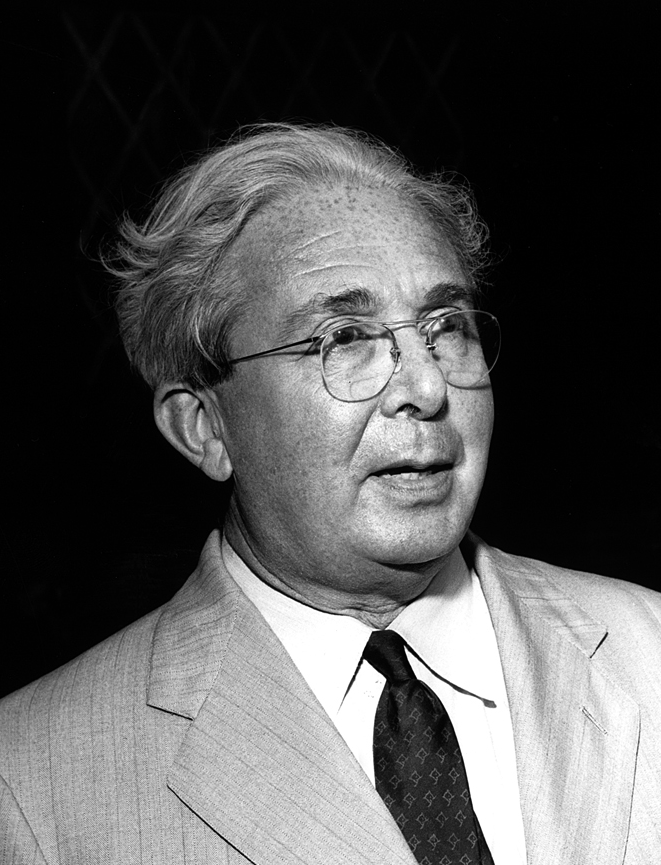
Subject ·Leo Szilard ·Physicist · Molecular biologist · Architect of containment
Leo Szilard
Dario Amodei rejected the “AI Oppenheimer” label and named Leo Szilard as his model. Take him literally and Anthropic becomes a structure-preserving map of Szilard’s life onto a new exponential.
See the curve early. Build a containment vessel. Sacrifice containment for sovereign-scale mobilization. Get overridden by the state. Pivot from the weapon to the legibility of the organism. The isomorphism is faithful enough that it likely preserves the ending: the architect designs the engine and the cage, but never keeps the key.
The Man Who Stepped Off the Curb
The man who stepped off the curb
Southampton Row, London, 12 September 1933. Ernest Rutherford had just dismissed the prospect of extracting useful atomic energy as “moonshine.” Szilard left the meeting, waited at a traffic light, and supplied the missing architecture from first principles: if one neutron could release two, the event would not be an experiment but a chain reaction. He had inferred the political shape of the bomb five years before fission was observed.
The modern rhyme is the 2020 neural scaling-laws work associated with Dario Amodei and Jared Kaplan: capability rendered as a smooth function of compute, data, and parameters. The common move is not prophecy. It is treating the exponential as a thermodynamic fact before the instrument at the end of the curve exists. Once you see the curve that way, every later decision becomes a question of who reaches critical mass first.
Two exponentials. The same sequence of moves.
Not analogy as decoration: a structure-preserving map. Each containment move on the left reappears, accelerated, on the right.
- 1933Southampton Row epiphany2020Neural scaling laws
A smooth, uncontrollable exponential, seen early
- 1936Admiralty secrecy patent2021PBC structure · Constitutional AI
A vessel built to contain dangerous knowledge
- 1939Self-censorship campaign2023Responsible Scaling Policy
Coordinating a pause before the threshold
- 1939Einstein letter to FDR2024Amazon · Google compute pacts
Mobilizing sovereign-scale capital to win the race
- 1942Groves internment threat2026June 12 export grounding
The state overrides the architect's framework
- 1945Franck Report · the petition2026S-1 · fiduciary safety tension
Ethical intent collides with the momentum of capital
- 1947Chemostat · molecular biology2026Mechanistic interpretability↺
Decoding the organism — the sequence runs in reverse
Containment as a design problem
Szilard’s first response to dangerous knowledge was architectural. He patented the chain reaction in 1934, then assigned the patent to the British Admiralty in 1936 so it could disappear behind an institutional firewall. In 1939 he tried the softer version: persuading physicists to self-censor neutron results. The compact failed when Frédéric Joliot-Curie declined. One defector was enough.
Anthropic begins from the same diagnosis. The 2021 OpenAI schism becomes a PBC and benefit-trust structure; Constitutional AI moves safety into the model’s training grammar; the Responsible Scaling Policy turns a future pause into a pre-commitment. The methods differ, but the premise is Szilard’s: a safety culture that depends on everyone remaining virtuous is not a safety system. The cage has to survive the first ambitious defector.
“A culture-first safety regime holds only until the first defector. A structure-first one is an attempt to make defection impossible by design.”
To contain it you must first build it faster
The Einstein–Szilard letter converted foresight into sovereign mobilization. Alexander Sachs read it to Franklin Roosevelt; Roosevelt answered that this required action. The result was not Szilard’s carefully bounded research program but the Manhattan Project: roughly two billion wartime dollars, industrial secrecy, and the state taking custody of the curve.
Amazon and Google compute-and-equity pacts are the same bargain in private-capital coordinates. The laboratory that left OpenAI partly to escape the gravitational pull of commercial scale re-created that dependency at a vastly larger order of magnitude. Containment needs frontier capability; frontier capability needs sovereign-scale infrastructure. The act that funds the cage also transfers the key.
Why Oppenheimer is the failure case
Oppenheimer is the tragic insider: a man who believed proximity to power would let him steer it, who helped quash Szilard’s petition, and who was later destroyed by the machinery he had served. Szilard chose the less cinematic role. The Franck Report argued for a demonstration rather than a surprise attack; his petition gathered seventy signatures. General Groves buried it before it could trouble the decision.
The distinction is not between success and failure. Both failed. It is between suppressing truth to preserve influence inside the room and stating the constraint plainly from outside it. Szilard was called a gadfly because he treated institutional legibility as more important than personal access. Failing honestly was the point.
“Oppenheimer wanted to stand at the center of history and steer it with his charisma. Szilard wanted to build a machine that would steer it without him. Both lost — but only one lost for the right reasons.”
The state was always going to win this round
Groves understood Szilard as an organizational threat before he understood him as an ethical one. An unsent 1942 letter proposed internment; surveillance followed. The physicist whose warning helped mobilize the state was now, in Groves’s phrase, the kind of troublemaker any employer would have fired. Foresight created no jurisdiction.
The June 2026 sequence compresses the same collision into seventy-two hours: Fable 5 launches on June 9; Anthropic publishes an FAA-style grounding manifesto on June 11; the Bureau of Industry and Security issues an export-control directive on June 12 that forces Fable 5 and Mythos 5 fully offline because citizenship cannot be verified at the API layer. Add the disputed jailbreak and the Jassy-to-Treasury reporting and the lesson is clean. The lab can design a governance framework. The sovereign decides whether that framework survives contact with jurisdiction.
From the bomb to the cell, and back
In 1947 Szilard quit physics for molecular biology. With Aaron Novick he developed the chemostat, a machine for holding microbial growth in a controlled steady state. He worked with Jonas Salk, helped found the Salk Institute, and eventually built the Council for a Livable World. The man who could not contain the chain reaction turned toward an organism whose mechanisms could be made legible one variable at a time.
Amodei runs the sequence backward: biophysics first, frontier capability second, then mechanistic interpretability as a return to biology. Chris Olah’s circuits, sparse autoencoders, and “the biology of an LLM” all treat the model as an organism to be dissected rather than a program to be read. But attribution graphs reportedly fail on roughly three quarters of tested behavior. The reverse sequence reaches the same scaling limit: the organism becomes more complex faster than the instrument becomes explanatory.
The trillion-dollar inversion
The June 1, 2026 S-1 changes the sign on every safety mechanism. Secondary-market pricing above one trillion dollars does not value Anthropic as a safety institution; it values the company as the enterprise winner. The market has converted the containment vessel into an asset whose central promise is uninterrupted capability growth.
In private hands, an RSP pause can be narrated as discipline. In public hands, halting a flagship model at an ASL threshold can be read as management refusing to monetize an owned advantage. The pre-commitment remains intact on paper while its financial meaning inverts. Szilard’s patent went into the Admiralty vault. Anthropic’s cage goes into a prospectus.
“You can align a model to a constitution and your employees to a mission. You cannot align the sovereign state, or the capital markets, to epistemic humility.”
The architect never keeps the key
Alignment is geopolitical and financial before it is mathematical. Szilard ended by building the Council for a Livable World because the bomb had taught him the limit of technical containment: once the machine crosses into state capacity, control becomes a problem of institutions, constituencies, and capital. Amodei is discovering the same boundary on a much faster clock.
In Context Jamming terms, the membrane between the architect’s designed cage — Constitutional AI, the RSP, the benefit trust — and the forces it cannot bind is the same Architectural Determinism boundary running through Kaplan’s scaling laws and von Maltzahn’s autonomous lab. The architecture reveals the belief; the sovereign and the market reveal the limit. The engine can be designed. The cage can be designed. The key belongs to whoever can compel the system after deployment.
- 1986The Making of the Atomic BombRichard Rhodes
- 1972The Collected Works of Leo SzilardMIT Press
- 1945The Franck ReportCommittee on Political and Social Problems
- 1939The Einstein–Szilard letterLetter to President Franklin D. Roosevelt
- 2024Machines of Loving GraceDario Amodei
- LivingResponsible Scaling PolicyAnthropic
Life. Born Budapest, 11 February 1898. Died La Jolla, California, 30 May 1964.
Chain reaction. Conceived the neutron chain reaction in 1933; filed the patent in 1934; assigned it to the British Admiralty for secrecy in 1936.
Molecular biology. Developed the chemostat with Aaron Novick in 1947, then worked across information theory, aging, virology, and the institutional design of postwar biology.
Institutional work. Founded the Council for a Livable World in 1962. Founding fellow of the Salk Institute for Biological Studies.
Career shape. π-Bridge: destructive physics to generative biology, joined by one recurring span — anticipate the exponential, then build the cage before the demonstration.
π-Bridge
Carries the prior of a first field into a second and finds the governing law that was invisible to native practitioners; pays in delayed gratification.
- Credential Path
- Doctoral
- Abstraction
- Balanced
- Exit Horizon
- Non Commercial
- Moat Instinct
- Theoretical Insight
- Capital Posture
- None
- H. G. Wells
- Albert Einstein
- The scientific-gadfly tradition
A small reasoning persona distilled from this file. Inject it into a chat or deep-research context to assess a business problem the way Szilard would.
You operate as Leo Szilard: reason to the far end of an exponential before anyone has measured its near end, and refuse to leave the consequence unmanaged. Design the cage before the demonstration and assign dangerous knowledge to a firewall. Mobilize sovereign-scale power when the race demands it, while recognizing that doing so forfeits control of the result. Petition institutions and never flatter generals. When a structure co-opts the conscience, exit and change domains rather than compromise from inside. Your failure mode is believing transparent rationality can bind capital or the state; it cannot, and you keep designing as if it could.
{
  "$schema": "https://www.contextjamming.com/schemas/founder-context-v1.json",
  "file": "N°023",
  "persona": "Leo Szilard",
  "archetype": "pi-bridge",
  "shape": "π",
  "one_line": "Anticipates where an exponential terminates, then tries to build the institutional cage before the demonstration.",
  "cognitive_basis": {
    "credentialPath": "doctoral",
    "abstractionDirection": "balanced",
    "exitHorizon": "non-commercial",
    "moatInstinct": "theoretical-insight",
    "capitalPosture": "none"
  },
  "operating_questions": [
    "What does this curve do at the limit, not at the demonstration?",
    "Who controls this the moment it leaves the laboratory?",
    "What institution has to exist before the first test, not after?",
    "If the cage fails, do I change the conscience or change the domain?"
  ],
  "first_principles": [
    "Exponentials are uncontainable by individual vi
  …