FounderFiles·N°041
HCI · fabrication · frontline operations

Co-founder & CEO, Tulip Interfaces · Co-founder & Chairman, Formlabs
Natan Linder
Linder keeps making the same architectural move: compress an expert machine into a tool ordinary people can author, alter, and use for themselves.
A robotic lamp that makes any surface computational. A desktop printer that brings industrial precision within reach. A frontline platform that lets the people closest to production encode their own work. The companies look different. The operating system is the same.
- Trained
- Computer science · product design · MIT Media Lab
- At
- Samsung · Rethink · Formlabs · Tulip
- File
- Human augmentation as systems architecture
§ 01 · Before the category
The operator was already inside the interface
Before the Media Lab, Linder had already crossed the layers most industrial software founders meet one at a time: production code at Sun Microsystems, venture formation at Jerusalem Venture Partners, and a mobile R&D organization inside Samsung Electronics. At Samsung he helped build the company’s Israeli R&D center and move locally developed mobile technology into a global product system.
The important detail is not the résumé sequence. It is the recurring position. Linder works at the seam where a general technical capability becomes usable by someone who is not its inventor. That seam is equal parts software, product grammar, organizational permission, and physical context. It later became the core design problem at both Formlabs and Tulip.
§ 02 · Fluid interfaces
A lamp that refused to stay a lamp
At the MIT Media Lab, under Pattie Maes, Linder built LuminAR: a compact projector-camera system carried by a robotic desk lamp. The familiar object became a movable computational surface. It could project information onto a table, read gesture, and reposition itself. The screen was no longer a rectangle the person had to approach. Computation entered the work area.
His doctoral work pushed the prototype toward the less glamorous question that matters more: how do projected interfaces survive contact with real environments? The dissertation studied rapid development, field deployment, and evaluation. The laboratory supplied the possibility. Deployment supplied the constraints. Linder’s systems instinct formed in the distance between the two.
“The interface should move toward the worker—not force the worker to move toward the software.”
§ 03 · Formlabs
Democratization, measured in microns
Formlabs began with an access problem. Professional stereolithography delivered extraordinary precision, but the machines could cost more than $100,000. Linder, Max Lobovsky, and David Cranor used modern components, careful calibration, and an inverted resin process to pull that capability onto a desktop. The Form 1 launched at roughly $3,300.
The category shift was not “cheap 3D printing.” It was professional fabrication without the institutional gate. Engineers and designers could move from a CAD file to a precise physical object without sending the work into a distant industrial queue. Linder became chairman as Formlabs scaled. The first durable company had made authorship physical.
§ 04 · Tulip
The factory application becomes editable
In 2014, Linder and Rony Kubat carried the same access logic onto the factory floor. Early work with New Balance exposed the mismatch: production systems changed continuously, while the software governing them arrived through multiyear implementation cycles. By deployment, the screen described yesterday’s operation.
Tulip inverted the authorship model. Manufacturing engineers could assemble applications around the real process, connect machines and sensors, observe what happened, and revise the workflow without waiting for a monolithic release. The worker did not disappear into automation. The worker became a participant in the system’s design.
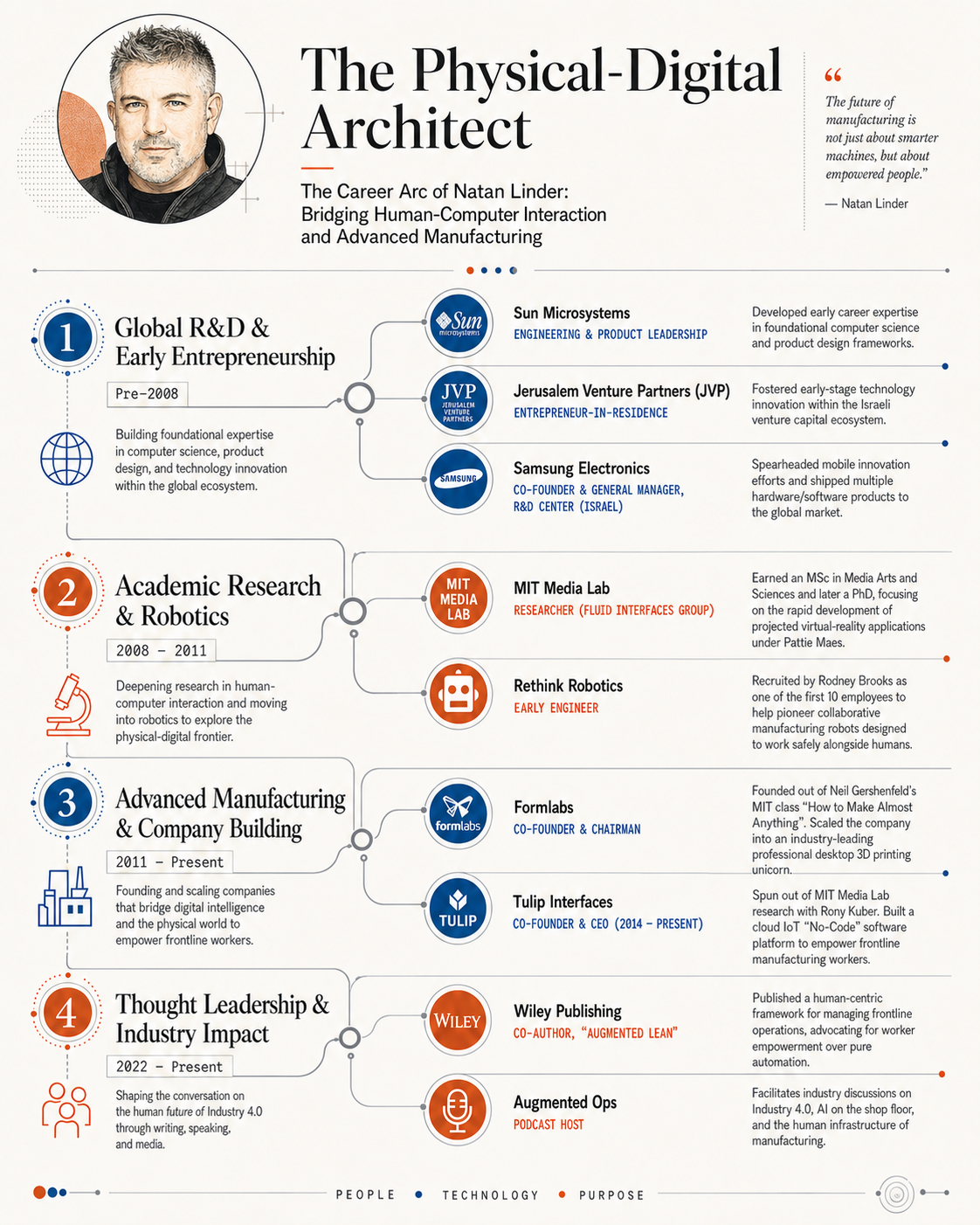
Exhibit A · Career system map
The physical-digital architect
Four epochs, one repeating move: bring digital capability into physical work, then give the person doing the work more authorship. Select the image to inspect the full-resolution infographic.
§ 05 · Composable operations
Replace the release cycle, not the ERP
Traditional manufacturing software treats stability as a reason to freeze the interface. Linder treats volatility as the design condition. A composable operation can add an inspection flow, replace a quality module, or rebuild a station application as the product mix changes—without beginning another enterprise replacement program.
This is the category architecture behind Tulip. “Composable MES” can intercept an active modernization budget. The larger idea is a Frontline Operations Platform: governed applications, data, devices, and AI that can change at the speed of the operation. Transformation stops being a project with an end date. It becomes a capacity the organization retains.
“Build for change, bet on your people, and the breakthroughs will follow.”
§ 06 · Augmented lean
The operator is not technical debt
Lean manufacturing already gave the person closest to the work a role in improving it. Digital transformation often reversed that logic: specialists configured the system elsewhere, then delivered a finished interface to the line. Augmented Lean, written with Trond Arne Undheim, argues for joining the two—software that increases the operator’s ability to see, decide, and improve.
The principle is human-centered without being anti-automation. Machines should absorb repetition and extend perception. People should retain judgment, local context, and the ability to modify the process. In this model, a frontline worker is not the last unstructured variable left over after digitization. The worker is the source of the operational model.
§ 07 · The recurring architecture
Two companies, one primitive
Formlabs and Tulip are usually filed in different markets. One sells machines, materials, and software for additive manufacturing. The other sells an application platform for frontline operations. Read through Linder, they are adjacent implementations of one primitive: convert expert infrastructure into a composable tool that moves authorship toward the edge.
The same logic now shapes his public work as host of Augmented Ops. The podcast is not a side channel. It is a distributed field-research system—operators, engineers, executives, and industrial technologists describing where the abstractions break. Linder’s deepest product is not a printer or an app builder. It is an institutional habit: make the system legible, give its users handles, and keep it open to revision.
“Manufacturing workers become knowledge workers, too.”
Timeline · systems brought within reach
Index · the file in six numbers
Reading list · primary and institutional sources
Dossier · Natan Linder
Primary affiliations. Co-founder and CEO, Tulip Interfaces. Co-founder and chairman, Formlabs. Formerly Samsung Electronics, Sun Microsystems, Jerusalem Venture Partners, Rethink Robotics, and the MIT Media Lab.
Training. Computer science and business administration; SM and PhD in Media Arts and Sciences at MIT. Doctoral advisor: Pattie Maes. Dissertation readers included Joseph Paradiso and Steven Feiner.
Operating thesis. The strongest physical-digital systems do not hide complexity behind an immovable interface. They expose governed primitives that let the people closest to the work build, revise, and improve.
Provenance note. This is an independent Context Jamming editorial profile. It is not commissioned by, affiliated with, or endorsed by Tulip Interfaces, Formlabs, MIT, or Natan Linder.
Comb Operator
Turns expert physical-digital infrastructure into composable tools that frontline builders can author and adapt themselves.
- Credential Path
- Graduate (M.S.)
- Abstraction
- Bottom-up / algorithmic
- Exit Horizon
- Deferred
- Moat Instinct
- Product Primitive
- Capital Posture
- Venture
- Reference class under editorial review.
The Career Shape summary is available. The extended downloadable persona is still under editorial review.