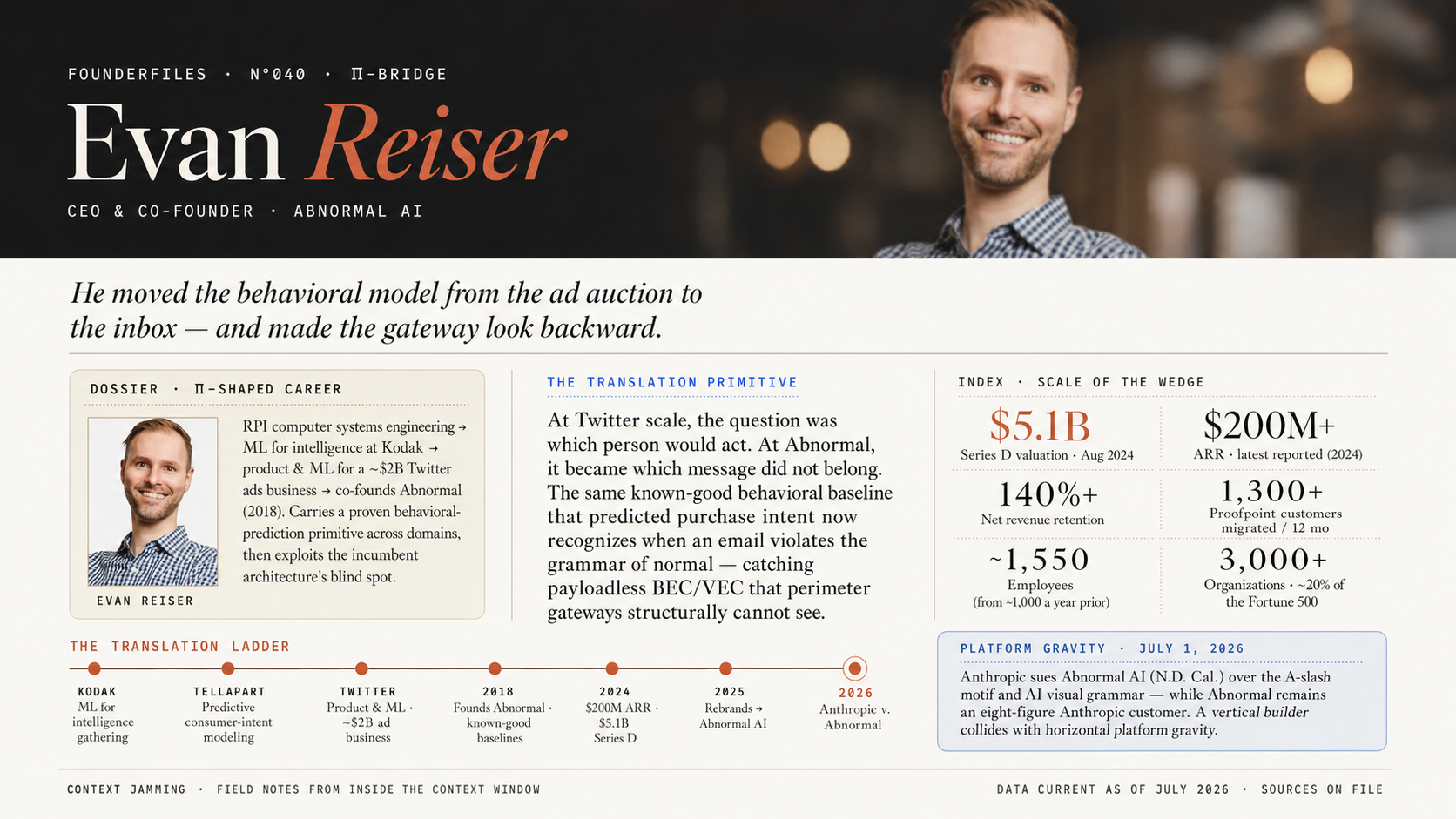
FounderFiles · N°040 · π-Bridge
Evan Reiser
He moved the behavioral model from the ad auction to the inbox — and made the gateway look backward.
Core thesis
Architectural asymmetry is a translated primitive.

Reiser's governing move is the translation of behavioral signal extraction and predictive modeling from high-volume consumer advertising into enterprise security. At Twitter scale, the question was which person would act. At Abnormal, the question became which message did not belong.
The resulting “known good” human-intent baseline became an API-native, post-delivery defensive primitive. It exposed the structural blindness of perimeter Secure Email Gateways to payloadless social engineering — attacks with no malicious attachment, no suspicious domain, and no signature to match.
§ 01 · The translation primitive
From consumer intent to enterprise intent
Reiser trained in computer systems engineering and computer science at Rensselaer Polytechnic Institute, then worked on machine learning for intelligence gathering at Eastman Kodak. After Twitter acquired TellApart in 2015, he ran product and machine learning for an advertising business operating at roughly $2 billion in annual scale.
Those systems combined clicks, dwell time, geography, purchase history, and relational context to predict commercial action. In 2018, Reiser and Sanjay Jeyakumar applied the same logic to employees, executives, and vendors: establish a granular behavioral baseline, then treat deviations in tone, location, relationship, or financial request as evidence of malicious intent.
“Instead of profiling consumers to predict purchase intent, Abnormal profiled organizations to recognize when a message violated the grammar of known-good behavior.”
§ 02 · The legacy blind spot
Why the perimeter could not see the attack
Secure Email Gateways were designed around MX routing, signature matching, sandbox detonation, and static policy. They evaluated messages as objects crossing a boundary. Business Email Compromise and Vendor Email Compromise often contain no malware, originate from legitimate infrastructure, and pass SPF and DKIM.
Abnormal entered through Microsoft 365 and Google Workspace APIs, where historical communication patterns and internal relationships were visible. The gateway's weakness was not a missing feature. It was a consequence of where the architecture stood.
§ 03 · Hypergrowth via asymmetry
The deployment layer became the growth engine
Abnormal moved from launch to more than $100 million ARR by August 2023, then crossed $200 million by mid-2024 with reported year-over-year growth of 100% and net retention above 140%. In one twelve-month period, it migrated more than 1,300 Proofpoint customers; 65% of customers ultimately dropped their third-party gateways.
The August 2024 Series D brought $250 million at a $5.1 billion valuation. The financial velocity followed the architectural one: an intelligence layer that could arrive through an API, demonstrate value quickly, and expand without asking the customer to rebuild its mail infrastructure.
Index · scale of the wedge
Data current as of July 2026 · sources on file
Scale
Efficiency
2026 status
April 2026 build-out
Abnormal appointed Stephen Harrison (VP Product, New Products), Noah Rolff (VP Customer Success), and John Slavitt (Chief Legal Officer) — a pre-IPO leadership build-out alongside a third consecutive CNBC Disruptor 50 listing.
Sources & method
- •Abnormal AI newsroom — Series D at a $5.1B valuation (Aug 2024); 2026 CNBC Disruptor 50 listing; April 2026 executive appointments.
- •CNBC Disruptor 50 — Abnormal ranked #25 (2025) and #46 (2026); three consecutive years on the list.
- •BusinessWire — funding history across six rounds totaling roughly $546M; Series D of $250M led by Wellington Management.
- •Anthropic, PBC v. Abnormal AI, Inc. — N.D. Cal., filed July 1, 2026 (trademark infringement and unfair competition).
§ 04 · The rebrand
Claiming the AI visual grammar
In April 2025, Abnormal Security became Abnormal AI again — a signal that its behavioral platform intended to extend beyond email into Slack, Teams, Zoom, Workday, and the wider digital workplace.
The identity's acute geometry and forward-slash motif traced to a 2021 engagement with brand consultancy A LINE. The rebrand made that existing system more strategically explicit just as horizontal AI companies were treating visual language as defensible platform territory.
“A vertical vendor can borrow the narrative energy of a horizontal platform — until the platform decides the visual grammar itself is part of the moat.”
§ 05 · Anthropic v. Abnormal
A customer becomes a defendant
On July 1, 2026, Anthropic sued Abnormal AI in the Northern District of California for trademark infringement and unfair competition. The complaint focused on the stylized A-slash motif, animated typing transitions, and typography it argued occupied Claude's generative-AI vernacular.
The collision was unusually revealing because Abnormal described itself as an eight-figure Anthropic customer, with Claude used across its workforce. Commercial dependency did not soften pre-IPO intellectual-property pressure. It sharpened the asymmetry between vertical application company and horizontal model provider.
§ 06 · The defense
Chronology, functionality, sophisticated buyers
Reiser's rebuttal rested first on time: the A LINE engagement began in April 2021, before Anthropic existed as a legal entity and before Claude's release. It also invoked procurement reality. Enterprise cybersecurity purchases take months and involve trained architects; confusion between a behavioral threat-detection platform and a general-purpose model API is not the same as confusion at a consumer shelf.
The deeper question is whether slash marks, cursor metaphors, and acute single-letter forms can be privately owned when they function as shared signs of computational generation. In an AI market converging on the same metaphors, trademark distinctiveness and industry grammar begin to pull against each other.
§ 07 · Implications
Vertical specialization meets horizontal gravity
The dispute is a structural consequence of market convergence. Abnormal moved outward from email security toward the digital workplace. Anthropic moved outward from a foundation model toward agents, enterprise workflows, and a total brand system. Their products remained different; their narratives and visual territory no longer did.
Whatever the resolution, the case tests the functionality doctrine for AI visual grammar, the sophisticated-buyer doctrine in enterprise software, and the new obligation for vertical AI companies to defend not only their technical architecture but the symbolic territory around it.
Timeline · the translation ladder
One primitive, carried forward: intelligence gathering, predictive intent, ad-scale ML, and finally the inbox — until the litigation reframes the whole arc.
- KodakMachine learning for intelligence gathering at enterprise scale.
- AdStack · TellApartPredictive email marketing and consumer intent modeling.
- TwitterProduct and ML leadership for a roughly $2B advertising business.
- 2018Co-founds Abnormal with Sanjay Jeyakumar and applies known-good baselines to enterprise communications.
- 2024Crosses $200M ARR and raises $250M at a $5.1B valuation.
- 2025Rebrands Abnormal Security as Abnormal AI and expands beyond email.
- 2026Anthropic litigation turns visual grammar into a platform-gravity test.
Dossier
- BS, Computer Systems Engineering and Computer Science · RPI
- Twitter Ads · product and ML leadership
- Abnormal founded in 2018 with Sanjay Jeyakumar
- API-native security for Microsoft 365 and Google Workspace
- π-Bridge archetype · a primitive carried between domains
π-Bridge
Carries the prior of a first field into a second and finds the governing law that was invisible to native practitioners; pays in delayed gratification.
- Credential Path
- Practitioner
- Abstraction
- Balanced
- Exit Horizon
- Deferred
- Moat Instinct
- Product Primitive
- Capital Posture
- Venture
- Ad-tech behavioral modelers
- API-native category builders
- Enterprise security architects
A small reasoning persona distilled from this file. Inject it into a chat or deep-research context to assess a business problem the way Reiser would.
Analyze the problem as Evan Reiser would: establish the known-good baseline, identify the incumbent architecture's blind spot, and import a proven predictive primitive through the lowest-friction integration layer.
{
  "$schema": "https://www.contextjamming.com/schemas/founder-context-v1.json",
  "file": "N°040",
  "persona": "Evan Reiser",
  "archetype": "pi-bridge",
  "shape": "π",
  "one_line": "Translate a proven behavioral-modeling primitive across domains, then exploit the incumbent architecture's blind spot.",
  "cognitive_basis": {
    "credentialPath": "practitioner",
    "abstractionDirection": "balanced",
    "exitHorizon": "deferred",
    "moatInstinct": "product-primitive",
    "capitalPosture": "venture"
  },
  "operating_questions": [
    "What is the known-good distribution of behavior?",
    "Which deviation reveals intent rather than suspicious content?",
    "Can the intelligence layer deploy without replacing infrastructure?",
    "Where will vertical specialization collide with platform gravity?"
  ],
  "first_principles": [
    "Relational context catches attacks signatures ca
…Companion POC
This file was built inside the Abnormal content-activation prototype.