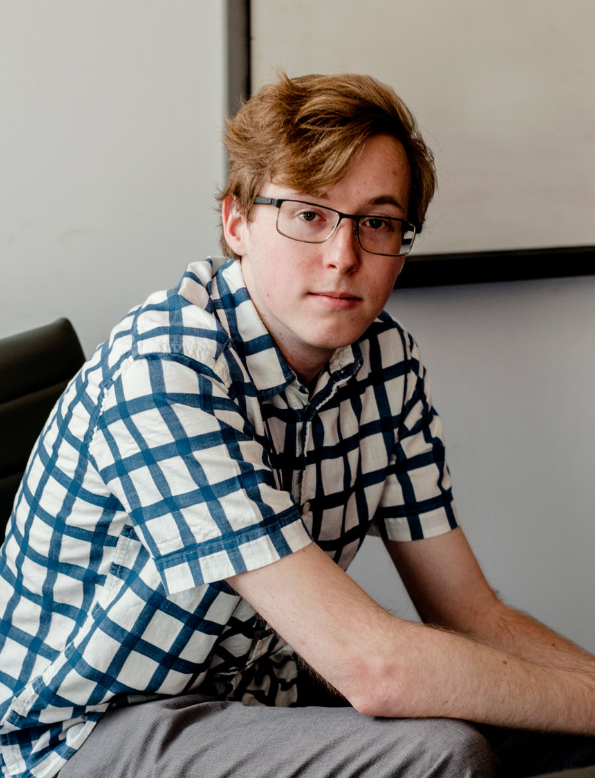
AI researcher · Generative pre-training · Transfer across modalities
Alec Radford
The low-profile researcher whose experiments helped turn unsupervised prediction into the operating system of foundation models.
From DCGAN and the sentiment neuron through GPT-1, GPT-2, CLIP, Image GPT, DALL·E, and Whisper, Radford repeatedly tested whether abundant natural supervision and a scalable objective could replace task-specific engineering.
- Documented span
- DCGAN · 2015/16 → Talkie · 2026
- Public record
- Papers, model reports, contribution ledgers
- Founder shape
- N°042 · I-Beam
Who is Alec Radford?
Alec Radford is an AI researcher associated with OpenAI work including GPT-1, GPT-2, CLIP, and Whisper. He was first-listed on the 2018 generative pre-training report and made lead or major contributions to systems spanning vision, language, multimodal learning, and speech. Those papers document consequential authorship; they do not turn team-built systems into a one-person invention story.
Train broad. Adapt lightly.
Learn from abundant naturally occurring data first. Reuse the resulting representation across tasks. Over time, move adaptation from a supervised weight update toward language itself.
Transformer ≠ GPT ≠ ChatGPT
The Transformer architecture preceded GPT. ChatGPT later added instruction tuning, human-feedback methods, safety work, and product systems built by much larger teams.
One research question, repeatedly re-instantiated
Context Jamming analytical synthesis
“The Generalization Program” is an editorial name, not a phrase Radford is known to have used. It describes a pattern visible across the papers: replace scarce task labels with a much larger naturally occurring signal; choose an objective that can absorb that signal at scale; learn a representation broad enough to travel; then make the downstream adapter thinner.
DCGAN asked whether generation could produce useful visual features. The sentiment-neuron experiment asked whether next-character prediction could discover a concept nobody labeled. GPT-1 pre-trained once and fine-tuned many times. GPT-2 tested tasks without a downstream gradient update. GPT-3 put demonstrations into the context window while leaving the weights frozen. Image GPT turned pixels into a sequence. CLIP changed the loss and used language as a flexible classification interface. Whisper accepted noisy web transcripts in exchange for breadth.
The continuity is methodological—not mathematical identity. CLIP is contrastive, not generative. Whisper is an encoder-decoder multitask system, not a decoder-only language model. DALL·E belongs to a team-led multimodal program. Later frontier models have contribution ledgers the size of institutions. A rigorous through-line has to preserve those breaks.
Read the sequence along three separate axes. The first is the source of supervision: curated task labels give way to books, web pages, image captions, and audio transcripts produced for reasons other than training a benchmark. The second is the learned object: visual features, a language model, aligned image-text embeddings, or an encoder-decoder speech system. The third is the adaptation interface: a linear probe, supervised fine-tuning, a completion format, demonstrations in a prompt, natural-language class names, or task tokens. Collapsing those axes into the word “scale” hides the experiments. Keeping them separate reveals what each paper actually changed.
This framing also prevents a common historical error. Later success does not retroactively prove that every earlier design was inevitable. DCGAN’s convolutional constraints, GPT-1’s fine-tuning, GPT-2’s completion framing, and CLIP’s contrastive pairs were competing empirical bets made under different compute, data, and evaluation regimes. The program looks coherent in retrospect because the same transfer question kept returning—not because a complete foundation-model roadmap existed in 2015.
The Generalization Program
Different modalities, recurring transfer logic
- DCGAN · 2015/16Adversarial generation; Unlabeled images; Transferred visual features.
- Sentiment · 2017Next-character prediction; Amazon reviews; Linear sentiment classifier.
- GPT-1 · 2018Next-token prediction; BooksCorpus; Supervised fine-tuning.
- GPT-2 · 2019Next-token prediction; WebText; Zero-shot task framing.
- GPT-3 · 2020Next-token prediction; 300B training tokens; Few-shot in-context learning.
- Image GPT · 2020Autoregressive prediction; Image data; Linear probe / fine-tuning.
- CLIP · 2021Contrastive alignment; 400M web image-text pairs; Zero-shot classification.
- DALL·E · 2021Autoregressive generation; Text-image pairs; Zero-shot synthesis.
- Whisper · 2022Sequence-to-sequence prediction; 680k hours of web audio; Zero-shot transfer.
The web becomes the labeler
Supervision source × modality × adaptation interface
| Modality | Curated labels | Unlabeled data | Weak natural supervision | Task interface |
|---|---|---|---|---|
| Vision | Downstream probes | DCGAN · Image GPT | CLIP image-text pairs | Linear probe · text labels |
| Text | GPT-1 task labels | Sentiment Neuron · GPT-1 | GPT-2/3 web corpora | Fine-tune → prompt |
| Image + text | Benchmark evaluation | — | CLIP · DALL·E web pairs | Text description |
| Audio + text | Evaluation sets | — | Whisper web transcripts | Task tokens · zero-shot |
The strongest counterargument
These projects use different architectures, losses, datasets, evaluation methods, and team structures. The “program” is useful only if it predicts what changes next—and honest only if it records where the objective stops being the same.
What Alec Radford contributed to DCGAN
GANs were not Radford’s invention. Ian Goodfellow and collaborators introduced adversarial training in 2014. The DCGAN paper by Radford, Luke Metz, and Soumith Chintala attacked the next problem: making convolutional adversarial networks stable enough to study and useful enough to transfer.
The authors imposed architectural constraints—strided convolutions instead of spatial pooling, batch normalization, a restricted use of fully connected layers, and carefully chosen activations. They then inspected what the generator and discriminator had learned. The paper reports feature hierarchies from object parts to scenes, vector arithmetic in representation space, and discriminator features that could support downstream classification.
That distinction matters. Sample generation made the paper visible. Transfer made it part of the Generalization Program. The adversarial game forced a model to absorb reusable structure without class labels, and the learned representation survived contact with another task.
The paper’s evaluation strategy is worth recovering. It did not ask only whether generated bedrooms looked plausible. The authors trained a discriminator on LSUN, reused intermediate features on CIFAR-10 with a linear classifier, visualized filters, and tested whether arithmetic directions in latent space corresponded to attributes. Those probes turned a generator paper into a representation-learning paper. They also established a recurring standard for this file: a broad objective earns the word “generalization” only when its internal representation becomes useful outside the exact loss that created it.
In April 2026, ICLR named DCGAN one of two Test of Time winners from ICLR 2016. The conference credited the paper as an early successful demonstration of diverse, realistic image synthesis and a key step in establishing modern image generation. The award belongs to all three authors.
Do not confuse
DCGAN did not invent adversarial training. It established influential architectural practices for deep convolutional GANs and showed that the learned features could transfer.
The neuron no one explicitly trained
The missing bridge between DCGAN and GPT-1 is a character-level language model trained on Amazon reviews. Radford, Rafał Józefowicz, and Ilya Sutskever trained a multiplicative LSTM to predict the next byte in review text. Sentiment labels were not part of that objective. The model was asked to continue sequences.
Inside the network, one unit became unusually sensitive to positive and negative sentiment. Freezing the language model and fitting a linear classifier over its representation produced strong sentiment results, including 91.8 percent on the binary Stanford Sentiment Treebank evaluation reported by OpenAI. Changing the value of that unit also changed the sentiment of generated reviews. Prediction had produced a controllable feature.
The result was striking but bounded. The official research page says the model degraded as inputs moved away from review data and struggled with long documents. One interpretable unit did not prove that language models had acquired a complete semantic world model. It demonstrated a narrower and more consequential possibility: a broad predictive task can make a downstream concept linearly available even when the concept was never named during training.
That is the conceptual bridge. DCGAN found reusable visual features through generation. The sentiment model found a reusable linguistic feature through prediction. GPT-1 would turn the observation into a general transfer recipe.
There is also a distinction between discovery and localization. The next-byte objective created a representation useful for sentiment; the surprising part was that so much of the signal concentrated in one unit. Most modern interpretability results do not license an expectation that every human concept occupies one clean neuron. The paper itself explored more distributed representations as well. Its durable lesson is not “concepts live in single cells.” It is that a model optimizing prediction can organize a task-relevant variable before a human supplies the task label.
What Alec Radford contributed to GPT-1
Improving Language Understanding by Generative Pre-Training lists Alec Radford, Karthik Narasimhan, Tim Salimans, and Ilya Sutskever—in that order. The paper is the public basis for calling Radford the lead author. It is not a license to assign every private design decision to him alone.
The system used a 12-layer decoder-only Transformer. First came generative language-model pre-training on BooksCorpus: predict the next token across long, contiguous passages. Then came discriminative fine-tuning on each labeled downstream dataset. Task-aware input transformations serialized different structures—premise and hypothesis, question and passage, multiple-choice candidates—into token sequences the same backbone could consume with minimal architectural change.
GPT-1 therefore did not eliminate supervised learning. It moved the expensive representation-learning phase into one reusable model, then used labeled data to specialize the weights. The authors reported new state of the art on nine of twelve evaluated datasets. The three non-wins matter: RTE, SST-2, and MRPC. RTE exposed a large shortfall; SST-2 and MRPC trailed the best reported systems. “Nine of twelve” is an empirical result, not a universal-law slogan.
Historically, the paper’s move was architectural compression. A field full of bespoke NLU systems became one backbone plus lightweight transformations and task-specific fine-tuning. The Transformer itself came from Vaswani and collaborators. Earlier language-model pre-training existed. GPT-1’s contribution was a clean, scalable demonstration that generative pre-training plus discriminative fine-tuning could travel across a broad NLU suite.
The joint objective during fine-tuning is another useful detail. The authors retained the language-model loss alongside the supervised task objective, weighted by a small coefficient. In the reported experiments, this auxiliary term improved generalization and accelerated convergence on larger datasets. That design makes the transition less like throwing away pre-training and more like specializing a model while continuing to remind it of the distribution that created its representation.
GPT-1’s famous “minimal changes” should therefore be read precisely. The backbone stayed substantially shared, but the input representation changed by task and the weights were optimized again on labeled examples. Entailment concatenated premise and hypothesis with delimiter tokens. Similarity tasks considered both orderings. Multiple-choice tasks paired each answer with the context before scoring. This was not yet the prompt interface people now associate with GPT. It was a disciplined way to express heterogeneous supervised problems as sequences.
How GPT-2 reduced downstream training
GPT-2 kept the autoregressive objective and made the pre-training distribution larger and more varied. Its 1.5-billion-parameter model trained on WebText, a corpus assembled from links that received human attention on Reddit. Instead of fine-tuning a separate model for each headline task, the report evaluated translation, summarization, question answering, and reading comprehension by framing tasks as text completion.
The results were uneven. GPT-2 set strong language-modeling results and showed rudimentary zero-shot transfer, but its task performance depended on formatting and often remained far behind supervised systems. The paper’s importance is not that it solved downstream adaptation. It changed what counted as a meaningful test: could one frozen language model infer a task from the text it was given, without a new training run?
WebText was also an intervention in data selection, not simply “the internet.” The team followed outbound links from Reddit posts that had received at least three karma, then deduplicated and filtered the resulting pages. The heuristic used human attention as a weak quality signal while excluding Wikipedia to reduce overlap with common benchmarks. It produced a broader distribution than the book corpus used for GPT-1, but it also imported the judgments and biases of the platform and the filtering pipeline. Web-scale does not mean neutral, exhaustive, or naturally representative.
The paper became a release-policy experiment
OpenAI initially released a smaller model and withheld the largest weights while studying misuse. It later released 355M, 774M, and finally 1.5B checkpoints through a staged process, publishing follow-up reports on partnership-based sharing and publication norms.
It is fair to say the episode supplied vocabulary and a public case study for model-release governance. It is not support for the stronger claim that GPT-2 directly caused every later closed-model policy. The documented fact is the staged release. The institutional lineage is analysis.
The sequence of releases mattered because it joined capability evaluation to publication practice. The organization used the intervals to solicit external research, compare synthetic-text detectors, and study how partners handled access. Critics could reasonably disagree with the original withholding decision; the point here is narrower. A model paper had become inseparable from a question about who receives weights, on what timetable, with which evidence. That governance layer would grow far beyond the six-author report.
GPT-3 moved adaptation into context
GPT-3 enlarged the model to 175 billion parameters and evaluated zero-, one-, and few-shot task performance without downstream gradient updates. A prompt could contain an instruction, demonstrations, and a final query. The model adapted its next-token predictions inside the forward pass while the parameters remained fixed.
That was a historical step beyond GPT-1’s supervised fine-tuning and GPT-2’s zero-shot completion format. It was not a clean victory on every benchmark. The paper documents strong results on some language, knowledge, and arithmetic tasks alongside stubborn failures in natural-language inference, word-in-context classification, and contamination-sensitive evaluation.
“Few-shot learning” in this paper names behavior at inference time, not a new training algorithm applied to each task. The demonstrations occupy context tokens. They change the conditional distribution for the next output, but they do not produce a gradient update or a new checkpoint. That distinction is why GPT-3 belongs beside GPT-1 in the adaptation ladder: the shared family name can obscure a major shift in where learning-like behavior occurs.
Scale bought breadth, but the paper also documented costs. The largest model required immense training compute, inherited biases from internet text, and could generate fluent falsehoods. Some test examples probably appeared in or resembled training data, so the authors developed contamination analyses rather than treating every benchmark score as clean transfer. The paper’s own limitations section is evidence against the mythology that 175 billion parameters converted prompting into universal competence.
Radford appears twenty-ninth on the contribution-ordered author list. That supports participation in the GPT-3 program, not sole leadership. Tom Brown is first-listed; Benjamin Mann, Nick Ryder, Melanie Subbiah, and Jared Kaplan follow. By this point the GPT line was already an institutional build.
From fine-tuning to in-context learning
Downstream adaptation moves out of the weights and into the input
- GPT-1 · 2018PRE-TRAIN → LABELED TASK DATA → GRADIENT UPDATES → FINE-TUNED MODEL. Weights: UPDATED.
- GPT-2 · 2019PRE-TRAIN → TASK FRAMING IN TEXT → ZERO-SHOT COMPLETION → ONE MODEL. Weights: FROZEN AT EVALUATION.
- GPT-3 · 2020PRE-TRAIN → INSTRUCTION + K EXAMPLES → NEXT-TOKEN PREDICTION → IN-CONTEXT ADAPTATION. Weights: FROZEN.
Do not confuse
GPT-1 fine-tuning, GPT-2 zero-shot evaluation, and GPT-3 in-context learning are related stages—not interchangeable names for prompting.
How one backbone replaced task-specific NLP architectures.
GPT-1 · 2018 · Fine-tuningRead the paper as an interactive systemIn-Context Learning at ScaleHow frozen weights learned from demonstrations.
GPT-3 · 2020 · Few-shotSparse attention attacked the sequence bottleneck
Scaling was never just “add parameters.” Dense self-attention requires time and memory that grow quadratically with sequence length. Rewon Child, Scott Gray, Alec Radford, and Ilya Sutskever introduced sparse factorizations that reduced the attention cost to roughly O(n√n), together with initialization, recomputation, and kernel work for training deep models.
The same architecture modeled images, text, and raw audio. OpenAI’s research page reported sequences thirty times longer than prior practice; the paper described experiments with tens of thousands of timesteps and the possibility, in principle, of far longer sequences. GPT-3 later used alternating dense and locally banded sparse attention.
Sparsity was not one universal mask. The paper described factored patterns suited to different data layouts: a strided pattern that attends across fixed offsets and a fixed pattern that combines local blocks with selected summary positions. The engineering contribution included fused sparse-attention kernels and activation recomputation, because asymptotic savings do not become usable training runs by notation alone. The result is a reminder that the “architecture” of generalization includes memory traffic and kernels as well as the diagram in the paper.
The historical point is modest and important: the Generalization Program depended on systems and architecture research that made larger contexts trainable. It does not follow that a 2019 sparse pattern describes the hidden architecture of every current frontier model.
Image GPT tested how far sequence modeling could travel
Image GPT deliberately removed much of the conventional two-dimensional inductive bias. Mark Chen, Alec Radford, Rewon Child, Jeffrey Wu, Heewoo Jun, David Luan, and Ilya Sutskever unrolled low-resolution images into sequences of color tokens and trained GPT-2-style Transformers autoregressively—or, in a separate variant, with masked prediction.
The experiment separated two questions that are often collapsed. Could the model generate coherent images? Could its internal representation support classification? The authors measured both linear-probe performance and fine-tuning. Their strongest generative model produced unsupervised features competitive with prominent convolutional baselines in the reported setting, while also showing a correlation between sample quality and classification accuracy.
The cost was severe. Dense attention over pixel sequences forced training at 32×32, 48×48, and 64×64 resolutions, with a compressed nine-bit color palette. Image GPT therefore tested a boundary; it did not establish next-token prediction as a universally efficient vision objective.
That negative space is scientifically useful. A deliberately generic sequence model could learn recognizable visual structure, but it spent computation modeling every discrete pixel token and lacked the translation-oriented biases of convolutional systems. CLIP would answer the transfer question differently: retain the scale and language interface, abandon pixel generation, and learn from paired views of the same web object. Image GPT is thus both an extension of the text recipe and evidence for why the recipe needed to change.
Why CLIP is both continuation and break
CLIP preserves the Generalization Program’s appetite for abundant web supervision. It trained image and text encoders on 400 million image-text pairs and learned to identify which texts belonged with which images. Natural language became a flexible output space: describe candidate classes in words, compare their embeddings with an image, and obtain a zero-shot classifier.
The official paper marks Alec Radford and Jong Wook Kim as equal contributors. The twelve-author team evaluated transfer across more than thirty datasets and documented both striking breadth and substantial limits. Prompt wording could matter. Some specialized, abstract, or fine-grained tasks remained difficult. The web distribution carried social biases into the model.
What continues? Broad pre-training, natural supervision, a reusable representation, language as the task interface, and zero-shot evaluation. What breaks? CLIP is not autoregressive. It uses two encoders and a contrastive objective, not a single stream predicting the next token. The loss does not reconstruct an image or a caption.
At training time, a batch supplies many candidate image-text pairings. The encoders produce embeddings, and the objective raises similarity for the matched pairs while lowering it for the mismatches. At evaluation time, class names become small natural-language prompts—often ensembled across templates— and the image embedding is compared with those text embeddings. No labeled examples from the target dataset need update the model. The adapter is now language plus similarity.
The paper’s breadth should not erase its boundary conditions. Zero-shot CLIP was competitive with a supervised ResNet-50 on many tested distributions, but performance varied sharply across tasks and prompt choices. It struggled with counting, fine-grained distinctions, and some kinds of abstraction. Dataset construction from the public web also created privacy, bias, and surveillance concerns. General-purpose transfer expanded; dependable task understanding did not arrive all at once.
Where the continuity breaks
The Generalization Program survives CLIP as a methodology of transfer from abundant natural supervision. The generative objective does not. Calling every project “the same beam” would erase the most informative change.
DALL·E extended the tokenization culture
DALL·E used a 12-billion-parameter autoregressive Transformer to model text and image tokens together. The paper’s first-listed author is Aditya Ramesh; Mikhail Pavlov, Gabriel Goh, Scott Gray, Chelsea Voss, Alec Radford, Mark Chen, and Ilya Sutskever complete the author line. Radford’s documented relationship is coauthorship inside a compact but unmistakably team-built project.
The conceptual continuity is real. Text and images became one serialized modeling problem, trained at scale on paired data. Natural language specified the task; the model synthesized without per-concept fine-tuning. But the public record does not support transferring first-author ownership from Ramesh to Radford, or turning a surrounding research culture into a sole-inventor claim.
DALL·E belongs in this file because it shows the pre-training program becoming multimodal and generative. It also marks the point where attribution discipline becomes part of the technical story.
Radford’s role in Whisper
Whisper’s paper marks Alec Radford and Jong Wook Kim as equal contributors, followed by Tao Xu, Greg Brockman, Christine McLeavey, and Ilya Sutskever. The team trained encoder-decoder Transformers on 680,000 hours of multilingual, multitask audio paired with transcripts collected from the web.
The dataset’s diversity was the intervention. Rather than optimize narrowly for a clean supervised benchmark, Whisper accepted imperfect transcripts, varied recording conditions, many domains, and multiple languages. Special tokens specified transcription, translation, timestamps, language identity, and whether speech was present. The result emphasized zero-shot robustness across evaluation sets rather than one leaderboard peak.
The paper is explicit about limits. Performance remained poor for many low-resource languages. Larger models reduced perceptual confusions but did not remove long-form failure modes: repetition loops, missed segment boundaries, and complete hallucinations unrelated to the audio. The authors proposed better data and optimization as possible remedies.
The comparison target was also intentionally broad. Rather than fine-tune Whisper separately on each evaluation corpus, the authors used the same models and decoding setup across diverse speech-recognition and translation datasets. That sacrifices the clean story of winning every in-distribution leaderboard in exchange for measuring robustness under distribution shift. The paper argues that conventional supervised systems can look strong because training and test conditions match; weakly supervised breadth becomes valuable when accents, background noise, recording hardware, domain, or language changes.
Whisper therefore sharpens the thesis without turning it into a miracle story. Weak supervision at large scale can buy robustness that narrow curation misses. Diversity is not the same thing as cleanliness, and scale is not the same thing as reliability.
When the author line became an institution
Early Radford papers have compact author groups. Later frontier systems do not. GPT-3 lists thirty-one authors in contribution order. GPT-4 publishes a category-level contribution record spanning pre-training, data, optimization, vision, safety, deployment, legal work, and operations. GPT-4o’s credit page is larger still.
That change is not administrative debris. It is part of the history of foundation models. Data pipelines, distributed systems, kernels, evaluation, post-training, product surfaces, and safety systems became inseparable from model research. First-author placement can support lead authorship on a compact paper. Alphabetical lists and institutional acknowledgments cannot resolve private conceptual ownership.
| Project | Documented Radford role | Team context | Attribution confidence |
|---|---|---|---|
| DCGAN | First-listed author | Three authors | Paper authorship documented; private division unresolved |
| GPT-1 | First-listed author | Four authors | Lead authorship documented; individual task ownership unresolved |
| GPT-2 | Co-first author | Six named authors; contribution-ordered | Paper explicitly marks equal contribution tiers |
| GPT-3 | Named author | Thirty-one authors; contribution-ordered | Team-level contribution; individual division unresolved |
| CLIP | Co-first author | Twelve authors | Paper marks Radford and Jong Wook Kim as equal contributors |
| DALL·E | Named author | Eight authors | Team-level contribution; Aditya Ramesh is first-listed |
| Whisper | Co-first author | Six authors | Paper marks Radford and Jong Wook Kim as equal contributors |
| GPT-4 | Data; vision architecture research | Institutional contribution record | Explicit categories; no broader ownership inferred |
GPT-4’s official ledger places Radford in the pre-training data group and in vision architecture research. That is unusually specific public evidence. It does not authorize broader claims about sole architecture ownership, RLHF, or ChatGPT. Where the record is silent, the correct label is: team-level contribution—individual division unresolved.
The recurring teams around the program
Coauthorship is observable; private relationships are not. The useful network is therefore a map of shared projects, not a theory of friendship or influence. Ilya Sutskever recurs across nearly the entire early sequence. Luke Metz and Soumith Chintala define the compact DCGAN team. Karthik Narasimhan and Tim Salimans complete GPT-1. Jeffrey Wu, Rewon Child, and David Luan recur through GPT-2 and adjacent scaling work. Jong Wook Kim shares equal-contribution markings on CLIP and Whisper.
| Collaborator | Documented shared projects |
|---|---|
| Ilya Sutskever | Sentiment Neuron · GPT-1 · GPT-2 · Sparse Transformer · GPT-3 · Image GPT · CLIP · DALL·E · Whisper |
| Luke Metz | DCGAN |
| Soumith Chintala | DCGAN |
| Karthik Narasimhan | GPT-1 |
| Tim Salimans | GPT-1 |
| Jeffrey Wu | GPT-2 · GPT-3 · Image GPT |
| Rewon Child | GPT-2 · Sparse Transformer · GPT-3 · Image GPT |
| David Luan | GPT-2 · Image GPT |
| Jong Wook Kim | CLIP · Whisper · later OpenAI multimodal work |
| Aditya Ramesh | GPT-3 · CLIP · DALL·E · GPT-4 vision architecture research |
| Greg Brockman | Whisper · institutional and infrastructure collaboration |
Jared Kaplan enters the public record through scaling laws and GPT-3 rather than the compact GPT-1 group. Read beside Radford, Kaplan supplies the measurement layer: empirical laws for compute, data, and parameters around a research program that kept asking what scale would make transferable.
What the public record says after OpenAI
Contemporaneous reporting in December 2024 said Radford told colleagues he was leaving OpenAI to pursue independent research. OpenAI research leader Mark Chen told The Information that the company respected his contributions and expected continued collaboration. The public record does not establish a private motive for the departure.
Thinking Machines Lab’s official site lists Alec Radford and Bob McGrew as advisors. It does not list Radford as a founding employee. That distinction is simple enough to preserve.
In April 2026, Nick Levine, David Duvenaud, and Radford published Talkie, a 13-billion-parameter “vintage” language model trained on 260 billion tokens of English-language text from before 1931, alongside a matched web-trained model. The controlled temporal cutoff creates a research instrument for studying contamination, in-context learning, and what capabilities depend on modern data. The official report and model cards establish the project, authors, scale, corpus boundary, and released checkpoints.
Unresolved in the public record
Why Radford left OpenAI, how he divides time among independent work and advisory roles, and what his long-term research plan is.
Technical impact without a spokesperson role
Radford’s public footprint is unusually paper-shaped. The observable record is dominated by technical reports, official research pages, author lists, model releases, and contribution ledgers. Compared with many researchers of similar prominence, there are few long-form interviews, few named conference talks, and no large personal publication apparatus readily visible in the primary record.
That is a structural observation, not a diagnosis. It does not prove shyness, secrecy, aversion to publicity, or any private motive. The safer conclusion is also the more interesting one: modern technical history often assigns public memory through product spokespeople, while the evidentiary record of research contribution lives elsewhere.
This profile therefore does not use celebrity quotations as proof of technical ownership. The papers are enough.
What is established, synthesized, unresolved, and wrong
Established
- First-listed author of GPT-1.
- Co-first author of GPT-2, CLIP, and Whisper.
- Coauthor of DCGAN, GPT-3, Image GPT, DALL·E, and Sparse Transformers.
- Named in GPT-4 data and vision-architecture categories.
- Coauthor of the 2026 Talkie report.
Analytical synthesis
- The projects form a Generalization Program.
- The method moves adaptation progressively out of task-specific weights.
- Natural supervision is the recurring economic and technical lever.
- CLIP preserves the program while changing its objective.
Unresolved
- Private division of conceptual labor on compact teams.
- Individual ownership inside later megateam systems.
- Private reasons for leaving OpenAI.
- Long-term scope of independent and advisory work.
Common misattributions
- Invented the Transformer.
- Invented ChatGPT.
- Alone invented GPT.
- Owned every capability in later GPT models.
- Proved one objective universally sufficient.
What the record still cannot answer
- Which parts of GPT-1’s task-transformation design belonged to each of its four authors?
- At what scale or modality does generative prediction stop being the most efficient transfer objective?
- Why did CLIP’s contrastive objective make such an effective language-facing interface for visual transfer?
- How much later multimodal architecture inherits the Image GPT line rather than parallel vision-language work?
- What is the minimum naturally occurring supervision required for robust cross-domain transfer?
- Which elements of the early OpenAI pre-training program survive in current frontier systems?
- Can vintage language models such as Talkie separate in-context learning from modern-data contamination cleanly enough to change benchmark practice?
The five-sentence version
- DCGAN showed that an adversarial model trained without class labels could learn visual features that transferred beyond image generation.
- The 2017 sentiment-neuron study showed that next-character prediction on reviews could make sentiment linearly available without sentiment labels.
- GPT-1 turned generative language-model pre-training plus supervised fine-tuning into one reusable architecture across a broad NLU suite.
- GPT-2 and GPT-3 progressively reduced downstream weight updates, culminating in few-shot adaptation through context with frozen parameters.
- CLIP and Whisper extended the transfer program across image-text and audio-text data while demonstrating that the objective, architecture, and failure modes change with the modality.
Alec Radford, answered plainly
Who is Alec Radford?
Alec Radford is an AI researcher whose documented work includes DCGAN, the sentiment-neuron study, GPT-1, GPT-2, Sparse Transformers, GPT-3, Image GPT, CLIP, DALL·E, Whisper, and Talkie.
What is Alec Radford best known for?
He is best known as the lead author of the 2018 GPT-1 report and as a lead or major contributor to GPT-2, CLIP, and Whisper. Across those projects, he repeatedly studied transfer from broad pre-training.
Did Alec Radford invent GPT?
No single researcher invented GPT alone. Radford was the first-listed author of GPT-1 with Karthik Narasimhan, Tim Salimans, and Ilya Sutskever, then contributed to later GPT systems built by increasingly large teams.
Did Alec Radford invent ChatGPT?
No. ChatGPT combined a pretrained GPT-family model with instruction tuning, reinforcement learning from human feedback, safety work, product engineering, and deployment systems created by broader teams.
What was Alec Radford’s role in GPT-1?
Radford was the first-listed author of Improving Language Understanding by Generative Pre-Training. The public paper establishes lead authorship but does not isolate the private division of conceptual and engineering labor among its four authors.
How did GPT-1 differ from GPT-3?
GPT-1 pre-trained a 12-layer Transformer and then changed its weights through supervised fine-tuning for each downstream task. GPT-3 evaluated one much larger pretrained model through zero-, one-, and few-shot prompts without downstream gradient updates.
What did CLIP change?
CLIP replaced autoregressive generation with a contrastive image-text objective. It preserved broad web supervision, natural language as an interface, reusable representations, and zero-shot transfer while breaking mathematical continuity with the GPT objective.
What is the “Generalization Program”?
The Generalization Program is Context Jamming’s analytical synthesis—not a name Radford is known to have used. It describes a recurring method: learn from abundant naturally occurring supervision, build a broad representation, then reduce task-specific adaptation.
What did Alec Radford contribute to Whisper?
Radford is the first-listed author of Whisper’s paper, which trained encoder-decoder Transformers on 680,000 hours of multilingual, multitask web audio and transcripts. The public record supports lead authorship, not sole ownership.
Is Alec Radford still at OpenAI?
No. Contemporaneous reporting documented his December 2024 departure to pursue independent research. Thinking Machines Lab lists him as an advisor, and the 2026 Talkie report names him as a coauthor.
Primary record and evidence class
The uploaded research brief shaped the audit questions, but it is not cited as authority here. Publication claims resolve to papers, official research pages, contribution records, model cards, and one clearly identified contemporaneous departure report.
| Year | Section / work | Primary source | Evidence class |
|---|---|---|---|
| 2016 | DCGAN | Unsupervised Representation Learning with Deep Convolutional Generative Adversarial Networks Alec Radford, Luke Metz, Soumith Chintala | Paper; ICLR 2026 Test of Time announcement |
| 2017 | Sentiment Neuron | Learning to Generate Reviews and Discovering Sentiment Alec Radford, Rafał Józefowicz, Ilya Sutskever | Paper; official OpenAI research page |
| 2018 | GPT-1 | Improving Language Understanding by Generative Pre-Training Alec Radford, Karthik Narasimhan, Tim Salimans, Ilya Sutskever | Paper, §§1–4 and Tables 1–5 |
| 2019 | GPT-2 | Language Models are Unsupervised Multitask Learners Alec Radford, Jeffrey Wu, Rewon Child, David Luan, Dario Amodei, Ilya Sutskever | Paper; official staged-release reports |
| 2019 | Sparse Transformer | Generating Long Sequences with Sparse Transformers Rewon Child, Scott Gray, Alec Radford, Ilya Sutskever | Paper, abstract and architecture sections |
| 2020 | GPT-3 | Language Models are Few-Shot Learners Tom Brown, Benjamin Mann, Nick Ryder, Melanie Subbiah, Jared Kaplan, et al. | Paper, §§1–4 and contribution-ordered author list |
| 2020 | Image GPT | Generative Pretraining from Pixels Mark Chen, Alec Radford, Rewon Child, Jeffrey Wu, Heewoo Jun, David Luan, Ilya Sutskever | Paper; official OpenAI research page |
| 2021 | CLIP | Learning Transferable Visual Models From Natural Language Supervision Alec Radford, Jong Wook Kim, Chris Hallacy, Aditya Ramesh, et al. | Paper; official OpenAI research page |
| 2021 | DALL·E | Zero-Shot Text-to-Image Generation Aditya Ramesh, Mikhail Pavlov, Gabriel Goh, Scott Gray, Chelsea Voss, Alec Radford, Mark Chen, Ilya Sutskever | Paper; official OpenAI research page |
| 2022 | Whisper | Robust Speech Recognition via Large-Scale Weak Supervision Alec Radford, Jong Wook Kim, Tao Xu, Greg Brockman, Christine McLeavey, Ilya Sutskever | Paper, §§2–7 |
| 2026 | Talkie | Introducing Talkie: a 13B Vintage Language Model from 1930 Nick Levine, David Duvenaud, Alec Radford | Official report; official model cards |
Editorial provenance
Research updated: July 29, 2026. Method: primary papers, official contribution records, archived or current research pages, official model cards, and clearly labeled analytical synthesis. Independent editorial profile. Not affiliated with Alec Radford or OpenAI.
Continue through the Founder Files index or inspect the primary papers as interactive systems in Context Jamming Explainers.
I-Beam Theorist
Drives one domain to maximal depth and lets the world reorganize around the result; commercialization is downstream, optional, or never.
- Credential Path
- Autodidact
- Abstraction
- Bottom-up / algorithmic
- Exit Horizon
- Non Commercial
- Moat Instinct
- Theoretical Insight
- Capital Posture
- Venture
- Ilya Sutskever
- The unsupervised / self-supervised learning lineage
- Large-team empirical AI research
A small reasoning persona distilled from this file. Inject it into a chat or deep-research context to assess a business problem the way Radford would.
Use the Alec Radford Founder File as an evidence-aware analytical lens, not a personality simulation. Ask what supervision a system uses, what representation it learns, how downstream tasks adapt it, and which claims the cited paper actually supports. Treat the Generalization Program as Context Jamming’s synthesis and preserve team attribution.
{
  "$schema": "https://www.contextjamming.com/schemas/founder-context-v1.json",
  "file": "N°042",
  "persona": "Alec Radford",
  "archetype": "i-beam",
  "shape": "I",
  "one_line": "Context Jamming synthesis: learn broad representations from abundant naturally occurring supervision, then reduce the amount of task-specific adaptation required at evaluation time.",
  "cognitive_basis": {
    "credentialPath": "autodidact",
    "abstractionDirection": "bottom-up",
    "exitHorizon": "non-commercial",
    "moatInstinct": "theoretical-insight",
    "capitalPosture": "venture"
  },
  "operating_questions": [
    "What is the minimal supervision required for a system to absorb the structure of a domain?",
    "How does scale interact with a generative next-token (or equivalent) objective to produce zero-shot and few-shot transfer?",
    "Which architectural choices remain stable when moving
  …