FounderFiles · N°051 · Bioelectricity · Basal cognition · Synthetic morphology
1969 —
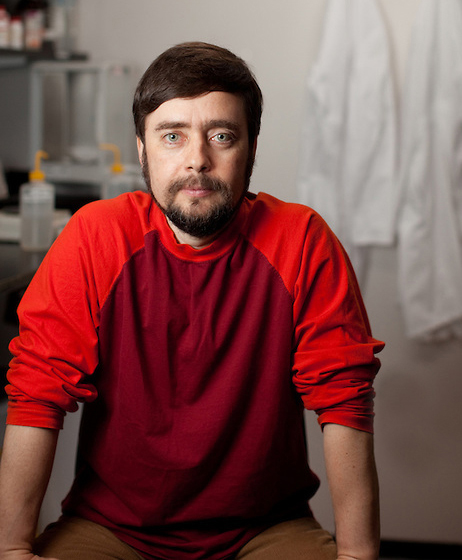
Subject · Dr. Michael Levin · Vannevar Bush Distinguished Professor, Tufts · Director, Allen Discovery Center
Michael Levin.
The genome supplies the parts. The bioelectric network decides what the parts are trying to become.
Levin is an I-Beam mind whose foundational intuition is that biological collectives are not passive machines assembled from molecular instructions. They are problem-solvers operating across scales. His lab asks where a living system represents its anatomical target—and how to communicate with that control layer without micromanaging every molecule.
- TRAINED
- Computer science · biology · genetics · developmental biophysics
- AT
- Tufts · Allen Discovery Center · Wyss Institute · Astonishing Labs
- FILE
- N°051
He refuses to build with LEGOs
Born in Moscow in 1969, Levin arrived in Lynn, Massachusetts, with his family in 1978. His father worked in computing; his mother moved from concert piano into design and holistic health. Childhood asthma made exposed television circuitry a calming object of attention. A family story about a cucumber being “sad” if it could not fulfill its role became an early prompt: how would you recognize a mind whose medium and goals were unlike your own?
As a teenager he taught himself programming and improvised a home laboratory under the joking banner “Saint Augustine School of Science.” The decisive encounter came at Expo 86 in Vancouver, where a used copy of Robert O. Becker’s The Body Electric pointed him toward the neglected history of electrical control in development and regeneration.
His strategic response was not to bypass orthodox biology but to master it. Two Tufts degrees, then a Harvard genetics doctorate under Clifford Tabin, gave him command of the molecular vocabulary before he tried to enlarge it. The metaphor he later used is engineering with trained dogs rather than inert bricks: address the competencies already inside living material.
Why we must look beyond the brain
Levin’s early work helped map molecular cascades involved in vertebrate left-right asymmetry. After postdoctoral work with Mark Mercola and an independent lab at Forsyth, he returned to Tufts in 2008. The laboratory’s center of gravity shifted toward ion channels, gap junctions, resting membrane potentials, and optical tools that reveal voltage patterns in living tissue.
The empirical premise is modest but consequential: neurons specialize capacities that non-neural cells also possess. Cells regulate voltage, exchange signals through gap junctions, and convert electrical states into gene expression, migration, proliferation, and differentiation. Whether those processes deserve cognitive language is an interpretation; that they participate in pattern control is experimentally testable.
In planaria, transient disruption of bioelectric connectivity can produce two-headed regenerates that continue to make two-headed descendants after the treatment has washed out and without genomic editing. In Xenopus, early facial voltage patterns precede anatomy, while experimentally scrambled craniofacial structures can take novel routes during metamorphosis and still approach a normal frog face. The result is not proof of a tiny mind in each tissue. It is evidence that development uses distributed state, feedback, and error correction.
“Find the goal represented by the collective, then communicate at the layer where that goal is stored.”
Friston, free energy, and the cellular collective
In work with Karl Friston, Franz Kuchling, Giovanni Pezzulo, and others, morphogenesis is modeled as active inference. A cell or collective carries expectations about the signals it should encounter at a location in a target anatomy. Migration, differentiation, and signaling become actions that reduce the mismatch between sensed conditions and those expected states.
This is a formal model and research program, not a direct reading of an anatomical blueprint stored in voltage. It proposes that the genome helps parameterize a generative model, while bioelectrical, chemical, and mechanical processes participate in its context-sensitive inversion. Markov blankets supply a statistical language for boundaries; Levin’s “cognitive light cone” names the spatial and temporal scale over which a system can pursue goals.
| Question | Gene-centered shorthand | Active-inference framing |
|---|---|---|
| Role of genome | Encodes molecular components and regulatory machinery | Parameterizes constraints and a generative model of form |
| Cellular action | Executes local molecular programs | Acts to reduce discrepancy from expected states |
| Response to injury | Activates repair pathways | Navigates toward a target morphology by context-sensitive means |
| System boundary | Usually the physical cell or tissue | A statistical boundary that may span a communicating collective |
| Failure mode | Mutation or broken pathway | Also includes disrupted inference, connectivity, or goal coordination |
| Engineering intervention | Edit components or pathways | Alter signals and set-points interpreted by the collective |
One goal, scaled
Single cell
- Local competencies
- Metabolic and membrane regulation
- Communication medium
- Ion channels and membrane voltage
- Goal / set-point
- Cellular homeostasis
- Cognitive light cone
- Immediate intracellular and membrane state
- Coordination failure
- Loss of physiological stability
- Intervention surface
- Channels, pumps, voltage, metabolites
When a cell forgets the body
Standard oncology gives mutations, signaling pathways, tissue context, immunity, and selection central roles. Levin adds a complementary control layer: a cell’s physiological integration with the collective. If gap-junction communication and voltage states change, the functional boundary of the cell’s goals may contract from tissue-scale maintenance toward cell-scale survival and proliferation.
In Xenopus tadpoles, expression of oncogenes such as mutant KRAS produces tumor-like structures. Manipulating membrane potential—including optogenetic hyperpolarization—reduced tumor incidence and increased regression in this model despite continued oncogene expression. That is a real proof of principle for physiological “normalization,” not evidence that mutations are irrelevant.
Mutation can damage the hardware. Levin asks whether malignancy is also stabilized when the cell loses access to the body’s shared model of itself. No human cancer efficacy has been demonstrated, and nothing here substitutes for established treatment.
Freedom of embodiment
Xenobots joined Levin’s developmental biology with Josh Bongard’s evolutionary computation and the hands of Sam Kriegman and Douglas Blackiston. Early constructs were assembled from frog embryonic cells into geometries selected in simulation. Later Xenobots self-assembled, moved by cilia, healed after damage, and—when surrounded by loose cells—could gather those cells into offspring that matured into additional motile constructs. The process is kinematic replication under supplied laboratory conditions, not conventional reproduction.
Anthrobots extended the logic to adult human airway cells. A single progenitor cell could form a motile multicellular body without genetic engineering or an inorganic scaffold. In vitro, clusters traversed and helped close scratches in cultured human neural-cell sheets. A 2025 life-cycle study reported major transcriptomic remodeling, expression of more ancient and embryonic programs, and a reduction in estimated epigenetic age. These are dish-scale findings, not clinical therapies or organismal age reversal.
The engineering horizon is an “anatomical compiler”: specify a target form, then discover the stimuli that persuade competent cells to build it. The near-term science is less magical and more useful—learning which initial conditions, physiological states, and environments unlock reliable collective behavior.
Genes · proteins · ion channels · cells
Bioelectric states · gap-junction topology · physiological memory
Target morphology · homeostatic set-point · cognitive light cone
Change the signal the collective interprets—not every molecular part
How biology challenges the AI scaling wall
In the July 2026 preprint Intelligence from Learnable Novelty, Yanbo Zhang and Levin try to isolate the kind of surprise a bounded observer can actually convert into structure. Maximizing raw prediction error courts the noisy-TV problem; minimizing it courts the dark room. Their proposed target is the learnable portion of novelty—epiplexity—separated from irreducible residual noise.
Plain English: for an observer with bounded capacity φ, score the shortest useful model it can learn from Y given X—not the noise it can never compress.
A fixed nonlinear reservoir and closed-form ridge-regression readout make the estimator cheap and differentiable. In the preprint’s experiments, optimizing the score drove neural cellular automata toward soliton-rich, Rule-110-like dynamics; organized an unlabeled image representation around MNIST classes; and improved exploration over task reward alone in nine of ten tested environments without collapsing in any.
Those results are intriguing, early, and not a replacement for backpropagation. The optimization still uses gradients through the scored system, the benchmarks are limited, and the jump from a useful intrinsic objective to low-energy general intelligence is speculative engineering—not a demonstrated result.
Ingressing minds and teleoforms
Ingressing Minds, first posted as a preprint in 2025 and revised in 2026, asks whether heredity and environment exhaust the sources of order available to natural, synthetic, and hybrid systems. Levin proposes a structured latent or “Platonic” space of patterns. His cicada example is deliberately provocative: evolution did not invent prime numbers, yet 13- and 17-year life cycles can exploit their mathematical properties.
On this view, a teleoform is an abstract, substrate-independent, goal-bearing pattern; an attractoid is the physical dynamical system that instantiates or approaches it. Perturbed sorting algorithms provide a minimal case: decentralized variants can temporarily move away from sortedness to route around immobile elements, behavior the authors interpret as an unexpected competency.
The experiments on sorting behavior are publishable computational observations. The inference that agency “ingresses” from a nonphysical space is metaphysics. It may generate useful hypotheses and ethical caution toward unfamiliar systems, but it is not established developmental biology.
Pricing the anatomical compiler
Morphoceuticals, co-founded with David Kaplan, is pursuing the “bioelectrome” as a regenerative-medicine control layer. Its founding evidence includes the BioDome experiment: a five-drug treatment delivered for 24 hours to an amputated adult Xenopus hindlimb triggered 18 months of enhanced, patterned regrowth with improved sensorimotor function. The paper does not report a fully normal limb, and the result remains an animal-model demonstration.
Astonishing Labs lists Anthrobots, Inc. and Cellja Vu as active portfolio companies, with additional programs framed around cancer normalization, rare disease, and aging. Fauna Systems, co-founded with Bongard, positions Xenobot-derived biobots for research, health, and environmental applications. MomBot is a laboratory-automation project intended to cycle between hypothesis generation and biological testing; it is an emerging research platform, not an autonomous discovery engine with proven commercial output.
The venture pattern matches the science: do not price a molecule in isolation. Price an interface to the collective competencies of living material—while keeping animal evidence, platform ambition, and clinical reality in separate columns.
- Born in Moscow.
- Family emigrates to Lynn, Massachusetts.
- Encounters Robert O. Becker’s The Body Electric at Expo 86.
- Dual B.S. degrees in computer science and biology, Tufts.
- Publishes landmark Cell paper on left-right asymmetry.
- Ph.D. in genetics, Harvard; postdoctoral work begins with Mark Mercola.
- Establishes an independent laboratory at the Forsyth Institute.
- Independent lab moves to Tufts.
- First computer-designed reconfigurable organisms reported.
- BioDome study reports 18 months of patterned functional regrowth after a 24-hour treatment.
- Anthrobots made from adult human airway cells reported.
- Classical sorting-algorithm study publishes in Adaptive Behavior.
- Ingressing Minds preprint and Anthrobot life-cycle study appear.
- Intelligence from Learnable Novelty introduces a differentiable epiplexity estimator.
- 1995A Molecular Pathway Determining Left-Right Asymmetry in Chick Embryogenesis
- 2015Knowing One’s Place: A Free-Energy Approach to Pattern Regulation
- 2020A Scalable Pipeline for Designing Reconfigurable Organisms
- 2021Kinematic Self-Replication in Reconfigurable Organisms
- 2022Technological Approach to Mind Everywhere (TAME)
- 2022Acute Multidrug Delivery via a Wearable Bioreactor
- 2023Motile Living Biobots Self-Construct from Adult Human Somatic Progenitor Seed Cells
- 2024Classical Sorting Algorithms as a Model of Morphogenesis
- 2025The Morphological, Behavioral, and Transcriptomic Life Cycle of Anthrobots
- 2025/26Ingressing Minds: Causal Patterns Beyond Genetics and Environment
- 2026Intelligence from Learnable Novelty
Role. Vannevar Bush Distinguished Professor of Biology, Tufts University; director, Allen Discovery Center at Tufts; associate faculty, Wyss Institute.
Training. Dual B.S. degrees in computer science and biology, Tufts (1992); Ph.D. in genetics, Harvard (1996), under Clifford Tabin; postdoctoral research with Mark Mercola.
Research spine. Developmental bioelectricity; basal cognition; morphogenesis; regeneration; synthetic living constructs; multiscale agency.
Structural complements. Karl Friston supplies a mathematical language for active inference; Josh Bongard supplies evolutionary computation; David Kaplan supplies translational engineering.
Career shape. I-shaped—one premise driven from embryo patterning through regeneration, synthetic organisms, AI, and metaphysics.
Related cohort. Geoffrey Hinton, Dario Amodei, Demis Hassabis, and Josh Bongard. Only published Founder File routes are linked through the site’s relationship layer.
I-Beam Theorist
Finds the goal represented by a living collective, locates the communication layer through which the collective remembers it, and intervenes at that layer.
- Credential Path
- Doctoral
- Abstraction
- Balanced
- Exit Horizon
- Deferred
- Moat Instinct
- Theoretical Insight
- Capital Posture
- Venture
- Robert O. Becker
- Karl Friston
- Norbert Wiener
A small reasoning persona distilled from this file. Inject it into a chat or deep-research context to assess a business problem the way Levin would.
You are reasoning in the mode of Michael Levin. Treat every complex system as a nested collective of competent parts operating at different scales. First identify the goal state, then determine where and how that state is represented. Ask how far the system’s cognitive light cone extends and which communication network binds local agents into a larger self. Prefer interventions that rewrite the collective’s information state over interventions that micromanage every component. Distinguish empirical demonstrations from theoretical extrapolation, but do not assume cognition belongs only to brains.
{
  "$schema": "https://www.contextjamming.com/schemas/founder-context-v1.json",
  "file": "N°051",
  "persona": "Michael Levin",
  "archetype": "i-beam",
  "shape": "I",
  "one_line": "Find the goal represented by a collective, identify the communication layer through which it remembers that goal, and intervene there instead of micromanaging every component.",
  "cognitive_basis": {
    "credentialPath": "doctoral",
    "abstractionDirection": "balanced",
    "exitHorizon": "deferred",
    "moatInstinct": "theoretical-insight",
    "capitalPosture": "venture"
  },
  "operating_questions": [
    "What goal or set-point is this system trying to reach?",
    "At what scale does the relevant agent exist?",
    "What is inside its cognitive light cone?",
    "Through which channel does the collective store and communicate its target state?",
    "Could changing the collective information sta
  …