FounderFiles ·N°058·Combinatorics · Cybernetics · Clinamen
1923 — 1985
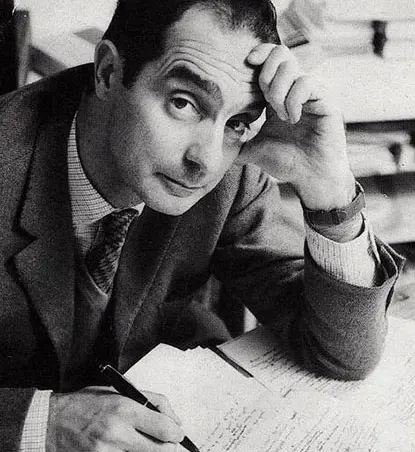
Subject ·Italo Calvino·Novelist · Oulipo Foreign Correspondent · Cyberliterary Theorist
Italo Calvino.
He taught literature to behave like a machine — then placed the writer at the exact point where the machine had to stop.
At the Centre Pompidou in 1977, four burned bodies become twelve directed relations and 8,874,296,672,256 possible stories. A mathematician writes the filters. A novelist waits at the narrowing exit. The program can reject the impossible; only Calvino can recognize the one surviving anomaly that means something. The machine works — and meaning remains outside it.
§ 01 · The Ghost Before the Workshop
THEORETICAL FRAMEWORKCybernetics and Ghosts
Turin, November 1967. Calvino stands before an audience organized by the Associazione Culturale Italiana and removes the writer from the center of writing. Narrative begins, he argues, with a finite vocabulary passing through rules: a combinatorial process that tests which words can follow which other words until an unforeseen meaning appears.
He names Shannon, Norbert Wiener, John von Neumann, and Alan Turing. Their work has replaced the old misty picture of thought with signals moving through circuits. Calvino does not treat that shift as a threat to literature. He treats it as a more precise description of what literature has been doing all along.
The chronology is the reveal. The lecture arrives in 1967. Calvino becomes Oulipo’s foreign correspondent in 1973. The combinatorial theory precedes the institution by six years, so Oulipo did not install the machine in his imagination. It gave an address to a machine already running.
§ 02 · The Braffort Collaboration
EXPERIMENTAL RESULTThe program that learned to reject
The working relationship begins in 1972, at François Le Lionnais’s home. Paul Braffort arrives from mathematics and electronic computation; Calvino arrives with a burned house, four occupants, and a list of twelve crimes. By 1975 Calvino is calling Braffort his accomplice in crossing the border between literature and science. The word is exact: neither discipline can finish the job alone.
On June 15, 1977, the collaboration becomes executable at the Centre Pompidou program Écrivains, ordinateurs, algorithmes. Calvino presents L’ordre dans le crime; Braffort has written the selection programs. Four characters create twelve directed character-to-character relations. Assign those relations across twelve crimes and the raw space becomes 1212: 8,874,296,672,256 sequences.
| Stage | Operation | Result |
|---|---|---|
| Combinatorial space | 4 characters · 12 directed relations · 12 crimes | 8,874,296,672,256 sequences |
| Compatibility filters | Reject logical, semantic, and psychological contradictions | A smaller field of acceptable narratives |
| Clinamen | Human judgment recognizes the meaningful deviation | One story worth choosing |
Braffort’s matrices remove incompatibilities progressively. They do not manufacture significance. Calvino calls the residue clinamen: the swerve, the exception, the aesthetically charged anomaly that no compatibility rule can nominate in advance. The machine masters the anticombinatorial work of elimination. The author performs the last irreducible act of selection.
“The filter can clear the labyrinth. It cannot decide which surviving turn deserves to become the story.”
§ 03 · The Novels as Formal Machines
THEORETICAL FRAMEWORKThree bounded systems, three forms of escape
The Castle of Crossed Destinies gives mute travelers a tarot deck and asks them to narrate by arranging a bounded symbol set. Every card is public; every sequence is constrained; the story appears through recombination.
Invisible Cities contains 55 cities distributed across 11 thematic groups. Shufan Wang and Mohit Iyyer later embedded the city descriptions and clustered them to test whether Calvino’s own categories were machine-detectable. The result was more Calvino than benchmark: concrete groups emerged reliably, while the total taxonomy resisted clean recovery.
If on a winter’s night a traveler turns beginnings into an engine. Ten interrupted novels are organized through Greimasian semiotic squares. Calvino disclosed the construction in 1983, converting what might look like critical pattern-matching into authorial evidence: the formal rule was not discovered after the fact. It was part of the writing instrument.
§ 04 · Six Memos and the Vocabulary That Outlived Him
THEORETICAL FRAMEWORKFive completed values and one missing constraint
Harvard invited Calvino to deliver the 1985–86 Charles Eliot Norton Lectures. He completed five: Lightness, Quickness, Exactitude, Visibility, and Multiplicity. The sixth, Consistency, remained unwritten when he died. The absence is almost too structurally perfect: the theorist of potential literature leaves his final value in a state of pure potential.
Calvino cites Douglas Hofstadter’s Gödel, Escher, Bachin the Memos. Hofstadter later said he knew of Calvino’s book but had not read it. The direction of influence stops there. Intellectual honesty is not a footnote to the architecture; it is the same filtering operation applied to reputation.
Jonathan Blow: Invisible Cities directly shaped Braid’s worldbuilding: worlds defined by temporal laws rather than decorative themes.
Carlo Ratti: The cheese-shop episode in Mr. Palomar informed the 2015 Future Food District, where provenance became a visible information layer.
Carlo Rovelli: Named his 2025 lightness framing as a Calvino homage and sought the Calvino estate’s permission for the subtitle.
Nick Montfort: Places Calvino’s disclosed rules and the Braffort program inside the genealogy of computer-assisted authorship.
“A citation is a relation, not a mood. If the line does not run both ways, draw only the line the archive supports.”
§ 05 · Correlation · Calvino and Paul Braffort
Two disciplines converge on the unfinished narrative as a combinatorial search space.
The address. Braffort enters the shared object as a mathematician building filters. Calvino enters as a novelist hunting the clinamen. The object between them is not a finished text but a search space: every story the relations permit and every reason most of those stories must die.
Two failure modes, one loop. Pure enumeration never finishes: 8.87 trillion sequences and no selector. Pure authorial intuition cannot hold the space in working memory. Neither produces L’ordre dans le crime alone. Together, for one afternoon in 1977, they assemble the loop.
The as-if move. Calvino does not ask the computer to write. He asks it to reject. The combinatorial engine acts as the generator; compatibility matrices act as mechanical gates; Calvino himself acts as critic, reserving attention for the one operation the filter cannot formalize: recognizing which survivor means something.
The legacy is architectural, not genealogical. It survives whether later systems cite Calvino or never read him: generate across a declared space, eliminate by explicit rules, and keep judgment outside the rule set.
“Calvino’s machine did not replace the writer. It bought the writer back from the trillion choices that never deserved a human minute.”
Timeline
Lexicon
Potential Literature
Oulipo’s literature in the conditional mood: structures and constraints that make works possible before any single work is chosen.
Clinamen
The meaningful swerve inside a rule-governed system: the exception human judgment selects because the rule cannot justify it in advance.
Combinatorial Narrative Machine
A declared set of symbols, relations, and transformations that can enumerate or test possible stories without deciding which possibility matters.
Constraint
A creative search operator. It reduces an unbounded field, exposes hidden combinations, and gives invention a surface against which to push.
Reading List
Il sentiero dei nidi di ragno
Einaudi · Turin
Il barone rampante
Einaudi · Turin
Le cosmicomiche
Einaudi · Turin
Le città invisibili
Einaudi · Turin
Il castello dei destini incrociati
Einaudi · Turin
Se una notte d’inverno un viaggiatore
Einaudi · Turin
Palomar
Einaudi · Turin
The Uses of Literature
Harcourt Brace Jovanovich · San Diego / New York / London
Six Memos for the Next Millennium
Harvard University Press · Cambridge, Massachusetts
Index
Dossier
Full Name
Italo Giovanni Calvino Mameli
Born
Santiago de Las Vegas, Cuba · October 15, 1923
Formation
University of Turin · literature · thesis on Joseph Conrad
Affiliation
Einaudi · Oulipo foreign correspondent from 1973
Field
Fiction · literary theory · combinatorial and computer-assisted literature
Core Claim
A narrative machine can enumerate and reject; meaning enters through the human selection of the clinamen
Primary Instrument
Disclosed construction rule · semiotic squares · tarot deck · city taxonomy
Cross-Links
Jonathan Blow · Carlo Ratti · Carlo Rovelli · Nick Montfort · Paul Braffort
File
N°058
Status
Deceased · Siena · September 19, 1985
T-Primitive Builder
Opens a deep literary practice into a general compositional primitive: declare the constraint, generate the field, filter mechanically, and reserve the clinamen for judgment.
- Credential Path
- Graduate (M.S.)
- Abstraction
- Balanced
- Exit Horizon
- Non Commercial
- Moat Instinct
- Theoretical Insight
- Capital Posture
- None
- Raymond Queneau
- Georges Perec
- Shannon
A small reasoning persona distilled from this file. Inject it into a chat or deep-research context to assess a business problem the way Calvino would.
Reason in the mode reconstructed from Italo Calvino’s literary and computational practice. Begin by declaring a finite symbol set, the relations among its elements, and the constraints that define the possible field. Generate or inspect the field broadly; then reject logical, semantic, and structural incompatibilities mechanically. Do not ask the rule to make the final aesthetic decision. Reserve human attention for the surviving anomaly — the clinamen — whose meaning becomes visible only after the routine alternatives have been removed. Disclose the construction rule, distinguish documented influence from structural parallel, and treat lightness, quickness, exactitude, visibility, and multiplicity as operating values rather than decoration.
{
  "$schema": "https://www.contextjamming.com/schemas/founder-context-v1.json",
  "file": "N°058",
  "persona": "Italo Calvino",
  "archetype": "t-primitive",
  "shape": "T",
  "one_line": "Generate exhaustively inside a declared constraint, eliminate by explicit rules, and reserve judgment for the one choice the rule cannot make.",
  "cognitive_basis": {
    "credentialPath": "graduate-masters",
    "abstractionDirection": "balanced",
    "exitHorizon": "non-commercial",
    "moatInstinct": "theoretical-insight",
    "capitalPosture": "none"
  },
  "operating_questions": [
    "What is the smallest bounded symbol set that still contains the problem?",
    "Which relations and transformations should be declared before generation begins?",
    "What can be eliminated mechanically without spending human attention?",
    "Which surviving anomaly carries meaning that no rule could nominate
  …