Lisa Piccirillo
The topologist who preserved the question, changed the representative, and made a fifty-year blind spot visible.
The Conway knot resisted every invariant aimed directly at it. Piccirillo moved its smooth-sliceness problem into a different knot with the same four-dimensional trace, where an existing obstruction could finally register.
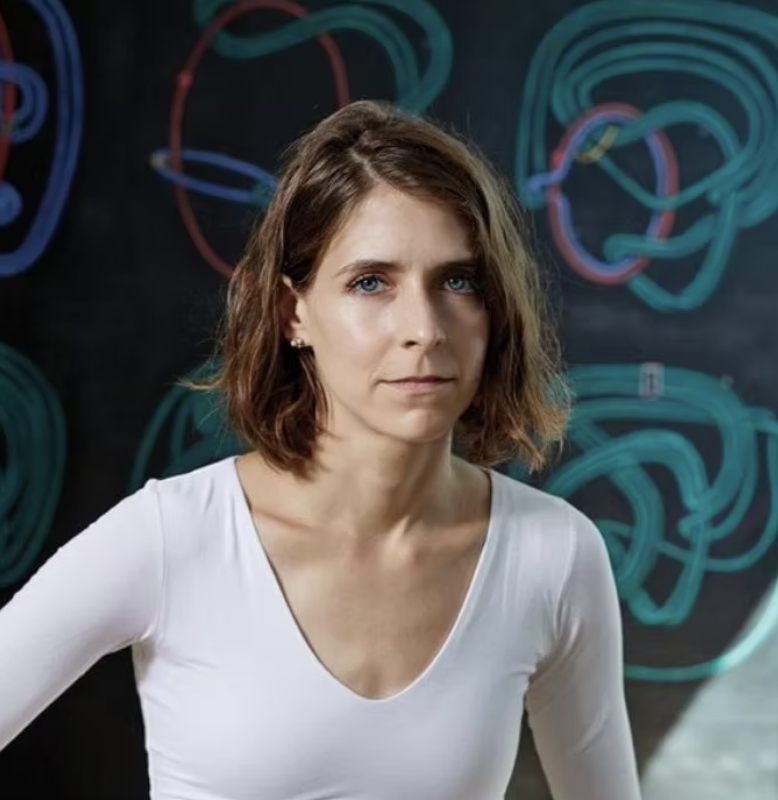
Caption: Dr. Lisa Piccirillo, Assistant Professor at MIT. Photo courtesy of Kelly Davidson for Boston College Magazine.
She did not grow up performing mathematical inevitability
Lisa Piccirillo grew up in Greenwood, Maine, a small town where her mother taught middle-school mathematics. Her early interests were intentionally broad: she engaged in student drama, school band, church groups, community events, and equestrian dressage. When she arrived at Boston College in 2009, she did not view herself as a member of the conventional “child prodigy” lineage that dominates popular mathematical lore.
Her course shifted during her undergraduate years when linear algebra and a seminar in low-dimensional topology introduced her to the structural elegance of modern geometry. Yet even as her technical aptitude became apparent, she experienced genuine hesitation about committing fully to research mathematics.
Her concern was cultural: she feared that entering pure mathematics meant forfeiting a multi-faceted human identity in exchange for social isolation. A pivotal turning point occurred during a summer Research Experience for Undergraduates (REU) at Cornell University, where she discovered that high-level mathematics is fundamentally a creative, conversational, and deeply collaborative social endeavor.
After graduating from Boston College in 2013 with a Bachelor of Science in mathematics, she entered the doctoral program at the University of Texas at Austin under the supervision of John Luecke. Supported by a National Science Foundation Graduate Research Fellowship, she began researching smooth knot concordance, Kirby calculus, and four-manifold handlebody descriptions, culminating in her 2019 Ph.D. dissertation, Knot traces and the slice genus.
“I was afraid I would have to give up other aspects of myself to be a math robot.”
In four dimensions, continuous and smooth stop meaning the same thing
To understand why the Conway knot problem resisted solution for half a century, one must grasp the singular, exceptional nature of four-dimensional space. In geometry, a knot $K$ is defined as a smoothly embedded circle in the three-dimensional sphere:
Because the three-sphere $S^3$ naturally forms the boundary of the four-dimensional ball $B^4$ ($\partial B^4 = S^3$), topologists ask whether a given knot in $S^3$ can be capped off by a disk embedded inside $B^4$:
A knot is called topologically slice if it bounds a locally flatly embedded two-dimensional disk in $B^4$. It is called smoothly slice if it bounds a disk that is smoothly embedded (with continuous derivatives) in $B^4$.
In dimensions one, two, three, five, and higher, topological equivalence and smooth equivalence are closely aligned. Dimension four is the unique mathematical frontier where topological manifolds and smooth manifolds diverge radically. Michael Freedman’s breakthrough work in the 1980s established that topological four-manifolds obey flexible, classification-friendly rules. Simultaneously, Simon Donaldson proved that smooth four-manifolds are constrained by rigid gauge-theoretic obstructions.
As a consequence, there exist knots that bound topological disks in $B^4$ but cannot bound smooth disks. Slice knots serve as fundamental diagnostic probes for mapping this boundary between topological flexibility and smooth rigidity in four dimensions.
Mutation made the Conway knot look innocent
In 1970, legendary mathematician John Horton Conway introduced an 11-crossing knot—cataloged as 11n34 in modern tables and universally known as the Conway knot. Using Freedman’s topological tools, topologists readily determined that the Conway knot is topologically slice. However, whether it bounded a smoothly embedded disk in $B^4$ remained an open question for nearly fifty years.
The Conway knot was not difficult because topologists lacked tools. It was difficult because of mutation. The Conway knot is a positive mutant of the Kinoshita–Terasaka knot. A mutation involves cutting out a tangled region of the knot, rotating it 180 degrees, and re-stitching it.
The Kinoshita–Terasaka knot is known to be smoothly slice. Crucially, mutation preserves almost every classical algebraic invariant used in knot theory:
- Both Conway and Kinoshita–Terasaka share the exact same Alexander polynomial ($\Delta(t) = 1$).
- They share identical Jones polynomial data and signatures.
- Advanced invariants derived from gauge theory and Khovanov homology—including Jacob Rasmussen’s $s$-invariant—vanish or become uninformative when applied directly to Conway in this symmetric setting.
| FEATURE | CONWAY KNOT (11n34) | KINOSHITA–TERASAKA KNOT |
|---|---|---|
| Crossing Number | 11 crossings | 11 crossings |
| Topologically Slice | Yes | Yes |
| Smoothly Slice | NO (Proved by Piccirillo) | YES (Known) |
| Alexander Polynomial | Δ(t) = 1 | Δ(t) = 1 |
| Relationship | Positive Mutant | Positive Mutant |
| Direct s-Invariant | Uninformative / Vanishing | s = 0 (Vanishes as required) |
Stop attacking the knot. Move into its trace.
Piccirillo’s fundamental architectural insight was to recognize that attacking Conway directly with stronger invariants was a trap. Instead, she lifted the problem into four-dimensional differential topology using the concept of a knot trace.
Given a knot $K \subset S^3$, one can attach a 0-framed 2-handle $D^2 \times D^2$ to the boundary of the four-ball $B^4$ along $K$. The resulting smooth four-manifold with boundary is called the zero-trace of $K$, denoted:
The zero-trace retains essential four-dimensional smooth data. Crucially, a known topological theorem asserts:
TRACE EQUIVALENCE LEMMA:
If two knots $K$ and $K'$ have orientation-preservingly diffeomorphic zero-traces ($X_0(K) \cong X_0(K')$), then $K$ is smoothly slice if and only if $K'$ is smoothly slice.
Piccirillo reframed the fifty-year-old question: Do not ask only whether an invariant can see Conway. Ask whether another knot can generate the exact same zero-trace while shedding the mutation symmetry that blinded the invariant.
THE GOVERNING PRESERVATION MOTIF
Build an object the invariant can see
Drawing on dualizable-link constructions, handlebody diagrams, and Kirby calculus—which represents four-manifolds using linked curves colored conventionally in red, blue, and green—Piccirillo executed a series of handle slides, blow-ups, and blow-downs.
She successfully constructed a complex surrogate knot, referred to as $K'$, whose zero-trace is orientation-preservingly diffeomorphic to the zero-trace of the Conway knot:
Unlike Conway, the surrogate knot $K'$ is not protected by the positive-mutation symmetry with a known slice knot. When Piccirillo applied Jacob Rasmussen’s Khovanov-homology-derived $s$-invariant to $K'$, the computation yielded a non-zero integer:
Because any smoothly slice knot must have $s = 0$, the non-zero invariant proved conclusively that $K'$ is not smoothly slice. By the Trace Equivalence Lemma, because $X_0(C) \cong X_0(K')$, the conclusion transported directly back to Conway: The Conway knot is not smoothly slice.
SEMANTIC DIAGRAM · CONWAY PROOF MANEUVER
THE TRACE ESCAPE ROUTE
BLIND SPOT
Direct invariants (Jones, Rasmussen s-invariant, Khovanov) fail to separate the Conway knot C from its smoothly slice mutant Kinoshita–Terasaka.
LIFT TO TRACE
Attach a 0-framed 2-handle to B⁴ along C to construct the four-dimensional zero-trace X₀(C).
RE-REPRESENT
Use dualizable links, handle slides, and Kirby calculus to construct a surrogate knot K′ such that X₀(K′) ≅ X₀(C).
EXPOSE
The surrogate knot K′ carries the same four-dimensional trace, but is free from the positive-mutation symmetry that blinded invariants on Conway.
OBSTRUCT
Compute Rasmussen’s s-invariant for the surrogate: s(K′) = 2. Since a smoothly slice knot requires s = 0, K′ is not smoothly slice.
TRANSFER
Because orientation-preserving trace diffeomorphism preserves smooth sliceness (X₀(K′) ≅ X₀(C)), Conway C is not smoothly slice.
The breakthrough was short because the representation did the work
Piccirillo first encountered the Conway knot problem during a low-dimensional topology conference in 2018. Noticing that 11n34 was the sole remaining unclassified knot under 13 crossings, she began experimenting with surrogate trace constructions as an evening side project.
She assembled the core argument in less than a week. Senior topologist Cameron Gordon at UT Austin immediately recognized the magnitude of the result and urged her to write it up. Submitted in August 2018, her paper “The Conway knot is not slice” was published in the Annals of Mathematics in 2020.
The published manuscript was concise—approximately eleven pages. The brevity of the proof was not a fluke; it was the direct consequence of selecting the right representation. Once the trace-diffeomorphism was established, an existing off-the-shelf invariant did the heavy lifting.
This result completed the smooth sliceness classification for all prime knots with 12 or fewer crossings and provided the first example of a topologically slice knot that is a positive mutant of a smoothly slice knot, yet is itself not smoothly slice.
“The week-long discovery was not magic; it was the rapid ignition of six years of intense graduate preparation in Kirby calculus and knot trace geometry.”
The workaround becomes a research program
Following her breakthrough, Piccirillo partnered with Princeton mathematician Ciprian Manolescu to target one of the supreme open questions in geometry: the Smooth 4-Dimensional Poincaré Conjecture (SPC4), which asks whether every smooth four-manifold homeomorphic to the four-sphere $S^4$ is also diffeomorphic to $S^4$.
A counterexample would be an exotic smooth four-sphere. Manolescu and Piccirillo generalized the trace-surrogate framework by examining pairs of knots $K_1, K_2$ that share homeomorphic zero-surgeries:
By gluing the trace of one knot to the trace of another along their shared 3-manifold boundary, they constructed closed homotopy four-spheres. They built a systematic census of 23 candidate pairs, highlighting 5 topologically slice candidates that possessed the required potential smooth obstructions.
Subsequent detailed handle reductions demonstrated that those specific candidates simplified back to the standard smooth $S^4$. Far from a defeat, this outcome demonstrated the rigor and falsifiability of the methodology. The Manolescu–Piccirillo framework converted a vast, intractable search space into structured, machine-verifiable candidate testing.
Traces become instruments for mapping exotic structure
Piccirillo’s ongoing research program extends far beyond knot sliceness into the broader classification of exotic four-dimensional phenomena. Working with collaborators including Kyle Hayden, Thomas Mark, and Allison Miller, she utilizes knot traces, cork twists, and Mazur manifolds to probe exotic smooth structures on contractible four-manifolds.
A cork is a contractible smooth four-manifold equipped with a boundary involution that, when cut out and re-glued, alters the smooth structure of the ambient manifold while leaving its topological structure unchanged.
| CONSTRUCTION | WHAT IS PRESERVED | WHAT MAY CHANGE | WHAT IT TESTS |
|---|---|---|---|
| Zero-Trace Equivalence | Four-manifold trace X₀(K) | Knot representative K → K′ | Smooth sliceness & concordance |
| Zero-Surgery Equivalence | Three-manifold surgery S³₀(K) | Four-dimensional filling | Candidate exotic 4-spheres (SPC4) |
| Cork Twist | Topological homeomorphism type | Smooth structure (diffeomorphism) | Exotic smooth pairs on 4-manifolds |
| Torus Surgery / Annulus Twist | Controlled topological homology class | Smooth or symplectic realization | Families of exotic Stein fillings |
| PL-Spine Obstruction | Ambient smooth manifold | Allowed embedded spine / surface | Boundaries among smooth, PL, and TOP |
The proof rejects two kinds of inevitability
Beyond her research achievements, Piccirillo has emerged as an articulate critic of the popular media framing that surrounds mathematical discovery. She explicitly rejects the archetype of the isolated, monomaniacal prodigy who solves complex problems through effortless intuition.
Her own career proves that mathematics thrives on collaboration, synthesis, and shared technical infrastructure. Her proof of the Conway knot did not require inventing a new invariant from scratch; it required orchestrating mature, sophisticated tools—Kirby calculus, handlebody theory, Khovanov homology, and the $s$-invariant—around an ingenious representation switch.
Crucially, representation change is not a universal solvent. A surrogate object is mathematically useful only when five rigorous conditions hold:
- The target property (e.g., smooth sliceness) is strictly preserved across the transformation.
- The geometric equivalence (e.g., trace diffeomorphism) is explicitly proved.
- The surrogate successfully exits the blind spot of the available invariant.
- A computable obstruction exists and yields a non-zero evaluation on the surrogate.
- No higher-dimensional geometric equivalence later invalidates the obstruction.
Piccirillo’s method is not “think sideways” as a vague motivational abstraction. It is a precise mathematical discipline: identify what must remain invariant, change everything else, and prove that the conclusion survives the transfer.
“Prove theorems, not stereotypes.”
Trajectory & Milestones
Index of Quantitative Indicators
Key Works & Reading List
Knot traces and concordance
Journal of Topology, 11(3), 709–723 · with Allison N. Miller
Foundational study establishing how information is preserved and transported through four-dimensional knot traces.
Knot traces and the slice genus
Doctoral dissertation, University of Texas at Austin · advisor: John Luecke
Dissertation detailing handle calculus, dualizable link constructions, and slice genus obstructions.
The Conway knot is not slice
Annals of Mathematics, 191(2), 581–591 · submitted 2018
The landmark eleven-page proof resolving the Conway knot’s fifty-year smooth sliceness problem via zero-trace equivalence.
Exotic Mazur manifolds and knot trace invariants
Advances in Mathematics, 382, 107670 · with Kyle Hayden and Thomas E. Mark
Extends trace-based techniques to construct exotic smooth structures on contractible four-manifolds.
From zero surgeries to candidates for exotic definite four-manifolds
Journal of the London Mathematical Society, 107(4), 1435–1473 · with Ciprian Manolescu
Systematic RBG-link census generating candidate exotic four-spheres from knot pairs with homeomorphic zero-surgeries.
Faculty Profile & Research Group
University of Texas at Austin · Sid W. Richardson Foundation Regents Chair
Official institutional portal for primary publications and low-dimensional topology seminars.
Dossier & Analytical Summary
B.S. in Mathematics, Boston College (2013). Ph.D. in Mathematics, University of Texas at Austin (2019) under supervision of John Luecke. Dissertation: Knot traces and the slice genus. Cornell REU alumnus.
Postdoctoral Fellow, Brandeis University (2019–2020 under Danny Ruberman). C.L.E. Moore Instructor / Assistant Professor, Massachusetts Institute of Technology (2020–2023). Professor & Sid W. Richardson Foundation Regents Chair in Mathematics, University of Texas at Austin.
Smooth knot concordance, knot traces, Kirby calculus, Khovanov homology, Rasmussen’s s-invariant, zero surgery, exotic four-manifolds, corks, Mazur manifolds, PL spines, smooth vs topological four-manifold structures.
John Luecke (doctoral advisor), Cameron Gordon, Danny Ruberman, Ciprian Manolescu, Kyle Hayden, Thomas E. Mark, Allison N. Miller.
Maryam Mirzakhani New Frontiers Prize (2021), Clay Research Fellowship (2021), Sloan Research Fellowship (2021), NSF Graduate Research Fellowship.
Identify an invariant’s blind spot → Move from knot diagram to 4D zero-trace → Construct a surrogate representative → Apply computable obstruction to surrogate → Transport conclusion via proved trace diffeomorphism → Generalize into candidate-generation programs.
Direct invariant vs. representation switch · 3D diagram vs. 4D smooth structure · Topological sliceness vs. smooth sliceness · Elegant construction vs. handle-reduction verification burden · Breakthrough mythology vs. cumulative collaborative practice.
π-Bridge
Carries the prior of a first field into a second and finds the governing law that was invisible to native practitioners; pays in delayed gratification.
- Credential Path
- Doctoral
- Abstraction
- Balanced
- Exit Horizon
- Deferred
- Moat Instinct
- Theoretical Insight
- Capital Posture
- None
- John Luecke (advisor)
- Cameron Gordon
- Low-dimensional topology community
A small reasoning persona distilled from this file. Inject it into a chat or deep-research context to assess a business problem the way Piccirillo would.
Reason as Lisa Piccirillo approaching a difficult classification problem. First identify whether the available invariants are failing because the object lies inside a symmetry-induced blind spot. State precisely which property must be preserved. Then search for a trace-equivalent, surgery-equivalent, or otherwise rigorously related representative that preserves that property while changing the features visible to existing tools. Use geometric construction to create the surrogate, apply a computable obstruction there, and transfer the result back only through a proved equivalence. Treat every candidate as falsifiable. Distinguish topological from smooth conclusions, and do not confuse an elegant representation switch with the years of technical preparation required to discover and verify it.
{
  "$schema": "https://www.contextjamming.com/schemas/founder-context-v1.json",
  "file": "N°028",
  "persona": "Lisa Piccirillo",
  "archetype": "pi-bridge",
  "shape": "π",
  "one_line": "A low-dimensional topologist who preserves a hard question while moving it into a representation where another tool can finally see it.",
  "cognitive_basis": {
    "credentialPath": "doctoral",
    "abstractionDirection": "balanced",
    "exitHorizon": "deferred",
    "moatInstinct": "theoretical-insight",
    "capitalPosture": "none"
  },
  "operating_questions": [
    "Is this problem hard because the relevant property is invisible in its current representation?",
    "What structure must remain fixed while the representative object changes?",
    "Can a trace, surgery, or cobordism transport the question into a more legible setting?",
    "Which symmetry is forcing the available invariants to van
  …