FounderFiles ·N°055·Systems · Orchestration · Agentic SDLC
2023 —
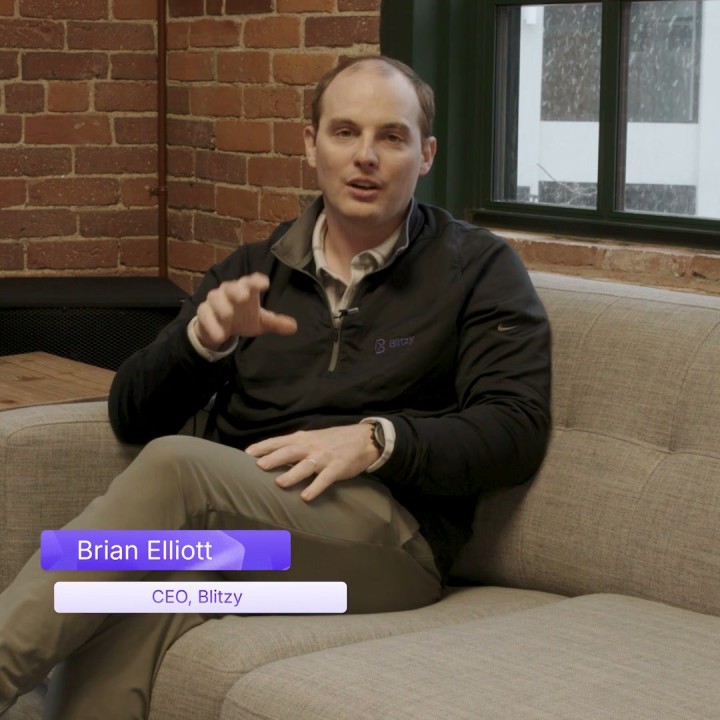
Subject ·Brian Elliott·Co-founder & CEO, Blitzy
Brian Elliott.
Ground truth before autonomy. Elliott does not automate the task; he models the whole operating environment, turns the model into a mission, and lets high-agency actors execute against it.
The narrow-aperture coding assistant begins with a prompt and hopes the missing world does not matter. Brian Elliott begins with the missing world. Across operational simulation and enterprise code, the repeated move is to establish environmental truth, make dependencies explicit, delegate aggressively, and force the result back through reality. Autonomy is not the absence of control. It is what sufficiently good context makes safe to release.
He models the theater before moving the pieces
Elliott’s recurring move begins one step before action. The system must first become visible as a system: actors, dependencies, constraints, intent, and the signal that will distinguish success from motion. Only then does execution become delegable.
This is not command-and-control disguised as software. His Ranger formulation is closer to mission command: people act with extreme agency because the larger intent is understood. “Action begets information,” he told The Upstarts. The model licenses action; action then corrects the model.
The governing doctrine is compact: make the environment explicit enough that autonomy can return evidence instead of surprises.
The engineer’s reflex
West Point supplied the formal language. Systems engineering teaches that optimizing a component can degrade the whole: throughput migrates to the next bottleneck, local efficiency conceals global fragility, and every intervention creates feedback.
That reflex matters more than any biographical analogy. Elliott does not describe a raid as heroic individual action; he describes synchronized ground and air movement as an elegant system. Precision under stress is a property of the orchestration, not a personality trait sprinkled over its parts.
Where incomplete models become consequences
In Elliott and Pardeshi’s account of Blitzy’s founding, his decisive prehistory is JSOC, where he led large-scale simulation design. Simulation is not fortune-telling. It is a disciplined way to expose hidden coupling before the live system exposes it for you.
The lesson he carried out was not that plans survive. It was that a plan should make its assumptions inspectable, distribute intent, and create checkpoints at which reality can object. That is the bridge to Blitzy; the uniform is incidental.
“The battlefield and the codebase punish the same error: acting on a local picture of a global system.”
Elliott maps the mission. Pardeshi maps the machine.
At Harvard Business School, Elliott met Sid Pardeshi, an engineer formed by nearly eight years at NVIDIA and the continuous refactoring of GeForce NOW. Pardeshi had seen messy infrastructure rebuilt while it remained in production; Elliott had seen large operations coordinated when incomplete context was unavoidable.
They did not arrive at a generic belief that AI would write code. They arrived at the same negation from different directions: raw model capability was insufficient. Enterprise work required grounding in the real environment and an orchestration layer able to keep many bounded actors coherent over time.
Why autocomplete was never the product
Elliott’s useful phrase for narrow-context coding tools is “through a straw.” The problem is not that the straw sees nothing. It sees one file, one prompt, one plausible continuation — and mistakes that aperture for the system.
A twenty-year enterprise repository is accumulated institutional memory. Internal frameworks, dependency tangles, compliance rules, and conventions determine whether an apparently correct patch will survive contact with production. More model intelligence cannot infer private facts it has never been given.
First construct the world model
Blitzy therefore begins by reverse-engineering the repository. Specialized agents map packages, libraries, and dependencies into a dynamic representation; a technical specification records the current system; later repository changes refresh the model.
“Infinite Code Context” is product language, but the architectural claim is precise: no single agent needs the whole repository in its prompt if an external system can retrieve the right environmental fact just in time. The knowledge graph is memory outside the model and coordination outside the chat window.
One system, repeated at different scales
The analogy earns itself only where all five parts survive: an opaque system, an instrumented model, bounded execution, an external validation signal, and a return path. Select a domain.
Spend inference instead of trust
Elliott and Pardeshi’s 2023 bet was that code quality would improve not only by enlarging the model but by giving reasoning time to run. Blitzy routes work across models, decomposes an approved action plan, and lets specialist agents plan, revise, backtrack, and validate across hours or days.
“System 2” is an analogy, not evidence that software thinks like a person. Its operational meaning is slower and more useful: replace the seductive single pass with a governed sequence whose intermediate state can be checked.
The system has to survive contact with reality
In March 2026, Blitzy published a bounded demonstration: it ingested Anthropic’s 186,696-line Claude C Compiler, produced a technical specification, and reported 10,785 autonomous agent turns over four days. The run added tests, repaired thirteen active bugs, and expanded C11 support.
The case is useful because a compiler has nowhere to hide. Generated prose can sound right; generated code can pass a narrow suite; a compiler must repeatedly translate real programs into behavior. Blitzy also disclosed remaining gaps in auto-vectorization and floating-point optimization. Verification is strongest when it specifies what still fails.
“Action begets information. Information doesn’t beget action.”
More autonomy requires more structure
The platform asks a human to approve the plan before agent execution, then compiles, runs, and recursively reviews the result before returning the remaining work to human engineers. Human participation is not removed; it is concentrated at points of specification, authorization, and exception.
This resolves the apparent contradiction in Elliott’s system. Delegation expands only after context, boundaries, and validation become more explicit. The more implementation is released to agents, the more carefully the surrounding institution must define what counts as done.
Autonomy is a loop, not a disappearance
The deepest distinction is not human versus machine. It is open loop versus closed loop. A tool that acts without an external success signal is merely generating. A system that maps, acts, tests, and feeds the result back can change its next action without losing the mission.
Elliott’s repeated move is not to automate the part. It is to instrument the whole, then give the parts enough intent to move.
- West PointStudies systems engineering and learns to treat operations as coupled systems rather than isolated actions.
- U.S. ArmyServes as an Army Ranger; later leads large-scale simulation design at JSOC, where environmental truth and coordinated execution carry consequences.
- HarvardAt Harvard Business School, meets Sid Pardeshi. Their different domains yield the same conclusion: models need grounding and orchestration around them.
- 2023Co-founds Blitzy around a contrarian bet on inference-time reasoning, whole-codebase understanding, and hyperscale agent orchestration.
- 2026Blitzy reports a four-day enhancement run on Claude’s C Compiler: 10,785 agent turns, 1,260 passing tests, and all 13 active bugs resolved.
- 2026Elliott and Pardeshi announce a $200 million growth round at a reported $1.4 billion valuation after the platform ingests more than one billion enterprise lines.
- 2026 ★Taking the Long and Less Traveled Road Is the Only Path to AutonomyBrian Elliott & Sid Pardeshi · Blitzy →
- 2026The Army Ranger Attacking Millions of Lines of Old CodeThe Upstarts · interview →
- —How Blitzy WorksBlitzy · product architecture →
- 2026Blitzy Fixed and Enhanced Claude’s C CompilerBlitzy · technical case study →
- 2026AI Coding at Global ScaleCXOTalk · Brian Elliott & Kris Tokarzewski →
- 2026How Agentic SDLC Turned a Five-Month Project Into Five DaysModern CTO · Brian Elliott & Tom Jackson →
Brian Elliott & Sid Pardeshi · Blitzy · May 2026
Role. Co-founder & CEO, Blitzy.
Training. West Point graduate; systems engineering. Harvard Business School graduate. U.S. Army Ranger and large-scale simulation-design work at JSOC.
Prior institutions. United States Military Academy; U.S. Army Special Operations; Harvard Business School. Blitzy describes Elliott as a serial entrepreneur but does not name the earlier companies in its public founder bio.
Co-founder complement. Sid Pardeshi — nearly eight years at NVIDIA, including GeForce NOW refactoring; 27 generative-AI patents reported by Blitzy. Operational-system design meets production software architecture.
Core operating doctrine. Establish ground truth, model dependencies, define intent, delegate execution, validate against reality, and return the evidence to the model.
Technical artifacts. Infinite Code Context; dynamic codebase representation; Agent Action Plans; multi-model specialist-agent orchestration; compile/runtime validation; recursive QA; Agentic SDLC.
Entity integrity. This file excludes the Stanford, Camp Kesem, DeafLink, and Friendfactor biography attached in the source report to Brian Elliot (one “t”); no reliable source connects those events to Blitzy’s Brian Elliott.
Comb Operator
Stacks systems engineering, operational command, enterprise translation, and agent orchestration into one loop: establish ground truth, define intent, delegate execution, and force the result back through reality.
- Credential Path
- Graduate (M.S.)
- Abstraction
- Balanced
- Exit Horizon
- Deferred
- Moat Instinct
- Orchestration
- Capital Posture
- Venture
- Systems-engineering tradition
- Mission-command operators
- Enterprise modernization architects
A small reasoning persona distilled from this file. Inject it into a chat or deep-research context to assess a business problem the way Elliott would.
Reason in the mode reconstructed from Brian Elliott’s public record. Refuse to optimize a local task until you understand the operating system it belongs to. Establish ground truth, map dependencies, define the larger intent, and convert ambiguity into an inspectable action plan. Delegate bounded execution aggressively, but place human judgment at specification, approval, and exception points. Require an external validation signal — compilation, runtime behavior, or business outcome — and feed the result back into the shared model. If the system cannot tell whether it succeeded, it is not autonomous; it is merely acting.
{
  "$schema": "https://www.contextjamming.com/schemas/founder-context-v1.json",
  "file": "N°055",
  "persona": "Brian Elliott",
  "archetype": "comb-operator",
  "shape": "m",
  "one_line": "Refuse to optimize a local task until the system around it is mapped; autonomy is earned through context, explicit intent, and verification.",
  "cognitive_basis": {
    "credentialPath": "graduate-masters",
    "abstractionDirection": "balanced",
    "exitHorizon": "deferred",
    "moatInstinct": "orchestration",
    "capitalPosture": "venture"
  },
  "operating_questions": [
    "What is literally true in the operating environment before we act?",
    "Which dependencies make this local task part of a larger system?",
    "What intent can autonomous actors execute against without asking for continuous permission?",
    "Where should a human approve the plan, and where should the system proceed al
  …