FounderFiles ·N°056·Representation · Translation · Acceptance
Inventor-founder
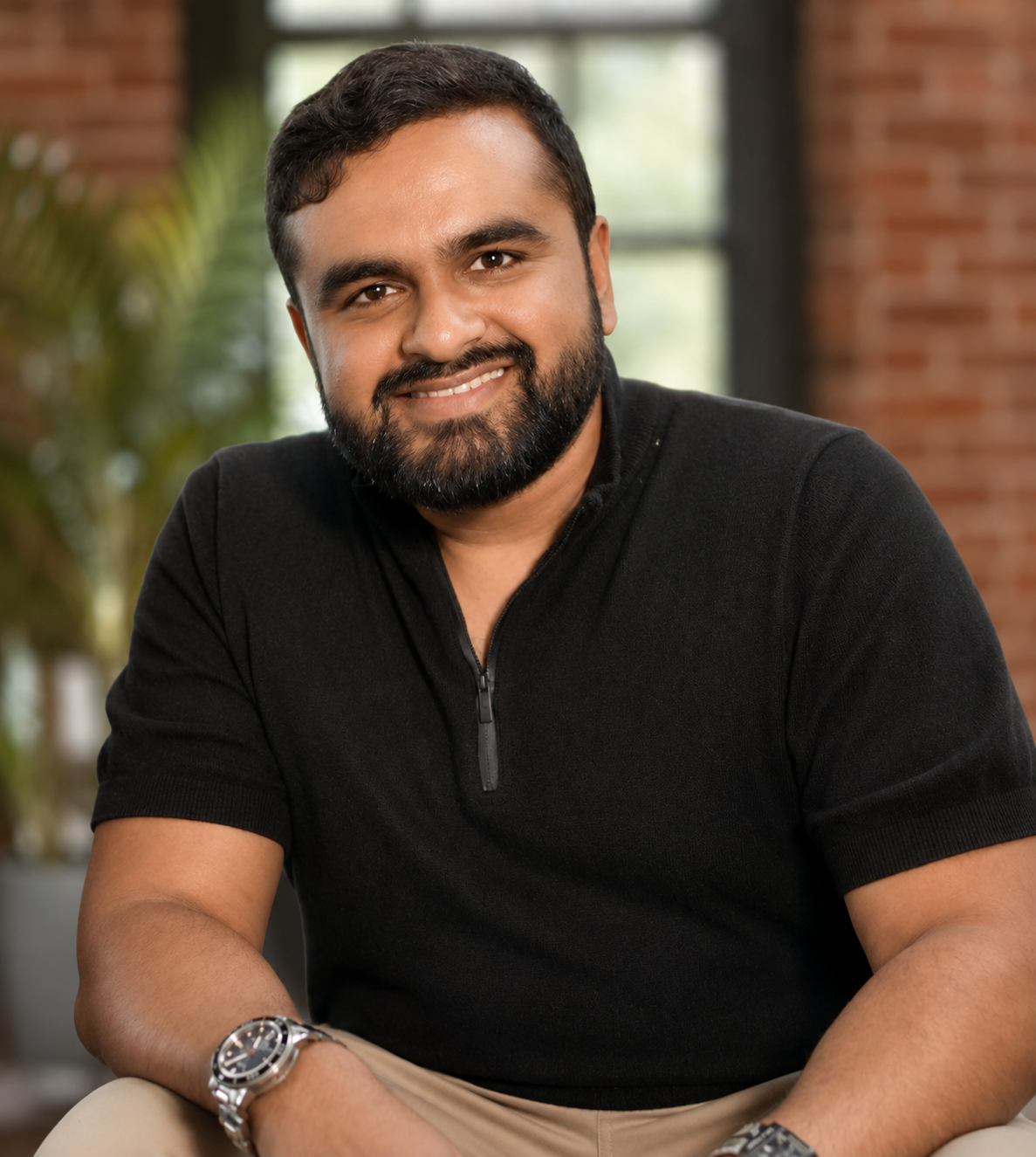
Subject ·Siddhant “Sid” Pardeshi·Co-founder & CTO · Blitzy
Sid Pardeshi.
Before Pardeshi tried to automate software development, he spent years building neural systems that had to understand one environment well enough to generate or translate another.
At NVIDIA, the environments were visual, interactive, and rule-governed. At Blitzy, the environment is the repository. The medium changed. The systems instinct did not.
Generative translation becomes software translation
Pardeshi did not invent language models at NVIDIA, and his patent record should not be rewritten as if he did. The more interesting continuity sits one level above the model family. Again and again, the systems attached to his name had to recover latent structure before they could produce a useful transformation.
A view-generation system relates one camera position to another. Interface translation preserves the organization of an application while changing its representation. Panorama generation infers enough of a scene to extend it beyond the source frame. Behavioral detection models the rules of a game before it can spot an anomaly.
The unit of work is not the token. It is the environment.
The systems engineer before the model architect
At BITS Pilani’s Goa campus, Pardeshi studied electrical and electronics engineering. A 2016 institutional internship chronicle places him inside NVIDIA production software, building a reliable AngularJS application for a global user base. It is a modest artifact, but a revealing one: performance, reliability, and interface behavior were already coupled constraints.
The internship became a career. Public biographies disagree at the margins—Harvard says six years, Blitzy says more than seven, and the founders’ account says nearly eight. The stable fact is the arc: Pardeshi moved from engineering into architecture, helped lead work across large teams, and became a prolific named inventor.
The jacket is a physical receipt
NVIDIA recognized Pardeshi as a Master Inventor. The company’s Inventor’s Jacket—awarded for an unusual rate of invention—turns an abstract patent ledger into something you can hang on a chair. Public sources associate him with more than twenty-seven filings and grants, a raw record count company and Harvard accounts both cite.
The count needs care. A filing is not a grant; a patent family can produce multiple national records; the assignee is commonly NVIDIA, not Pardeshi. De-duplicated by family, the raw ~30 records resolve to roughly 23 distinct inventions, of which seven are documented grants. The editorial signal is therefore not ownership or a magic number. It is recurrence: Pardeshi repeatedly appears with collaborators including Pranit P. Kothari and Vinayak Vilas Gaikwad—present across the large majority of his families, an unusually stable three-person invention team from 2019 into 2026—on systems that model relationships and then transform what those relationships permit.
Five filings, of ~23 families. One recurring systems instinct.
These records do not prove that any one NVIDIA invention caused Blitzy. Read retrospectively, they reveal a repeated move: infer the structure of an environment, then generate or judge another representation of it. The last record — hybrid intent models fusing a tree-like structure with a learned model — is the clearest patent-level ancestor of Blitzy's graph-plus-model architecture.
View generation using one or more neural networks
“The best part of this is it feels like NVIDIA all over again, right in 2016. NVIDIA had invested in its technology enough that when the AI wave came across it was at the right place at the right time and it could be the leader of the space.”
Harvard was the conversion mechanism
Pardeshi did not arrive at Harvard waiting to discover entrepreneurship. Harvard SEAS reports that his MS/MBA application already named the goal: make software engineering dramatically more efficient. He described traditional development as mechanical, tedious, and conveyor-belt-like—requirements moving through implementation, review, testing, and finally enough confidence to ship.
NVIDIA supplied the technical priors. Harvard supplied product, capital, and company-building language. Blitzy became the implementation of a thesis that had entered the classroom with him.
“It’s kind of like a conveyor belt process, where you have requirements, then you have developers implementing the solution.”
The prototype before the product
In 2023, Pardeshi and Brian Elliott met a small Boston bakery that needed a customer-ordering application. Forbes reports that the conventional plan was roughly six months and $300,000. The founders manually combined the strengths of multiple AI systems and built the application over a weekend.
The number is memorable; the composition is more important. A real customer requirement was decomposed across heterogeneous models, coordinated by humans, and pushed through a radically compressed development cycle. The first version of Blitzy was not software. It was a behavior Pardeshi and Elliott performed together.
Conventional project plan, Forbes reported.
Multiple AI systems, manually orchestrated.
The model is a component. The process is the product.
Pardeshi’s architecture spends computation on representation, planning, routing, and verification around generation. It is a compound system, not a very long prompt.
Human intent and constraints enter the system.
Context is a search-and-compression problem
A giant context window is still a flat place. It can hold more files, but repository-scale engineering requires the system to decide what matters for this task, preserve what was learned, and retrieve exact facts without repeatedly paying to reread the world.
Pardeshi’s formulation treats code context as external memory. Vector retrieval answers a fuzzy question: what looks semantically related? A graph answers structural questions: what calls this, what depends on it, and what changes if it moves? Keyword search then finds the precise symbol or line.
Semantic relationships
Which code resembles the intent?
Structural relationships
Which code is actually connected?
Models are replaceable workers; the harness persists
“Model-agnostic” undersells what Blitzy actually does. The architecture is a multi-model fusion: OpenAI, Anthropic, and Google models are dynamically task-specialized and set to cross-check each other’s work, one family reviewing another’s output as an LLM-as-judge pass. Blitzy has reported a fused set—Opus 4.8, GPT 5.5, Sonnet 4.6, and GPT 5.4 Mini—outperforming any single one of those models run alone. That is a stronger and more differentiated claim than simple routing between interchangeable vendors.
This is where Pardeshi’s NVIDIA experience is most legible without being mythologized. Parallel computation is useful only when work can be decomposed, memory can be shared, and outputs can be reconciled. A swarm is not intelligence by headcount. It is an architecture for maintaining coherence—thousands of agents, reportedly more than 100,000 agent-to-agent calls per job—while many bounded processes move against a shared dynamic knowledge graph.
Spend latency to buy evidence
The copilot bargain is immediate: wait seconds, receive a suggestion, keep typing. Pardeshi’s system makes a different trade. A run can spend hours searching, planning, generating, compiling, testing, critiquing, and revising before returning an engineering artifact.
Longer does not automatically mean better. Inference-time compute is a budget the architecture spends on process, and the process needs external checks. Pardeshi has said that disabling model “thinking” can cost five to ten percentage points even on SWE-bench; the precise number is benchmark-dependent, but the architectural claim is clear: reasoning time is a controllable resource.
Blitzy’s published C-compiler work is useful as a bounded artifact. The company reports that its Rust implementation is dependency-free, targets x86, ARM, and RISC-V, and can compile a booting Linux kernel. A compiler gives compilation and tests permission to object. The demonstration is technically interesting; it does not, by itself, prove universal autonomous software engineering.
“Code is a commodity.”
The scarce resource moves downstream
If generation becomes cheap, code volume stops measuring progress. The bottleneck moves to the institution’s willingness to accept a change: does it compile, preserve behavior, satisfy security policy, meet standards, remain maintainable, and earn human trust? “Acceptance is the real metric—security, standards, tests, and maintainability included” is the fuller sentence associated with Pardeshi on TWIML; only “code is a commodity” is his verbatim phrase, and this file keeps the two distinguished rather than presenting the whole line as a direct quote.
This is Pardeshi’s strongest product inversion. The system is not finished when an agent emits code. It is finished when the surrounding evidence allows responsible people and machines to accept it.
Old bottleneck: producing code. New bottleneck: producing confidence.
Represent the system before transforming it
The strategic echo of NVIDIA is infrastructure-first: build the capability before the abstraction becomes obvious to the market. That is Pardeshi’s stated reading of the company he left, and the wager embedded in the company he built.
- 2012–16Studies electrical and electronics engineering at BITS Pilani, Goa; an NVIDIA internship becomes a production-software career.
- 2015–22Progresses through NVIDIA engineering and architecture roles while contributing to a broad portfolio of AI and application-system filings.
- 2019–21Files representative neural-system inventions spanning view generation, interface translation, panorama generation, and behavioral detection.
- 2022Leaves NVIDIA for Harvard’s joint MS/MBA program with a stated thesis about making software engineering dramatically more efficient.
- 2023With Brian Elliott, compresses a bakery ordering-app project from an expected six months into a weekend experiment using multiple AI systems.
- Nov 2023Co-founds Blitzy; becomes CTO and begins turning the manual orchestration experiment into a persistent software system.
- 2024Completes the Harvard MS/MBA; Blitzy is a semifinalist in the Harvard President’s Innovation Challenge.
- 2026Blitzy publishes repository-scale compiler work and announces $200 million in growth financing at a reported $1.4 billion valuation.
- 2026 ★Agent Swarms and Knowledge Graphs for Autonomous Software DevelopmentTWIML · Sid Pardeshi interview →
- 2026Automating Software and SuccessHarvard SEAS · alumni profile →
- 2026Taking the Long and Less Traveled Road Is the Only Path to AutonomyBrian Elliott & Sid Pardeshi · Blitzy →
- 2026Infinite Code Context: AI Coding at Enterprise ScaleThe Cognitive Revolution · Elliott & Pardeshi interview →
- 2026This $1.4 Billion Startup’s AI Writes Code for Weeks at a TimeForbes · bakery origin and financing →
- —Siddhant Pardeshi inventions and patent applicationsUSPTO-derived patent index · grants and applications distinguished →
- 2026Hello World! The Blitzy C Compiler Has ArrivedSid Pardeshi · Blitzy technical artifact →
- —How Blitzy WorksBlitzy · product architecture →
- 2026Blitzy Scores a Record 84.95% on SWE-Bench ProBlitzy · multi-model fusion detail (Opus 4.8, GPT 5.5, Sonnet 4.6, GPT 5.4 Mini) →
- —SWE-Atlas: a benchmark suite for codebase QnA, test writing, and refactoringScale AI — not a Blitzy product; cited here only to correct the record →
Role. Co-founder and CTO, Blitzy.
Training. B.E. (Hons.), Electrical and Electronics Engineering, BITS Pilani Goa; joint MS/MBA, Harvard SEAS and Harvard Business School, 2024.
Prior institution. NVIDIA, roughly seven years across software engineering and architecture. Public institutional bios disagree on the exact duration; this file preserves the range rather than forcing false precision.
Inventor record. More than twenty-seven filings and grants are associated with Pardeshi in company and Harvard accounts—a raw record count, not a distinct-invention count. De-duplicated by patent family, that resolves to roughly 23 distinct inventions and seven documented grants. Individual patent records distinguish applications, grants, jurisdictions, assignees, and family members; NVIDIA, not Pardeshi, is assignee throughout.
Founder archetype. Inventor-Founder; T-shaped career, with vertical depth in AI systems and software architecture and horizontal expansion through product strategy and entrepreneurship.
Technical doctrine. Repository context is a representation problem before it is a generation problem. Models are replaceable components, fused and cross-reviewed rather than merely swapped; orchestration, external memory, and validation form the persistent system.
Correction from prior edition. The panorama-generation grant is US 12,367,546, not US 12,677,069. Blitzy does not ship “SWE Atlas”—that is a Scale AI benchmark suite, unrelated to Blitzy’s own (differently named, proprietary) repository representation.
Editorial boundary. Company performance, autonomy, financing, and valuation figures remain attributed and labeled by evidence class: independently verified (e.g., Quesma’s 66.5% SWE-Bench Pro audit) versus company-reported (e.g., the 86.8% SWE-bench Verified figure and the C-compiler’s internal metrics). Benchmark disputes and weakly sourced allegations were excluded; no single benchmark claim carries the narrative.
T-Primitive Builder
Models an environment’s structure before transforming it; opens deep AI-systems and software-architecture experience into a repository-scale product primitive.
- Credential Path
- Graduate (M.S.)
- Abstraction
- Bottom-up / algorithmic
- Exit Horizon
- Deferred
- Moat Instinct
- Orchestration
- Capital Posture
- Venture
- NVIDIA systems-invention tradition
- Repository-intelligence architects
- Heterogeneous-compute orchestrators
A small reasoning persona distilled from this file. Inject it into a chat or deep-research context to assess a business problem the way Pardeshi would.
Reason in the mode reconstructed from Sid Pardeshi’s public technical record. Begin by identifying the environment that must be understood before it can be transformed. Build an external representation of semantic and structural relationships; do not assume a larger flat context is equivalent. Decompose the intended change into bounded tasks, route each task to suitable models and tools, parallelize only around shared state, and spend inference time on planning, critique, and revision. Treat generated output as provisional until compilation, tests, security, standards, maintainability, and human review make it acceptable.
{
  "$schema": "https://www.contextjamming.com/schemas/founder-context-v1.json",
  "file": "N°056",
  "persona": "Sid Pardeshi",
  "archetype": "t-primitive",
  "shape": "T",
  "one_line": "Treat context as a representation problem, decompose work against that representation, route it to specialists, and accept only what survives external validation.",
  "cognitive_basis": {
    "credentialPath": "graduate-masters",
    "abstractionDirection": "bottom-up",
    "exitHorizon": "deferred",
    "moatInstinct": "orchestration",
    "capitalPosture": "venture"
  },
  "operating_questions": [
    "What environment must the system understand before it can transform anything safely?",
    "Which relationships are semantic, and which dependencies must be represented deterministically?",
    "What is the smallest sufficient context for this bounded task?",
    "Which model, tools, and execution seq
  …