
Context Jamming·Vol. 26 · Dispatch·ACRA Insight LLC
AI × Culture · Dispatch
The Whisperer and the Stack.
OpenAI hired a person to win over Hollywood. Anthropic built a stack. One buys access but bets on dinner invites; the other buys credibility but skips the room where licensing deals get made.
Two lines in New York
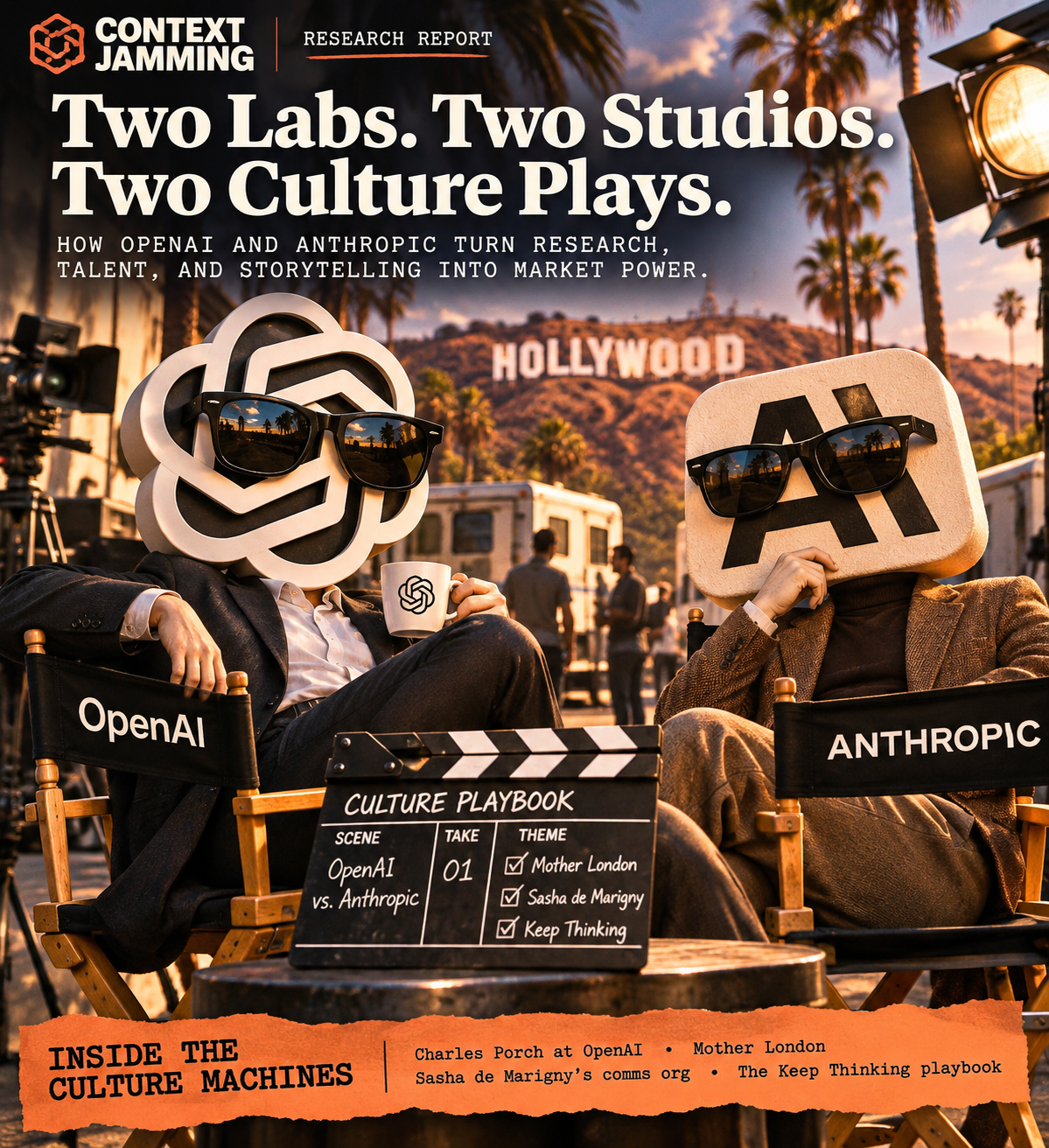
On a crisp October afternoon, Charles Porch sat outside Sant Ambroeus in Soho with an Arnold Palmer and explained to New York magazine how a dinner had turned into a scandal. In August, Puck’s Matthew Belloni had reported that Gwyneth Paltrow would host a private, off-the-record dinner for Sam Altman at her home in Amagansett. The internet answered with contempt, and the dinner was postponed. Porch, OpenAI’s vice president of global creative partnerships, had brokered it. In Charlotte Klein’s profile for the magazine’s Nov. 2 Power Issue, he shrugs it off as an ordinary investor dinner that the internet inflated.
A year earlier, a few neighborhoods away, I stood in a different kind of line. In October 2025 Anthropic took over the Air Mail newsstand in the West Village for about a week. There were no screens. There was free coffee, there were books, pens and paper, and there was a cap with the word thinking on it for anyone who could show the Claude app on their phone. I waited about two hours. The line ran down the block, and trade coverage later counted more than 5,000 visitors and over 10 million social impressions. Nobody famous hosted it, and nobody was invited. Anyone could stand in that line.
Those two scenes hold the culture strategies of the two leading AI labs in miniature. OpenAI built a person. Anthropic built a stack. As of November 2026, no executive, team or job title at Anthropic brokers celebrity, talent or studio relationships the way Porch does. Anthropic does the same job through an agency, a narrative, a brand-and-communications organization and a product that people adopt on their own. Each design mirrors its company’s exposure. OpenAI’s Hollywood problem is about likeness and generative video, so it hired a relationship broker. Anthropic’s creative-industry problem is about training data and lawsuits, so it relies on lawyers, a values story and agency-made brand work.
The broker
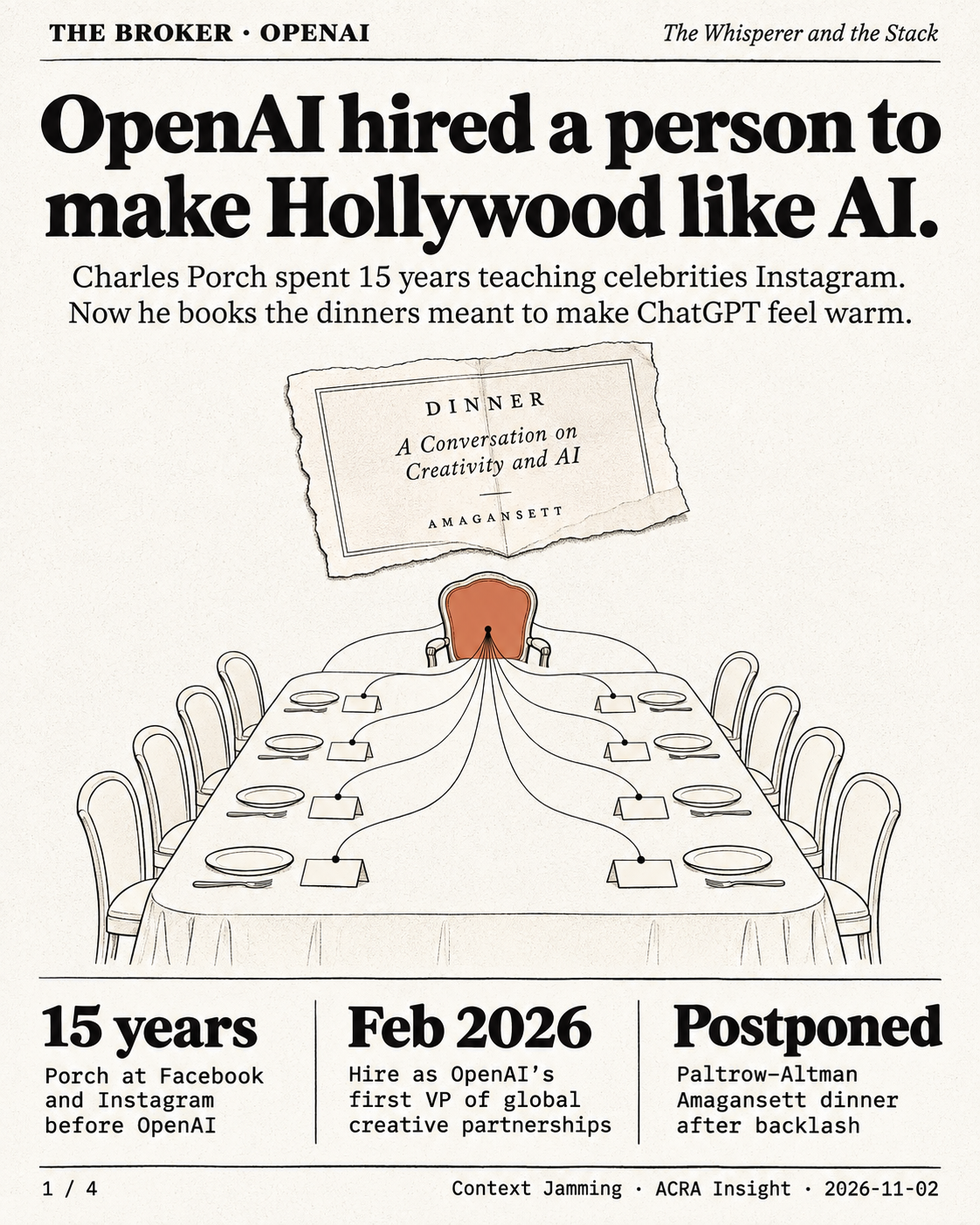
Vanity Fair broke the hire on Feb. 18, 2026: Porch would become OpenAI’s first vice president of global creative partnerships after 15 years at Facebook and Instagram. At Instagram he was the man who told Kevin Systrom that pop culture could move off Twitter. He helped Beyoncé drop a surprise album on the platform in 2013, watched Vogue put nine “Instagirls” on a September cover in 2014, and recruited Eva Chen to run fashion partnerships. New York’s profile says Fidji Simo recruited him in January and he started in March. The magazine also says Altman hired him in 2025, which its own timeline and the February announcement contradict; the record points to 2026.
His method is the dinner table. He began with a listening tour that ran through the Council of Fashion Designers of America, HBO showrunners and the Cannes Film Festival. Then came the rooms: a Paris Fashion Week dinner at Sushi Park with Pharrell Williams’s auction house Joopiter, and dinners in Los Angeles and New York for TBPN, the tech talk show OpenAI bought in April. He told Klein that the work runs on friendship rather than contracts: “It’s not about deals; it’s about relationships.”
The visible results are thinner than the guest lists. OpenAI’s clearest celebrity deal, a Lionel Messi tie-in for ChatGPT Images at the June 2026 World Cup, was billed as its first global collaboration with a public figure; public coverage credits the company, not Porch. The magazine adds rookie quarterback Fernando Mendoza describing ChatGPT meal planning to GQ, and designer Francesco Risso discussing GPT Astra in an OpenAI-sponsored Vogue video. A media executive quoted in the piece put the star’s calculation bluntly: a big check, and a lot of blowback.
The broker also sits on an unsteady org chart. Simo went on medical leave in April and stepped down to a part-time advisory role on July 9. OpenAI’s chief marketing officer, Kate Rouch, left as well. No public source says who Porch reports to now, and his team’s size and budget have not been disclosed. In August, TechCrunch reported a separate backlash against OpenAI’s first luxury influencer trip at an upstate New York resort; whether Porch had a hand in it is not confirmed.
TBPN shows how OpenAI splits the job. The show, which the Wall Street Journal says averages about 70,000 viewers an episode and earned around $5 million in ad revenue in 2025, reports to Chris Lehane’s strategy organization, not to Porch. It is a narrative channel, and Altman used it to answer Anthropic’s Super Bowl ads. Porch handles the people; Lehane handles the message.
The stack
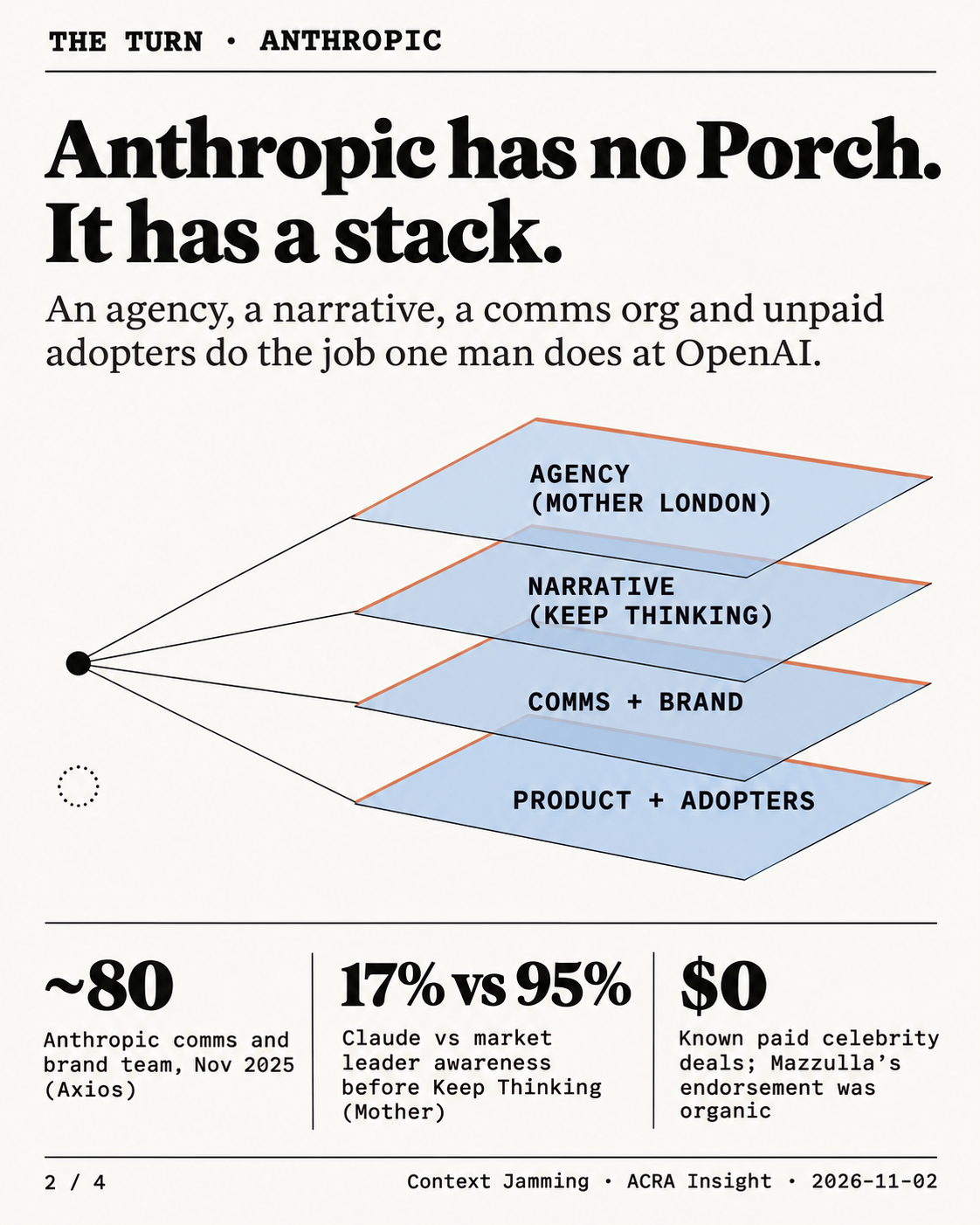
Anthropic’s nearest counterpart to Porch is Sasha de Marigny, its chief brand and communications officer. She joined in August 2023 from Thrive Capital and, before that, Stripe, where she ran brand communications and Stripe Press. Axios reported her promotion to chief communications officer in November 2025 and said she reports to president Daniela Amodei. Her team grew fast. In May 2025 Axios counted about 20 people and a plan to triple; by November the comms and brand team had reached ~80 people. She told Axios then that the team would build out its influencer programs.
The creative engine is outsourced. Mother London built Keep Thinking, Anthropic’s first paid campaign, which launched in September 2025 with a 90-second film shot on 16mm, 35mm and Ektachrome by director Daniel Wolfe, with Initiative buying the media. Mother’s own case study says Claude started at 17% awareness against 95% for the market leader. Andrew Stirk, Anthropic’s head of brand marketing, runs the client side. The platform’s tone is anti-slop and anti-attention, which makes a celebrity endorsement awkward on its own terms.
The campaign’s biggest moment had no stars in it. At Super Bowl LX in February, Mother’s four spots ran under the line “Ads are coming to AI. But not to Claude.” Altman called them funny and also clearly dishonest. A July iteration asked the public to submit hard questions about AI, jobs, creativity and safety, and drew input from more than 120,000 people.
The rest of the stack is people Anthropic never paid. On Oct. 29, Celtics coach Joe Mazzulla told 98.5 The Sports Hub that he uses Claude every day and is “all in on Claude.” There is no evidence of a deal. The film Artificial, with Will Angus as Dario Amodei, premiered at the New York Film Festival on Oct. 5 under Neon, not Anthropic. Ben Affleck’s InterPositive, often linked to Anthropic online, was bought by Netflix. Even the Air Mail pop-up made the point: one secondary analysis found an Anthropic employee’s personal post drew about 2.1 million views against roughly 360,000 for the brand account.
Anthropic is adding culture capacity, but inside brand. An open role, Head of Anthropic Creative, pays $385,000 to $460,000 and covers brand campaigns, flagship events, media and publication partnerships, and managing outside agencies. It is a creative director’s job, not a talent office.
Why Anthropic can’t throw the dinner
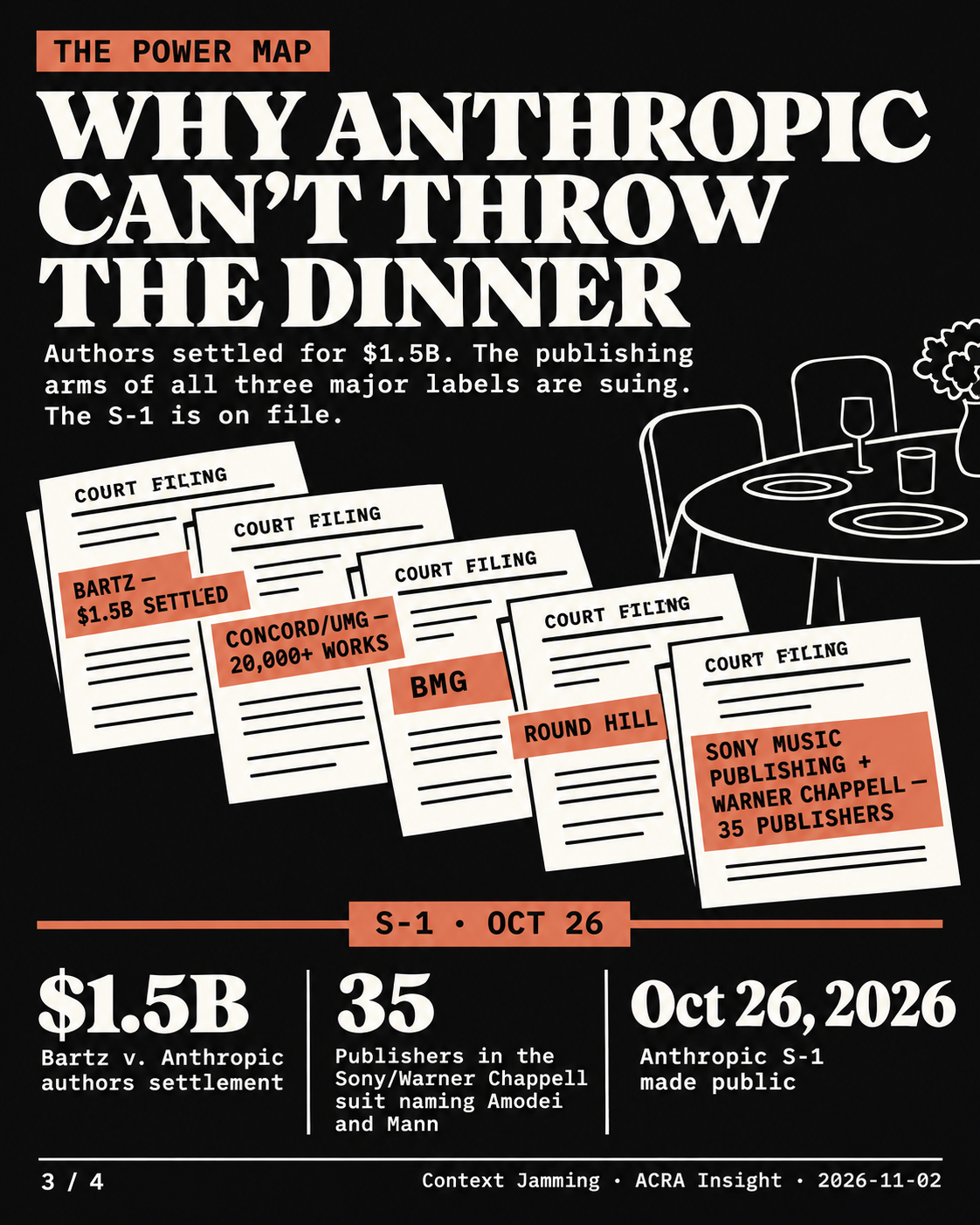
The power map explains the restraint. Anthropic agreed to a $1.5B settlement with authors over pirated books in Bartz v. Anthropic. Concord and Universal sued over song lyrics in 2023 and again in January 2026, over more than 20,000 works and more than $3 billion. BMG followed in March and Round Hill in July. On Aug. 28, Sony Music Publishing and Warner Chappell led 35 publishers in a suit that names Amodei and co-founder Ben Mann personally. The publishing arms of all three major labels are now on the other side of the table.
Then there is the calendar. Anthropic’s S-1 went public on Oct. 26. Securities practice during registration generally tolerates ordinary advertising but discourages new hype that could look like conditioning the market. That is general practice, not a disclosed company rule. A new celebrity-broker program in this window would invite exactly that scrutiny. A glamorous dinner with recording artists, while their publishers are suing the founders, is a risk the stack is designed to avoid.
OpenAI’s exposure runs the other way. NPR reported that Sora 2 alarmed Hollywood after users made videos of Fred Rogers, Tupac Shakur and Robin Williams. That is a problem of likeness and consent, which relationships can soften and licensing deals, like OpenAI’s agreement with Disney, can paper over. A broker fits that problem. He does not fit a fight over training data.
The scoreboard
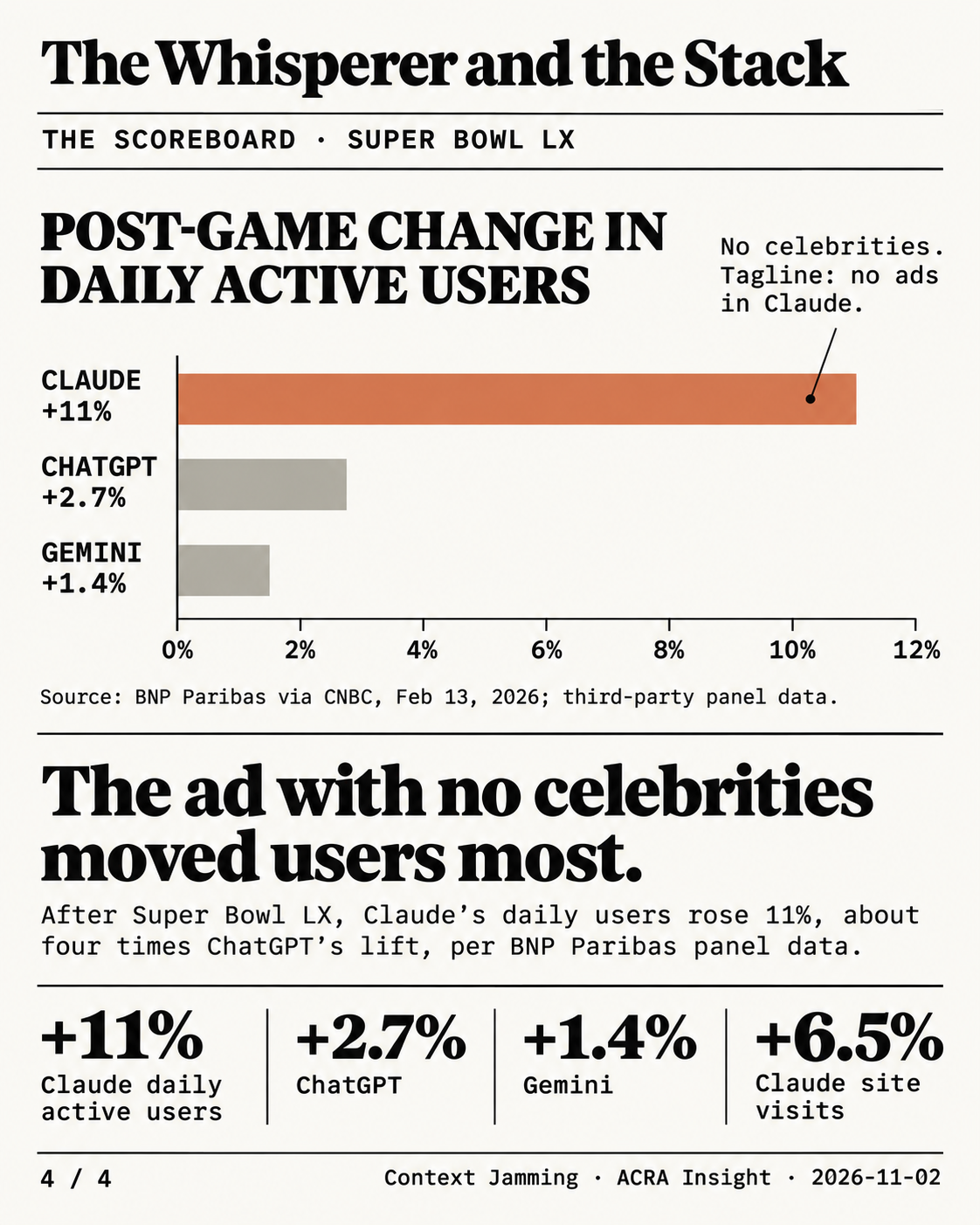
The measurable results favor the stack. After the Super Bowl, BNP Paribas panel data reported by CNBC showed Claude’s daily active users up +11% and site visits up 6.5%, against a 2.7% lift for ChatGPT and 1.4% for Gemini. Claude climbed into the top ten free apps on the App Store. The S-1 shows what that efficiency cost: advertising rose from $33 million in 2024 to $147 million in 2025, according to Digiday’s reading of the filing. Sales, marketing and partnerships reached $3.17 billion in the first half of 2026, though $2.7 billion of the increase was fees to the cloud companies that resell Claude.
The caveats are real. BNP’s numbers are third-party panel data. ChatGPT remains far larger; Altman’s line was that more Texans use ChatGPT for free than Americans use Claude. No public poll compares how people feel about the two companies, and Mother has published no awareness figure after the campaigns. Google and Meta both ran Super Bowl AI ads, and this research found no named Porch at either.
The empty chair
The gap neither lab has closed is licensing peace with the creative industries. OpenAI has the right person for that conversation and the wrong reputation. Anthropic has the reputation and nobody whose job is to take the meeting. Once it is public, settlements and licenses with music publishers may matter more than any campaign, and a stack cannot sit across a table from a label chief. Two seats are worth watching: whoever fills Anthropic’s Head of Creative role, and whoever Charles Porch reports to now that Fidji Simo is gone.
Filed from the field
— Bret Kerr
Also on Substack
Read The Whisperer and the Stack on bretkerr.substack.com ↗New York magazine details are checked against the archived Nov. 2, 2026 article. Hero numbers were re-checked before publishing: Porch’s hire and tenure (Vanity Fair, Feb 2026), the Super Bowl daily-user lift (BNP Paribas via CNBC) and S-1 marketing spend (Digiday, CNBC). Still open: who Porch reports to after Simo, his team’s size and budget, and any head-to-head favorability polling.
Context Jamming is a dispatch from ACRA Insight LLC on cross-model orchestration, AI safety, and the economics of the new cognitive stack.
Subscribe at bretkerr.substack.com