FounderFiles·N°068·Information · Cryptography · Prediction
1916 — 2001
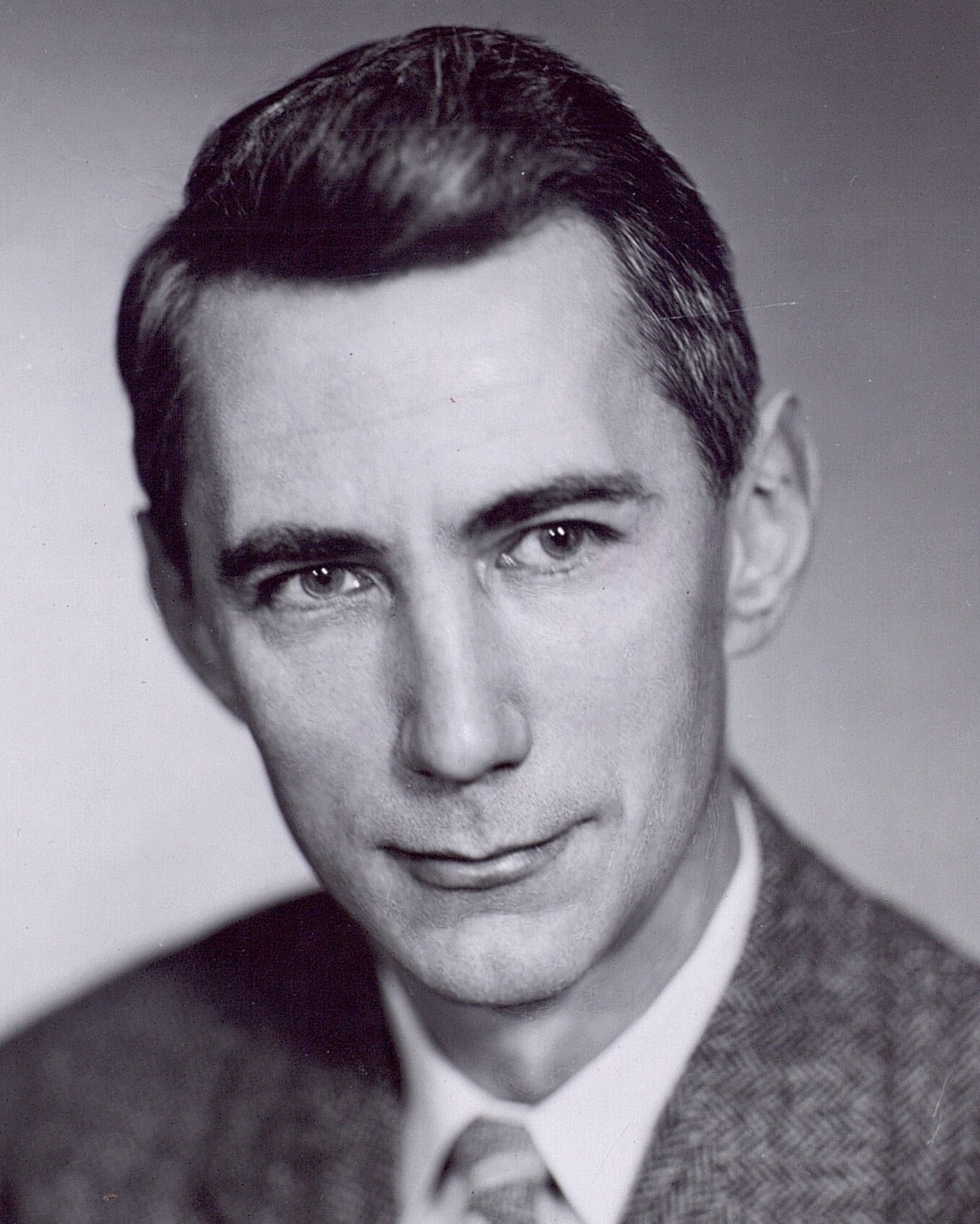
Subject·Claude E. Shannon·Mathematician · Bell Labs · MIT · Founder of information theory
Claude Shannon
Shannon built the first statistical model of English inside a classified codebreaking memo, declared meaning irrelevant, and handed AI the quantity it still minimizes.
In September 1945 a Bell Labs mathematician generated fake English by opening books at random and copying down the next letter. The memo was stamped CONFIDENTIAL. Three years later he published the same samples, defined the bit, and threw meaning out on page one. In 1951 he had people guess the next letter of a Jefferson biography and measured English at about one bit per letter. Every frontier model since is trained to win that guessing game.
Boolean algebra, wired into relays
He was born on April 30, 1916, in Petoskey, Michigan, and grew up in Gaylord. As a boy he built a telegraph out of barbed wire. In high school he delivered messages for Western Union. He left the University of Michigan in 1936 with two bachelor’s degrees, one in mathematics and one in electrical engineering.
At MIT he took a job tending Vannevar Bush’s differential analyzer, a room-sized mechanical calculator run by a thicket of relays. Shannon looked at the relays and saw logic. His 1937 master’s thesis, A Symbolic Analysis of Relay and Switching Circuits, showed that George Boole’s nineteenth-century algebra of true and false could describe, simplify and design switching circuits. Open and closed. One and zero. A version ran in the Transactions of the American Institute of Electrical Engineers in 1938, and circuit designers who had worked by intuition suddenly had a calculus.
Howard Gardner later called it “possibly the most important, and also the most famous, master’s thesis of the century.” He was twenty-one when he wrote it.
He did not stay with circuits. His 1940 MIT doctorate was An Algebra for Theoretical Genetics, mathematics applied to population genetics. He spent the following year at the Institute for Advanced Study in Princeton. It was a pattern he kept for life. He would solve the foundational problem in a field, then leave for another one.
Logic became something you could solder. Every gate that has ever executed a matrix multiply for a neural network is downstream of a twenty-one-year-old who was bored by the maintenance work on Bush’s machine.
The first language model was a secret
He joined Bell Telephone Laboratories in 1941. The war put him on fire-control systems and on secrecy systems, the mathematics of codes. In early 1943, Alan Turing spent about two months at Bell Labs [single-source].
On September 1, 1945, Shannon finished a memorandum titled A Mathematical Theory of Cryptography. The cover sheet reads CONFIDENTIAL. Its routing list names Nyquist, Hartley and Bode, the giants of the lab. Section three is headed The Series of Approximations to English.
In it, Shannon generates text. First, letters drawn with equal probability: XFOML RXKHRJFFJUJ. Then letters drawn at their English frequencies. Then pairs, then triples, then whole words, then word pairs, until the page produces THE HEAD AND IN FRONTAL ATTACK ON AN ENGLISH WRITER THAT THE CHARACTER OF THIS POINT IS THEREFORE ANOTHER METHOD.
The purpose was not literature. It was redundancy, the share of English that is constraint rather than choice. Redundancy is what a codebreaker exploits. When he published the method, the footnote naming his letter-frequency tables cited Fletcher Pratt’s Secret and Urgent, a popular history of codes and ciphers.
The memo was declassified and published in 1949 as Communication Theory of Secrecy Systems. By then the language samples had already appeared, almost word for word, in a more famous paper. Nothing in the method knew what a word meant. It knew only which letter tended to follow which, and that was enough to make the page look like English from across the room.
The received story says AI borrowed information theory. The record says the first statistical model of English was built as a security instrument, and spent three years classified before anyone outside Bell Labs saw it.
One opens a book at random
A Mathematical Theory of Communication ran in the Bell System Technical Journal in July and October 1948. The first page sets the problem: reproduce, at one point, a message selected at another. The next sentences discard everything a linguist would care about. “These semantic aspects of communication are irrelevant to the engineering problem.”
The paper defines the unit. Binary digits, “or more briefly bits, a word suggested by J. W. Tukey.” It defines entropy as the average information a source produces per symbol. Then, in section three, it reprints the series of approximations from the 1945 memo. The alphabet has 27 symbols, the 26 letters and a space.
The method was manual. For the higher orders, Shannon explains, one opens a book at random and picks a letter. One then opens the book to another page, reads until that letter appears, and records the letter that follows it. Then repeat. This is sampling from a conditional distribution, one token at a time, with the corpus as the probability table. It is autoregressive generation, done with a library and a pencil.
He noticed the scaling property. Each sample held good structure “out to about twice the range” of the context used to build it. Four-word runs from the bigram sample could be dropped into real sentences. He also noticed the wall: “the labor involved becomes enormous at the next stage.”
The stopping point was labor, not theory. Seventy years of compute removed the labor. The theory did not need changing.
For what the word entropy does and does not license outside the channel, see The Entropic Architecture of Reality.
“It appears then that a sufficiently complex stochastic process will give a satisfactory representation of a discrete source.”
About one bit per letter
In January 1951 he published Prediction and Entropy of Printed English. The 1948 estimate had used statistics over at most eight letters, about 2.3 bits per letter and 50 percent redundancy. He wanted the long-range structure too, the influence of phrases and sentences. No frequency table could hold it. A person could.
So he made prediction the instrument. A subject sees a passage up to some point and guesses the next letter, then the next. In one early test, 89 of 129 letters, 69 percent, were guessed right. In another, the subject got 79 of 102 symbols on the first guess. The main experiment drew its passages from Dumas Malone’s Jefferson the Virginian. The acknowledgments thank “Mrs. Mary E. Shannon”, Betty, his wife and a numerical analyst, for help with the experimental work.
From the guesses he derived bounds. With 100 letters of context, the entropy of English sat between 0.6 and 1.3 bits per letter. Ordinary literary English came out at something like one bit per letter, about 75 percent redundant. The same paper works out “some properties of an ideal predictor.”
Read it now and the frame is unmistakable. Language is measured by how well the next symbol can be predicted from the preceding ones. The measure is in bits. The better predictor is the one with lower entropy on held-out text.
That is the training objective of every frontier model, stated in 1951 with a human in the role of the network. The cross-entropy loss on Kaplan’s scaling curves is Shannon’s guessing game, scored on a machine instead of a person.
Chess, a mouse, and a summer at Dartmouth
He kept building things that decide. Programming a Computer for Playing Chess, received in November 1949 and published in March 1950, does the arithmetic first. There are about 10¹²⁰ variations from the opening position. At one variation per microsecond, the first move would take more than 10⁹⁰ years. Brute force is out, so the machine must evaluate, prune and judge.
The paper’s preamble lists what such machines might soon do. They might design circuits, route telephone calls and make strategic decisions. They might also be “capable of translating from one language to another” and “capable of orchestrating a melody.” Chess, he wrote, would be a wedge.
In 1950 he built Theseus, a relay-brained mouse that learned a maze by trial and remembered the route. On August 31, 1955, he co-signed the proposal for a Dartmouth summer project with John McCarthy, Marvin Minsky and Nathaniel Rochester. It requested $13,500 from the Rockefeller Foundation. It proposed that “every aspect of learning or any other feature of intelligence can in principle be so precisely described that a machine can be made to simulate it.”
His own section of the proposal read differently. He wanted to study “matched environment” brain models. “Even the complex human brain first adapts to the simpler aspects of its environment, and gradually builds up to the more complex features.” He also wanted to bring channel capacity and redundancy to computing with unreliable parts.
He signed the founding document of symbolic AI while his own paragraph described something closer to curriculum learning, with statistics and noise inside it. The field followed the cover page for fifty years.
“Seldom do more than a few of nature’s secrets give way at one time.”
Sold, if not oversold
By 1956 information theory was famous, and Shannon did not like what fame was doing to it. In a one-page editorial in the IRE Transactions on Information Theory, titled The Bandwagon, he wrote that the subject had “perhaps been ballooned to an importance beyond its actual accomplishments.” He listed the fields borrowing it, among them biology, psychology, linguistics, economics and physics.
He named the danger plainly. The use of “a few exciting words like information, entropy, redundancy” would not solve everyone’s problems. Applying the theory elsewhere was “not a trivial matter of translating words to a new domain,” but slow hypothesis and experiment. “The subject of information theory has certainly been sold, if not oversold.”
Then he largely stepped back. He became a visiting professor at MIT in 1956 and Donner Professor of Science from 1958 to 1978. He juggled. He rode a unicycle through the Bell Labs halls while juggling three balls. He built a juggling machine, rocket-powered Frisbees, motorized pogo sticks and a device that solved Rubik’s Cube. His house north of Boston was called Entropy House.
Italo Calvino named him in his 1967 lecture Cybernetics and Ghosts, alongside Wiener, von Neumann and Turing, an influence traced in the Calvino file. Shannon did not write that essay. He was elsewhere, building toys.
Alzheimer’s took the last years. He died on February 24, 2001, at a nursing home in Medford, Massachusetts. He was 84.
He did not police the bandwagon. He got off it. The warning was right for sixty years, and then a single application, next-symbol prediction at scale, outran it.
The meaning was never in the signal
The founding sentence of information theory, as far as AI is concerned, is a dismissal. These semantic aspects of communication are irrelevant to the engineering problem. It reads like modesty. It was a bet.
Symbolic AI, the program launched by the proposal Shannon co-signed, spent decades betting the other way. It wrote meaning in by hand, as rules, frames, ontologies and logic. The statistical turn that finally worked took him literally. Through backpropagation, which Geoffrey Hinton kept alive, and then Transformers trained on next-token cross-entropy, the field ignored meaning, predicted the next symbol, measured the error in bits, and scaled. Meaning showed up anyway, as a property of the predictor.
Then there is the name. It is widely said that Anthropic named Claude after him. We found no primary statement from Anthropic that says so. Wikipedia says “reportedly,” citing a 2023 New York Times feature. A 2026 Michigan public-radio piece calls Claude “an homage to him,” also citing the Times. Other accounts read the name as a plain contrast to Alexa and Siri. The connection is unconfirmed. We treat it as a rhyme, not a fact.
On November 2, 1989, thirty-seven years before this file, John Horgan asked him whether machines could think. Shannon said yes, and that “so long as we build them, they won’t take over.”
The one claim in Shannon’s story that everyone repeats is the one nobody can source. It is a name passed down without its meaning. He would have called that a perfectly good message.
See where he sits in What AI Owes Them: the top tier.
“I’m a machine, and you’re a machine, and we both think, don’t we?”
- 1916Petoskey, Michigan — born April 30; grows up in Gaylord.
- 1936University of Michigan — B.S. in mathematics and in electrical engineering; to MIT and Bush’s differential analyzer.
- 1937MIT — master’s thesis, A Symbolic Analysis of Relay and Switching Circuits (published 1938).
- 1940MIT — S.M. and Ph.D., An Algebra for Theoretical Genetics; IAS fellowship, 1940–41.
- 1941Bell Telephone Laboratories — joins; affiliated until 1972.
- Sep 1 1945Bell Labs — CONFIDENTIAL memo, A Mathematical Theory of Cryptography, with the first n-gram approximations to English.
- 1948Bell System Technical Journal — A Mathematical Theory of Communication, July and October.
- 1949Communication Theory of Secrecy Systems published; marries Mary Elizabeth “Betty” Moore.
- 1950Philosophical Magazine — Programming a Computer for Playing Chess; Theseus, the maze-learning mouse.
- 1951Bell System Technical Journal — Prediction and Entropy of Printed English.
- Aug 31 1955Dartmouth — co-signs the summer research proposal with McCarthy, Minsky and Rochester.
- 1956IRE Transactions — The Bandwagon; visiting professor at MIT.
- 1958–78MIT — Donner Professor of Science.
- 2001Medford, Massachusetts — dies February 24, after a long battle with Alzheimer’s disease.
- 1937A Symbolic Analysis of Relay and Switching CircuitsMIT S.M. thesis →
- 1945A Mathematical Theory of CryptographyBell Labs memorandum, Sept 1 — CONFIDENTIAL · IACR scan →
- 1948A Mathematical Theory of CommunicationBell System Technical Journal, vol. 27 →
- 1950Programming a Computer for Playing ChessPhilosophical Magazine, ser. 7, vol. 41 →
- 1951Prediction and Entropy of Printed EnglishBell System Technical Journal, vol. 30 →
- 1955A Proposal for the Dartmouth Summer Research Project on Artificial IntelligenceMcCarthy, Minsky, Rochester, Shannon →
- 1956The BandwagonIRE Transactions on Information Theory · one page →
- 2017A Mind at Play: How Claude Shannon Invented the Information AgeJimmy Soni & Rob Goodman · Simon & Schuster →
- 2026Featured in: What AI Owes Them — the tier list, annotatedContext Jamming →
Born · died. Born April 30, 1916, Petoskey, Michigan. Died February 24, 2001, Medford, Massachusetts, aged 84, after a long battle with Alzheimer’s disease.
Education. University of Michigan (B.S., mathematics; B.S., electrical engineering, 1936). MIT (S.M., electrical engineering, and Ph.D., mathematics, 1940; theses A Symbolic Analysis of Relay and Switching Circuits and An Algebra for Theoretical Genetics). National Research Fellow, Institute for Advanced Study, 1940–41.
Affiliations. Bell Telephone Laboratories, 1941–1972. MIT, visiting professor 1956; Donner Professor of Science 1958–1978; then emeritus.
Collaborators / peers worth naming. Betty Shannon (numerical analyst, his wife, acknowledged on the 1951 prediction experiments). Vannevar Bush. Warren Weaver. John W. Tukey, who suggested the word bit. John McCarthy, Marvin Minsky and Nathaniel Rochester, his Dartmouth co-proposers. B. M. Oliver.
Honours. National Medal of Science (1966). IEEE Medal of Honor (1966). Kyoto Prize in Basic Science (1985). Member of the National Academy of Sciences, the American Philosophical Society, the Royal Society and the Leopoldina. Honorary degrees from 11 institutions.
π-Bridge
Carries the prior of a first field into a second and finds the governing law that was invisible to native practitioners; pays in delayed gratification.
- Credential Path
- Doctoral
- Abstraction
- Bottom-up / algorithmic
- Exit Horizon
- Non Commercial
- Moat Instinct
- Theoretical Insight
- Capital Posture
- None
- George Boole
- Vannevar Bush
- Harry Nyquist and Ralph Hartley
A small reasoning persona distilled from this file. Inject it into a chat or deep-research context to assess a business problem the way Shannon would.
Reason as Claude Shannon would. Begin by stating what is irrelevant to the engineering problem and setting it aside, including meaning if the task permits. Identify the measurable quantity and its unit, and look for the hard limit no design can beat. Model the source statistically, adding structure one order at a time, and measure how well the next symbol can be predicted. Build the smallest machine or example that demonstrates the claim. Be suspicious of exciting words borrowed across domains; demand hypothesis and experiment before application. Prefer play to publicity.
{
  "$schema": "https://www.contextjamming.com/schemas/founder-context-v1.json",
  "file": "N°068",
  "persona": "Claude Shannon",
  "archetype": "pi-bridge",
  "shape": "π",
  "one_line": "Strips a problem to the quantity that can be measured, proves the limit, builds a toy that demonstrates it, and leaves before the field turns the result into a slogan.",
  "cognitive_basis": {
    "credentialPath": "doctoral",
    "abstractionDirection": "bottom-up",
    "exitHorizon": "non-commercial",
    "moatInstinct": "theoretical-insight",
    "capitalPosture": "none"
  },
  "operating_questions": [
    "What part of this problem is irrelevant to the engineering problem, and can I throw it out?",
    "What is the measurable quantity, and what is its unit?",
    "What is the limit no clever design can beat?",
    "How well can the next symbol be predicted from the ones before it?",
    "Can I bui
  …